The new shape of in-house strategy and transformation teams: Lean central functions, expert flex and on-demand firepower
This article explores how in-house strategy and transformation teams are shifting from large, generalist functions to lean, senior cores supported by on-demand interim expertise.


Enter your details and we'll take you straight to the download. We'll also email you a copy.
Over the past 18 months I’ve noticed something interesting inside in-house strategy and transformation teams.
Strategy and transformation teams are being redesigned; not quietly, but structurally. Where once the model was a sizable in-house strategy function with broad generalist capability, the emerging pattern is smaller, more senior teams that draw on external expertise and interim execution support as needed.
It’s not a ‘nice to have’ shift, it’s becoming the operating model of choice for companies that need to move faster than traditional headcount cycles, while keeping fixed costs low and flexing resources up or down as ROI dictates. This approach is especially popular in tougher economic climates.
Why the old model is under pressure
Corporate headcount processes are slow. Approving a director-level strategic hire can take months, involves multiple stakeholders, and, especially in tighter economic conditions, is increasingly viewed through a cost and risk lens: ‘Do we really need this role full-time and permanently?'
At the same time, the complexity of strategic work is rising. Pricing requires specialist competence. Go-to-market design now spans digital, sales enablement and RevOps. CDD-style market validation is no longer only relevant to private equity, corporates are now using it to justify investment, M&A and new product bets.
Matching that level of sophistication with a full-time team across every dimension is expensive, slow and, in most cases, unnecessary.
Why interim is no longer a compromise
Ten years ago, interim talent was seen as a stopgap. Today, that perception has flipped.
There is now a substantial and growing interim talent pool, ex-consultants, former BU leaders, transformation specialists, commercial operators, pricing experts, and industry CxOs who are choosing project-based work over permanent roles. The sheer quantity of high-quality professionals available for projects has fundamentally shifted the market, and their expertise often surpasses what corporate recruitment processes can surface within the same timeframe.
Three key factors driving the rise of interim and project-based work at senior levels:
- Career optionality: Many senior operators now prefer portfolio careers over permanent employment, embracing a mix of projects and permanent roles. The stigma of a “gap on your CV” has faded, moving between permanent and project work is increasingly seen as a valid, fluid career path, often serving as a “try before you buy.”
- Remote-first work: Geography no longer limits supply. Talent can now be sourced globally, giving companies access to the best people regardless of location.
- Demand sophistication and market dynamics: Corporations are far more precise in articulating what they need, e.g., “pricing diagnostic + packaging,” “CDD-style market sizing,” “RevOps strategy”, which maps perfectly to interim engagements. At the same time, more projects in the market create a virtuous circle: increased project opportunities attract more high-quality professionals to this way of working.
Movemeon Hiring Index shows that the freelance/interim talent market shows continued over-supply of high-quality professionals relative to roles. This reflects broader shifts we’ve documented in the market: many of the best consultants and operators are choosing project-based work for greater control over their careers, contributing to a deeper pool of available interim talent.
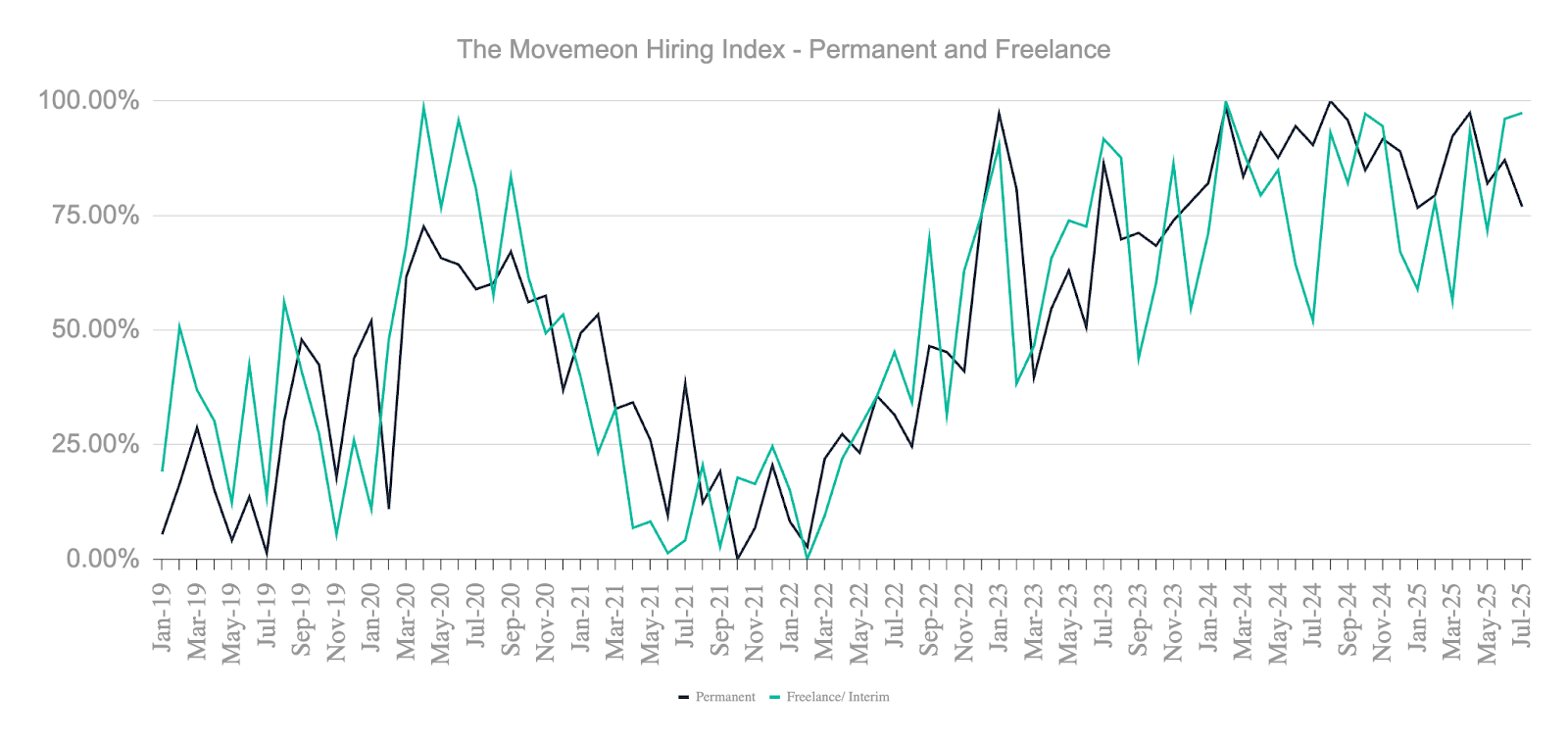
Today, interim talent isn’t simply a cheaper alternative to permanent hires, it’s the faster, more precise, lower-risk way to get specialist work done.
Many clients still underestimate how deep this talent pool is and how accessible it can be. Movemeon’s data shows that interim talent is highly cost-effective, there are no ramp-up periods or lengthy notice periods, just straight delivery, and access is rapid: clients can interview suitable professionals within 1–2 days, with many ready to start as soon as the following week.
Enter your details and we'll take you straight to the download. We'll also email you a copy.
Want to talk about what this means for you?
Project-based work favours flexibility
There’s a structural point here that often gets missed: most high-value strategic and commercial work is project-based by nature.
Examples from real clients:
- Pricing reviews every 12-18 months
- Market entry or product expansion strategies every 2-3 years
- Commercial due diligence ahead of acquisitions or divestments
- Transformation PMOs aligned to specific value creation cycles
- GTM re-designs tied to one-off product launches
You would never build permanent teams to run these cycles continuously, unless you are a private equity fund or a global consulting firm. Corporates don’t, and shouldn’t, operate that way.
Cost efficiency over the annual planning cycle
A point that CFOs in particular appreciate: interim isn’t cheaper on a day-rate basis, but it is significantly cheaper over a full budget year versus FTEs.
The maths is straightforward. A corporate hiring a strategy director pays not just base salary, but NI, pension, bonus, LTIPs, managerial overhead and future redeployment risk. An interim team, even at premium day rates, disappears the moment the job is done.
Layer in the fact that strategic demand is irregular, and the logic becomes clearer: variable cost for variable work beats permanent cost for intermittent work.
A more modern operating model for strategy
The emerging structure we now see more and more:
1. A small, sharp internal strategy nucleus
- Typically 3–10 people
- Focused on enterprise priorities, capital allocation, annual strategy, board engagement, and mobilisation
- High internal connectivity, high context
2. Modular access to specialist expertise
Brought in for spikes in specific domains such as:
- Pricing and monetisation
- Commercial due diligence
- GTM strategy and sales enablement
- Customer and product strategy
- Digital and data strategy
- Restructuring and cost transformation
3. Temporary horsepower for execution
When volume matters more than niche expertise (e.g. transformation PMO, market sizing workstreams, integration projects).
This model does three things that corporates increasingly need:
Moves fast, maintains quality, and avoids adding permanent cost.
Where Movemeon fits
This is precisely the model we’re helping global corporates build, not just by supplying talent, but by advising on how best-in-class organisations structure strategy and transformation.
We do that in three ways:
1. Access to specialist expertise
Targeted specialists for very specific strategic problems, pricing, CDD, GTM, operating model design, digital & AI strategy, and transformation PMO, drawn from ex-MBB, Big 4 and senior industry operators across sectors and geographies.
Examples:
- A global media group bringing in a market analysis specialist for a 6-week sprint to size a new growth vertical.
- A major restaurant chain engaging a partnerships expert for a 4-week project to design and prioritise strategic alliances.
- A B2B SaaS scale-up appointing a pricing specialist for a 3-month engagement to redesign packaging and monetisation.
- A large logistics business bringing in an operations transformation lead for a 6-month programme during a major cost and service transformation.
2. Access to horsepower
On-demand teams of ex-MBB / Big 4 / boutique consultants to execute time-bound strategy and transformation work at pace, from growth strategy builds and PMI execution to market entry sprints and board-level strategy refreshes.
Examples:
- A Tier 1 telco deploying a small team of generalist strategy freelancers to support a board-level strategy refresh under tight timelines.
- A PE-backed industrials group standing up a temporary strategy pod to support PMI delivery across multiple workstreams post-acquisition.
- A global consumer business mobilising a sprint team to build a market entry strategy and execution roadmap for a new geography.
3. Advisory on operating model design
Insights on how the best corporate strategy functions are evolving- headcount, structure, and where interim makes sense.
The outcome is not a new buzzword, it’s simply a more modern way to run strategy: leaner, faster, and tuned to how work actually gets done.
Where talent meets opportunity





Our latest articles
.png)
Our new white paper. Clients increasingly want partners who can deliver rapid, measurable change rather than advice, and the senior talent best placed to deliver it now often sits outside the big consulting firms. Drawing on data from more than 100,000 strategy and transformation professionals, we look at what this shift means for buyers of consulting and the delivery models replacing the traditional firm.

The Strategy and Transformation Hiring Index closed Q2 2026 at 39 - its highest reading since October 2023. This has been driven primarily by freelance hiring demand in Private Equity, but momentum in corporate and advisory is also growing.
We’ve seen a structural shift in the composition of demand over those 2.5 years, with companies preferring to bring in expertise on an interim basis. A second shift is visible in the mandates themselves - a quarter of the roles that went live with us in Q2 2026 mention AI in the job description, against roughly one in six a year ago.


Fifty people, one former CEO of Xero, Apple Asia Pacific, Ninemsn and Microsoft ANZ. The Movemeon Group brought together a small group of clients, network members and friends of the firm in Sydney for a fireside chat between Steve Vamos and Movemeon co-founder Richard Rosser, introduced and closed by Pete Clifton-Smith (GM APAC, The Movemeon Group), with closing remarks from Richard Whiteoak (MD, Whiteoak Private Equity).
The brief was simple: what does it actually take to lead, and to lead well, through constant disruption? What followed was one of the clearest, most practical breakdowns of the CEO role that anyone in the room had heard.

Join our ecosystem to discover unique opportunities and advice
100,000+