Attracting freelance talent: 5 key considerations
Five key considerations from MoveMeOn’s Freelance and Interim Report 2023 for companies considering hiring freelance (ex-)consultants.


Following the publication of our Freelance and Interim Report 2023, we’ve put together five of the report’s key implications for employers considering hiring freelancers.
This is a growing market, and one that can provide considerable savings compared to engaging external consultancies, but there are some important factors to consider before hiring freelancers, especially the importance of flexibility and how to convert perm salaries into day rates.
And read the full report here.
Overview
Over three years since our last survey of freelance consultants, the latest Freelance & Interim Report is out. The report identified a growing market with deep, high-quality expertise.
Here, we identify five key findings from the report and highlight their relevance for employers considering hiring freelancers for their key strategic projects.
5 key considerations for attracting freelance talent
Freelancers are cost-effective for long term projects
While hiring a consultancy makes sense for highly strategic, time critical projects, they are an expensive option compared to hiring freelancers.
Over the course of a six-month transformation project, our report found £100k savings on Analyst day rates compared to consultants, and £280k savings on freelance Managers compared to those working for an external consultancy. Overall, a freelance team costs 68% less than a consultancy team.
On Movemeon we have many freelance opportunities. Find your next project today!
Freelancers are motivated by good work-life balance
The freelance market is growing thanks to the great resignation, and the main driver of respondents’ switch to freelance work was work-life balance.
This indicates that companies employing permanent staff are lagging in the flexibility they offer staff. When considering and engaging potential freelance hires, it is important to remember that this flexibility is likely to be important to them.
For this reason, freelance hires are best-suited for roles or projects that are primarily about individual delivery, as opposed to (for example) those that involve lots of face time with clients, colleagues or other stakeholders, or on-call requirements.
Work that can be done at any time of day within a given timeframe, without needing excessive coordination with stakeholders, is well-suited to freelancers.
Freelancers are working, and earning, more
Day rates have remained flat since the last report in 2019, with a 7% increase at Analyst level and 1-3% for Managers.
However, high utilisation means that freelancers now out-earn permanent counterparts. Bear in mind, when planning costs and negotiating day rates, that freelancers are looking for high utilisation – as many days of the week, month or year worked – as possible, as this has a higher impact on their annual take-home than day rate alone.
Divide a perm salary by 120 to find the equivalent day rate
There are various costs incurred by employing permanent staff that don’t apply to freelancers, such as pensions, bonuses, training costs, etc.
The back-of-the-envelope calculation to convert the cost of a permanent salary into a day rate is to divide the perm salary by 120.
However, because freelancers typically work for just under 200 days per year, they tend to earn 25-45% more than they did as full time employees.
Platforms are rising in importance
Since 2019 there has been a 50% increase in the number of freelancers finding work through platforms, with 21% of respondents saying they found the majority of their projects through them.
Agencies were the main source for 20% of respondents, with word of mouth the largest source at 40%.
If you are struggling to find suitable freelancers through your own network, consider signing up to a freelancer platform, or speak to Movemeon for access to our global network of over 60,000 (ex-)consultants.
More detail on the state of the freelance market can be found in our Freelance & Interim Report 2023, including the kinds of projects that freelance consultants have worked on over the past 12 months, the primary reasons that respondents give for reducing their day rates, and the average day rates that freelance consultants at different seniorities seek.
Are you thinking about hiring a freelancer for your team, looking for more information about hiring or just want some advice? Get in touch with one of our team of friendly specialists.
For more insight into the preferences of freelance consultants, see our chat with Mark for Life after Consulting.
https://www.youtube.com/watch?v=mVR2kNdT-wA&ab_channel=LifeafterConsulting
Follow our Youtube channel to make sure you don’t miss any exciting interviews with leaders and to get the most exciting industry insights.
About the author: Dan McEvoy is a freelance writer and editor, with extensive experience in finance, technology, HR, recruitment, and marketing content.
Where talent meets opportunity





Our latest articles

The Strategy and Transformation Hiring Index closed Q2 2026 at 39 - its highest reading since October 2023. This has been driven primarily by freelance hiring demand in Private Equity, but momentum in corporate and advisory is also growing.
We’ve seen a structural shift in the composition of demand over those 2.5 years, with companies preferring to bring in expertise on an interim basis. A second shift is visible in the mandates themselves - a quarter of the roles that went live with us in Q2 2026 mention AI in the job description, against roughly one in six a year ago.


Fifty people, one former CEO of Xero, Apple Asia Pacific, Ninemsn and Microsoft ANZ. The Movemeon Group brought together a small group of clients, network members and friends of the firm in Sydney for a fireside chat between Steve Vamos and Movemeon co-founder Richard Rosser, introduced and closed by Pete Clifton-Smith (GM APAC, The Movemeon Group), with closing remarks from Richard Whiteoak (MD, Whiteoak Private Equity).
The brief was simple: what does it actually take to lead, and to lead well, through constant disruption? What followed was one of the clearest, most practical breakdowns of the CEO role that anyone in the room had heard.

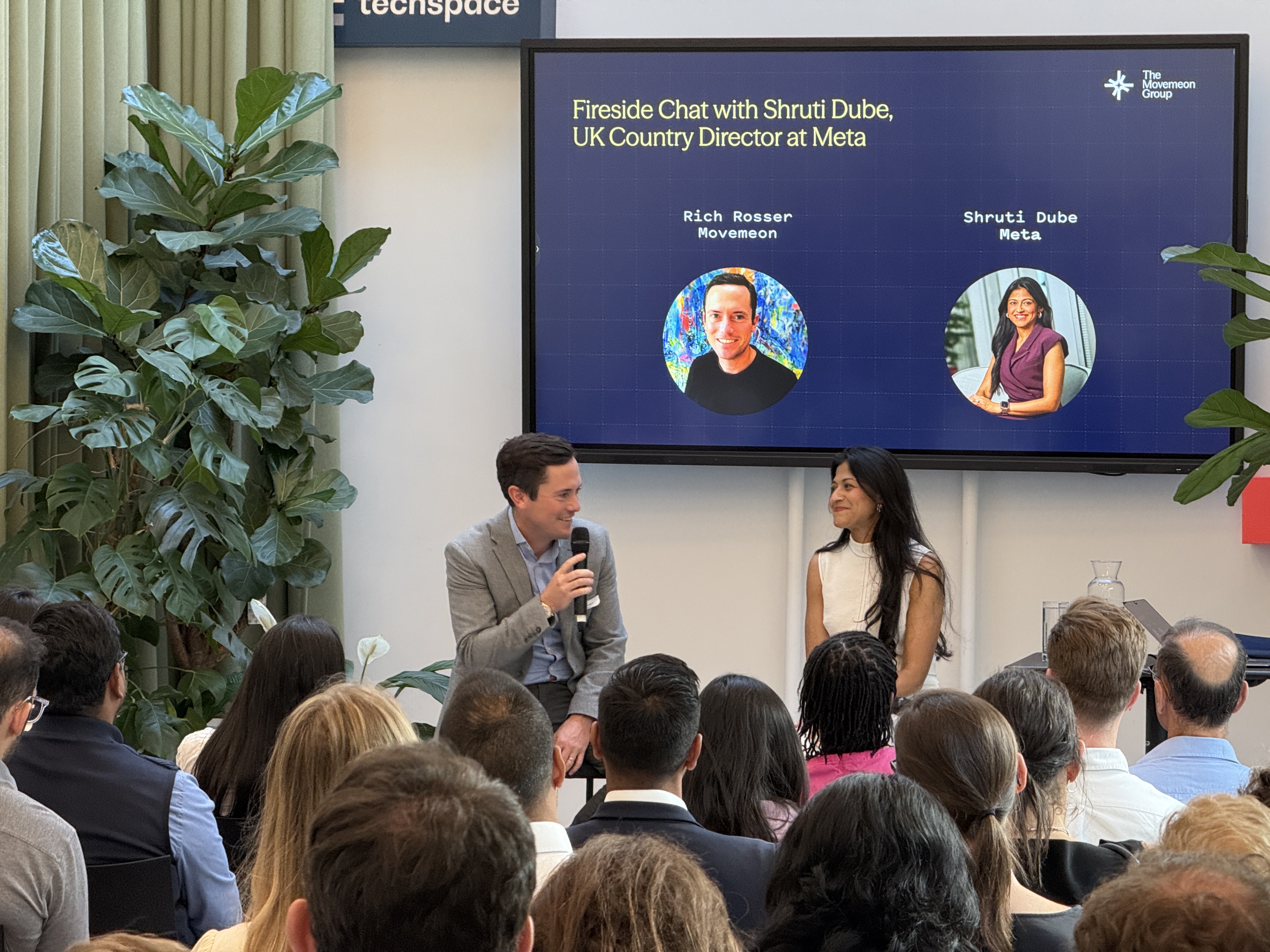
Meta UK's chief exec (ex-McKinsey, ex-Sequoia) shares a career framework built on rising complexity and expanding influence rather than titles, plus advice to stay close enough to real work to catch mistakes, including bad AI outputs. She ties this to Meta's strategy: WhatsApp agents aim to restore personal trust at scale, AI is expanding jobs rather than cutting them, and targeted fixes beat blanket bans.
Join our ecosystem to discover unique opportunities and advice
100,000+