From MBB to Sydney: A McKinsey Consultant's Journey to BC Strategy and Australia


At The Movemeon Group, we love sharing firsthand insights from professionals who have made exciting career transitions. In this feature, we spoke with a former McKinsey consultant who recently joined boutique strategy firm BC Strategy in Australia. He spoke with us about what drew him to consulting, why he decided to move away from MBB, what attracted him to a smaller firm, and what life in Australia has been like.
Can you walk us through your consulting career journey so far, and what it has taught you?
I started my career at PwC in Russia, initially in assurance before moving into corporate finance, where I worked on transactions, investment analysis and strategic questions. I later joined McKinsey, working across strategy and transformation topics for senior clients across different sectors, while also completing my MBA. More recently, I joined BC Strategy in Sydney, where I’ve been able to combine large-firm training with a more entrepreneurial and hands-on consulting environment.
What initially attracted me to consulting was the idea that structured thinking and strong analysis could bring clarity to complex problems. One of the most valuable lessons I learned over time was that you do not need perfect information to arrive at a strong conclusion. It taught me to stay hypothesis-driven, focus on what really matters, and remain practical rather than getting lost in analysis for its own sake.
The decision to move away from MBB
At a certain point, I started to realise that I was looking for an environment that was a better cultural fit for me personally. MBB is an exceptional place to learn: it is fast-paced, high-performing and very demanding, and I gained a huge amount from that experience. But over time I became clearer on the kind of setting in which I do my best work. I was looking for something a bit more personal, a bit more flexible, and a bit less tied to the machinery of a very large institution.
So, it was not really about moving away from quality or ambition; it was more about finding a model and a culture that felt more aligned with how I wanted to work and contribute over the longer term.
Why BC Strategy appealed to you
What attracted me to BC Strategy was the combination of strong people, an agile team structure, and the chance to make an impact from day one. The firm has a high-quality consulting foundation, while still offering real room for contribution and impact. I liked the idea of joining a team where I could not only work on interesting client problems, but also contribute to how the firm grows and develops.
How the role differs from MBB
What feels different is the level of agility and proximity. The teams are leaner with less overhead, decision making is faster, and there is generally greater scope to exercise judgment without as much institutional process around every step.
I also feel much closer to clients. In some cases that means embedding more deeply into their teams, understanding their internal dynamics in greater detail, and sometimes even contributing to their internal processes rather than only delivering recommendations from the outside.
There is also more freedom to shape your own path. Compared with a more structured MBB environment, that creates a different kind of responsibility: you have more autonomy, but also more accountability for defining where you can add value.
Why Australia
Australia appealed to me as a safe, well-functioning and high-lifestyle developed country, but it was also the sense of distance and novelty that drew me in. There was something exciting about moving somewhere so geographically far from where I had previously lived and worked. At the same time, everything I knew about Australia suggested that it offered a very attractive combination of professional opportunity and quality of life.
I wanted to experience a different part of the world and test myself in a new environment, while still being in a country with strong institutions and a highly liveable lifestyle.
Life in Australia
Overall, it has delivered on what I expected. Australia does offer the lifestyle quality, safety and general ease of living that attracted me in the first place.
One thing I do miss at times is the density of culture-related experiences I associated with living in Russia, especially museums, theatres and exhibitions. That said, Australia has its own strengths, and cities like Melbourne help fill some of that gap. Overall, the experience has been very positive.
One of the most noticeable differences is how early people start their days and how naturally sport and outdoor activity are woven into everyday life. There is a much stronger culture of exercise, movement and general physical activity than in many parts of Europe, and I think that does contribute to how healthy people often seem.
Another thing I have noticed is that people are generally willing to help and take pride in doing their jobs properly, even in roles that some societies might undervalue. That creates a pleasant everyday experience, because interactions often feel straightforward, constructive and low-friction.
Advice for MBB consultants considering a similar move
I would say that there really are greener pastures outside the big firms, and MBB experience is genuinely valued in the market. But the most important thing is to be very clear on what you actually want from the move, whether that is more ownership, a different culture, a tighter team, or a different lifestyle.
If you are clear on your priorities, the transition can be very rewarding; if you are not, it is easy to move into something that is different but not necessarily better for you.
The Movemeon Group is actively working with BC Strategy on exciting consulting roles based in Australia. BC Strategy is also open to sponsoring visas for suitable overseas candidates.
Click here to view and apply on Movemeon now!
Interested in other opportunities with BC Strategy? Get in touch with us at info@movemeon.com and we'll see where we can help.
Where talent meets opportunity





Our latest articles

The Strategy and Transformation Hiring Index closed Q2 2026 at 39 - its highest reading since October 2023. This has been driven primarily by freelance hiring demand in Private Equity, but momentum in corporate and advisory is also growing.
We’ve seen a structural shift in the composition of demand over those 2.5 years, with companies preferring to bring in expertise on an interim basis. A second shift is visible in the mandates themselves - a quarter of the roles that went live with us in Q2 2026 mention AI in the job description, against roughly one in six a year ago.


Fifty people, one former CEO of Xero, Apple Asia Pacific, Ninemsn and Microsoft ANZ. The Movemeon Group brought together a small group of clients, network members and friends of the firm in Sydney for a fireside chat between Steve Vamos and Movemeon co-founder Richard Rosser, introduced and closed by Pete Clifton-Smith (GM APAC, The Movemeon Group), with closing remarks from Richard Whiteoak (MD, Whiteoak Private Equity).
The brief was simple: what does it actually take to lead, and to lead well, through constant disruption? What followed was one of the clearest, most practical breakdowns of the CEO role that anyone in the room had heard.

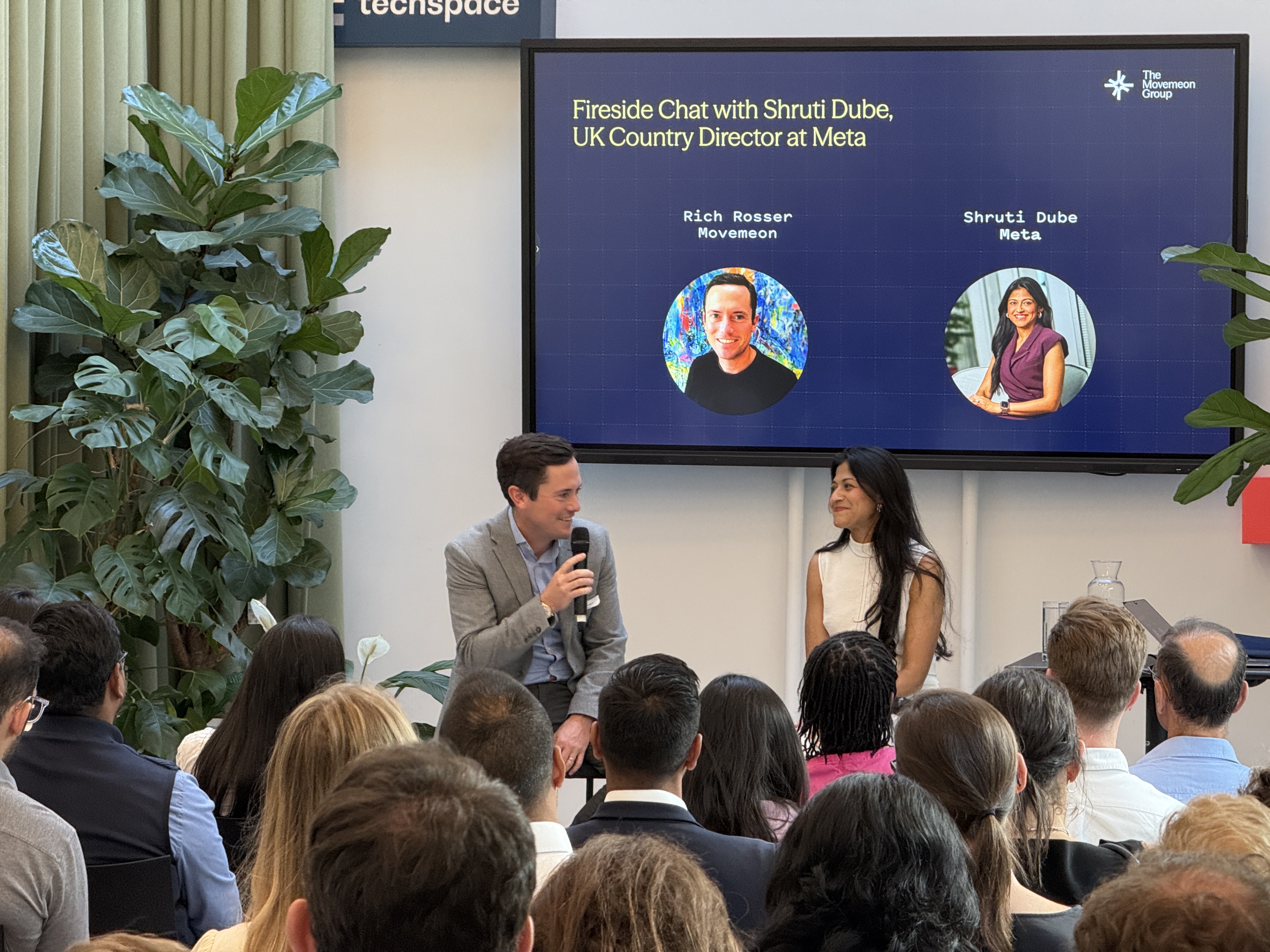
Meta UK's chief exec (ex-McKinsey, ex-Sequoia) shares a career framework built on rising complexity and expanding influence rather than titles, plus advice to stay close enough to real work to catch mistakes, including bad AI outputs. She ties this to Meta's strategy: WhatsApp agents aim to restore personal trust at scale, AI is expanding jobs rather than cutting them, and targeted fixes beat blanket bans.
Join our ecosystem to discover unique opportunities and advice
100,000+