Why do consultancies produce so many CEOs?
The future leader factories and what it means for hiring senior leadership roles


A disproportionate number of CEOs have worked in top-consulting firms.
OnDesk recently ran the numbers - they looked at the CEOs of the US’s largest operating companies and analysed where people had started their careers. Of the top 8 most common companies, 6 are consultancies:
.png)
In this article, we look into what makes consulting alumni so well-suited to lead organisations. And what this means for you hiring for leadership positions in your team and organisation.
If you'd like to find out more about senior hiring with Movemeon get in touch with our team here.
Diverse exposure: versatility for complex challenges
Consultants are exposed to a wide array of industries, challenges, and business models during their careers. This breadth of experience enables them to adapt quickly to new environments, making them invaluable as leaders in dynamic or fast-changing markets.
High-Profile Example:
- Indra Nooyi, former CEO of PepsiCo, leveraged her experience at BCG to navigate PepsiCo’s global expansion and drive innovation in sustainability.
Consultants’ ability to analyse diverse scenarios and develop tailored solutions makes them particularly adept at addressing complex, multi-faceted challenges. This versatility can mean the difference between an executive who only fits into a niche and one who can lead across functions and industries.
Analytical proficiency: a data-driven and structured approach to leadership
Consultants are trained to analyse problems methodically, using data to guide decision-making. For CEOs, this analytical rigour is crucial in navigating uncertainty and driving strategic priorities.
High-Profile Example:
- James Gorman, Chairman and former CEO of Morgan Stanley, used his McKinsey-honed analytical skills to stabilise and grow Morgan Stanley following the 2008 financial crisis.
Hiring managers should value candidates with consulting backgrounds for their ability to synthesise complex information into actionable insights—a skill essential for steering organisations through uncertainty and change.
Strategic insight: long-term thinking for organisational growth
A key focus of consulting is strategy development—defining clear goals, aligning resources, and ensuring execution. This mirrors the core responsibilities of a CEO, making consultants natural fits for leadership roles.
High-Profile Example:
- Sheryl Sandberg, former COO of Meta (Facebook), transitioned from McKinsey to redefine Facebook’s operational strategy, contributing significantly to its growth trajectory.
Candidates with consulting experience bring a proven ability to think beyond immediate challenges and design strategies that position organisations for long-term success.
Extensive networks: access to key relationships
Consultants develop extensive professional networks through interactions with senior executives, cross-functional teams, and industry leaders. These connections often become a powerful asset in leadership roles.
High-Profile Example:
- Sundar Pichai, CEO of Alphabet (Google), utilised the network and insights gained from his time at McKinsey to transition into leadership in the competitive tech industry.
When considering candidates, hiring managers should recognise that consultants often bring with them a wealth of professional relationships that can facilitate partnerships, mentorships, and market opportunities.
Leadership development: coached for executive excellence
Consulting firms invest heavily in leadership development, equipping their employees with early management responsibility and structured training programs. Consultants are often tasked with leading client projects and managing teams early in their careers, giving them a head start in developing the skills required for executive roles.
High-Profile Example:
- Julie Sweet, CEO of Accenture, exemplifies how consulting firms prepare individuals for leadership, transitioning seamlessly into executive roles by leveraging her extensive consulting experience.
This preparation translates into candidates who are not only strategic thinkers but also adept at managing teams, driving results, and navigating high-pressure environments.
What this means for your team and your company
Consultants are a great succession plan for your Board. They will bring with them a broad skillset, proven leadership ability and clear strategic vision. Whilst this is critical in leadership roles, it’s also an invaluable skillset to have throughout your organisation.
Despite the number of well documented redundancies across consulting, it hasn’t made the market any easier to hire in. We typically find clients are looking for an ex-consultant who has already made the adjustment into “industry”, be that a PE-backed company or an Enterprise business. They’ve therefore built up a track record of delivery and “operating” over the previous 5-10 years.
If you’d like to learn more about how you would bring this type of talent to your team or company, please do let us know.
Where talent meets opportunity





Our latest articles
The Strategy and Transformation Hiring Index closed Q2 2026 at 39 - its highest reading since October 2023. This has been driven primarily by freelance hiring demand in Private Equity, but momentum in corporate and advisory is also growing.
We’ve seen a structural shift in the composition of demand over those 2.5 years, with companies preferring to bring in expertise on an interim basis. A second shift is visible in the mandates themselves - a quarter of the roles that went live with us in Q2 2026 mention AI in the job description, against roughly one in six a year ago.

Fifty people, one former CEO of Xero, Apple Asia Pacific, Ninemsn and Microsoft ANZ. The Movemeon Group brought together a small group of clients, network members and friends of the firm in Sydney for a fireside chat between Steve Vamos and Movemeon co-founder Richard Rosser, introduced and closed by Pete Clifton-Smith (GM APAC, The Movemeon Group), with closing remarks from Richard Whiteoak (MD, Whiteoak Private Equity).
The brief was simple: what does it actually take to lead, and to lead well, through constant disruption? What followed was one of the clearest, most practical breakdowns of the CEO role that anyone in the room had heard.

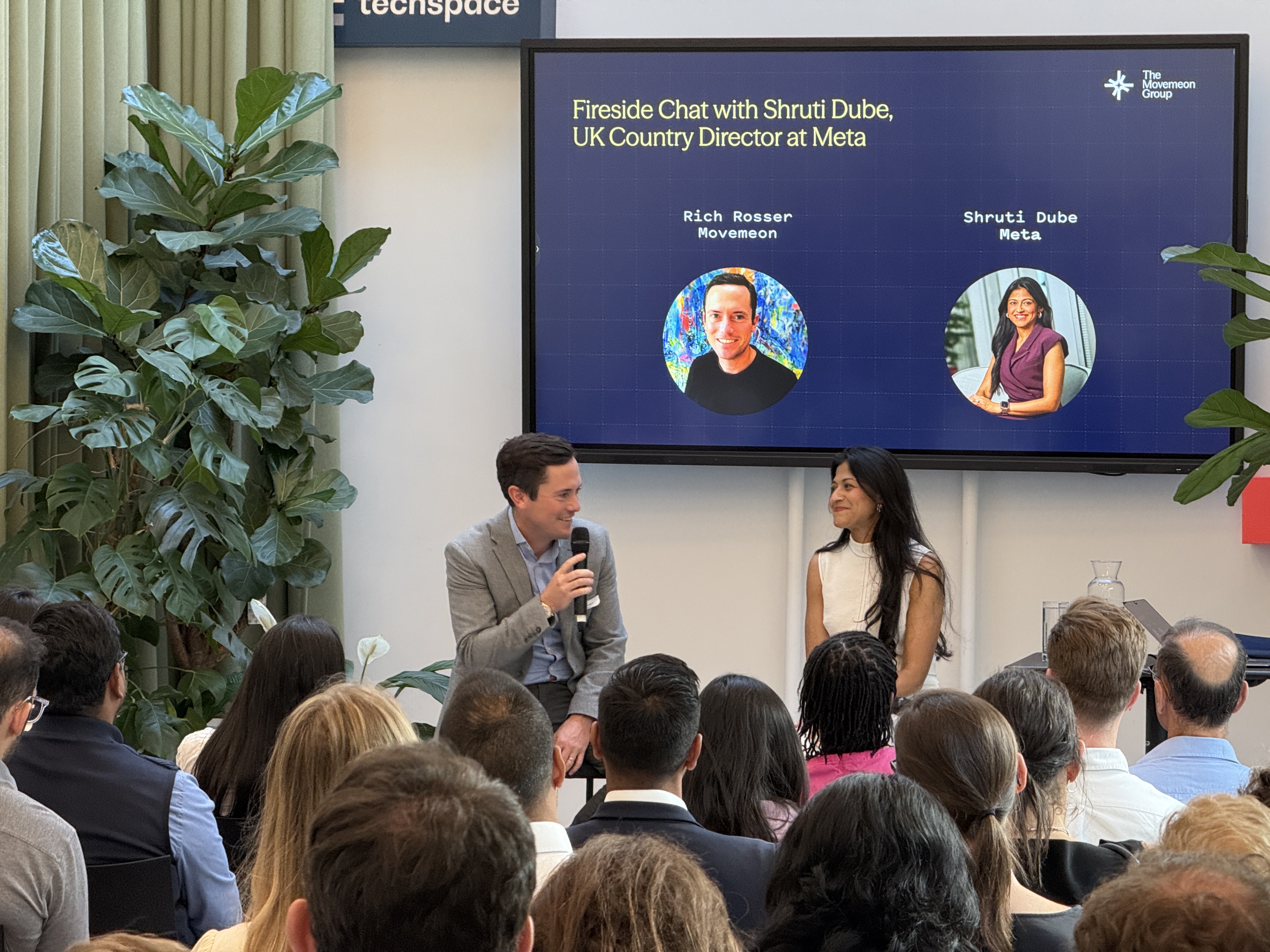
Meta UK's chief exec (ex-McKinsey, ex-Sequoia) shares a career framework built on rising complexity and expanding influence rather than titles, plus advice to stay close enough to real work to catch mistakes, including bad AI outputs. She ties this to Meta's strategy: WhatsApp agents aim to restore personal trust at scale, AI is expanding jobs rather than cutting them, and targeted fixes beat blanket bans.

Join our ecosystem to discover unique opportunities and advice
100,000+