AI without a plan? Why fractional strategy leaders are filling the gap
As AI moves from experimentation to real business impact, many scaling organisations are struggling to translate ambition into results. This article explores why fractional AI strategy leaders are emerging as a practical solution, helping leadership teams prioritise, execute and de-risk their AI agenda without the cost of a full-time hire.

%20(1).jpg)
AI has firmly established itself as a core focus point for C-Suites, Leadership Teams and Boards, but for many scaling businesses, the question remains as to how to best ensure AI implementation can drive real commercial outcomes. That’s where fractional AI strategy leaders come in: senior talent that sits between product, tech and the exec team to design, prioritise and de-risk your AI agenda, without the cost and commitment of a full-time CAIO.
1. The AI moment: from hype to “show me the value”
Over the last two years, AI has shifted from experimentation to infrastructure. McKinsey’s latest research suggests AI adoption among companies has jumped to around 72%, after hovering near 50% for several years. A majority of executives expect to increase AI investment in the next three years, and three-quarters now believe AI will help their organisation grow.
At the same time, 2026 is being described as a “make-or-break” year: boards and customers increasingly expect tangible AI value. Mid‑market and scaling organisations in particular are feeling the strain - they have AI ambition and budget, but are wrestling with data foundations, workflow redesign and security.
For scaling leadership teams, the question is no longer whether AI is a tool to invest in, but who owns AI strategy, how do we prioritise, and how do we ensure a return on investment?
2. What “AI strategy” really means for a scaling business
In practice, AI strategy usually means four things:
- Where AI creates value in this business
Identifying specific use cases across product and operations (e.g. smarter pricing, better sales targeting, support automation, forecasting, underwriting) that can move the dial on revenue, margin or productivity. - How to sequence those bets
Deciding which initiatives to do first, what to park, and what dependencies (data, platforms, process) need to be in place. - How to govern AI responsibly
Setting guardrails around data, security, compliance and explainability, especially as customer expectations on transparency and traceability rise. - What capabilities and operating model you need
Choosing where to build vs. buy, and how to blend product, engineering, data and operations so AI becomes part of day‑to‑day work.
This is classic strategy work: framing the problem, sizing the value pool, prioritising initiatives, defining the target operating model. It’s no surprise we’re seeing a surge in AI‑related strategy roles and projects - often reporting into the COO, CTO, CPO or directly to the CEO.
Recent market analysis highlights an emerging cluster of “AI-native” roles focused on commercial and organisational impact (Head of AI Strategy, Director of Applied AI, AI Transformation Lead), not just technical build. These roles sit at the intersection of product, data, operations and P&L, exactly where many ex‑strategy consultants already operate.
3. The talent landscape: AI-native strategy leaders are scarce and expensive
Demand for AI skills is exploding: AI‑related job postings grew more than 100% between 2024 and 2025, and global AI and cloud investment is projected to reach around $1.5 trillion by mid‑decade. Employers are not just hiring more engineers; they are creating leadership roles that marry AI with commercial strategy and change.
Two realities follow:
- Profiles are scarce
Talent with:- deep enough understanding of AI capabilities and limitations,
- repeated experience designing and prioritising AI use cases,
- and the stakeholder skills to align product, tech, operations and finance
are still relatively rare.
- Compensation is moving fast
For senior AI leaders in major markets, total comp has risen materially, with pay levels growing roughly twice as fast as for comparable non‑AI roles as companies compete for the same small pool of people. A full-time CAIO/Head of AI is an expensive commitment.
For a lot of scaling businesses, that creates a complex trade-off:
- Over‑hire too early - and risk an expensive leader stuck in “strategy without execution” mode;
- Or delay - and risk falling behind competitors who are quietly embedding AI into their operating model.
This is exactly the gap where fractional AI strategy leadership is starting to make sense.
4. Fractional AI strategy leadership: what it is and where it wins
A fractional AI strategy leader (sometimes a fractional CAIO, Head of AI, or AI Strategy Lead) is a senior operator who joins you part‑time or on a defined project to design and steer your AI agenda. They typically work one to three days per week, on an ongoing basis, or over a defined time-period, and are embedded with the leadership team rather than parachuted in as an external consultant.
Where this model tends to beat a full‑time hire:
- You have AI budget and pressure, but not yet clarity
The business acknowledges a need for an AI plan, but there’s no agreed view on where AI should play in your business, or who owns it. - Foundations are not ready for a permanent CAIO
Data quality, architecture and workflows still need work; hiring a permanent AI exec into that environment is high‑risk. A fractional leader can define the target state and the first wave of initiatives before you commit. - You need top‑tier expertise, but not 5 days a week
For many scale-ups, the real need is concentrated in decision points: designing the roadmap, setting guardrails, unblocking execution. That can often be achieved with a day or two a week of senior involvement. - You want to de-risk the role
Fractional gives you a way to “test” what senior AI strategy leadership looks like in your context - scope, reporting line, interfaces - before crystallising a permanent job description.
In practice, fractional AI strategy leadership often looks less like interim cover, and more like a hands-on architect of your AI operating model.
5. What a fractional AI strategy leader actually delivers
The best fractional leaders are outcome‑obsessed. Within 60–90 days, you should expect to see tangible progress on three fronts.
- A sharp, business-first AI narrative for the leadership and board
- Clear articulation of where AI can drive revenue, margin and productivity in your business (not a generic slide on “AI in retail/FS/etc”).
- A small number of prioritised use cases, each linked to P&L impact and feasibility.
- A pragmatic AI roadmap and operating model
- A sequenced roadmap (e.g. 12-18 months) combining quick wins, enabling foundations (data, platforms, processes) and longer‑dated bets.
- Decisions on build vs buy; where to rely on off‑the‑shelf tools vs. internal development, and how functions will work together.
- Governance and guardrails that let you move faster, safely
- Simple policies that clarify how AI is used across functions, how data is governed, and how risk/compliance concerns are handled.
- A hiring and resourcing plan: which roles you need in‑house, where contractors/freelancers make sense, and how to phase that spend.
Crucially, this isn’t just a PowerPoint exercise. Done well, fractional leaders are in the room for key product, tech and operations decisions, helping teams translate the roadmap into sprints, projects and KPIs.
6. Why now is a particularly good moment to explore fractional AI strategy support
A few dynamics are converging in 2026:
- AI expectation is high; adoption reality is mixed
While global adoption is rising, a large proportion of mid‑market and scaling businesses are still early in real operational change - which means there is still an opportunity to differentiate. - The market for AI talent is hot - but uneven
Competition for a small pool of senior AI leaders is driving up prices, while there remains an oversupply of high‑calibre freelance and interim strategy/transformational talent. That imbalance favours fractional models. - Boards are shifting from “innovation theatre” to accountability
Investors and customers increasingly want to see clear linkages between AI initiatives and P&L impact, as well as robust governance. That plays directly to leaders who can frame trade‑offs and prioritise.
For scaling leadership teams, this combination creates a window: you can access senior AI strategy capability on a fractional basis, shape what “good” looks like for your organisation, and then decide, with evidence, whether and when to invest in a permanent CAIO/Head of AI.
How The Movemeon Group can help
Through our network, we see growing demand for AI‑related strategy and transformation mandates, and a strong pool of ex‑strategy consulting talent working on a freelance or interim basis. That includes profiles who have:
- Led AI and data‑driven transformations in corporates, PE‑backed assets, or tech companies.
- Sat at the intersection of product, operations and technology, not just within an isolated data team.
- Worked as fractional or project‑based leaders, comfortable landing in a scaling environment and making progress quickly.
For scaling businesses, that translates into a practical offer:
- Explore whether fractional AI strategy leadership is right for your stage and context.
- See examples of leaders who have done this before in organisations like yours.
- Design a mandate that starts small, and can grow or convert to permanent as your AI agenda matures.
If you’re leading a scaling business and recognise some of the themes in this piece, AI ambition without a clear owner; experiments without a roadmap; board pressure without a narrative, it may be the right moment to bring in fractional AI strategy support.
We’d be happy to share examples of recent mandates and profiles from our network, and to help you work out what “good” could look like for your organisation.
Where talent meets opportunity





Our latest articles
The Strategy and Transformation Hiring Index closed Q2 2026 at 39 - its highest reading since October 2023. This has been driven primarily by freelance hiring demand in Private Equity, but momentum in corporate and advisory is also growing.
We’ve seen a structural shift in the composition of demand over those 2.5 years, with companies preferring to bring in expertise on an interim basis. A second shift is visible in the mandates themselves - a quarter of the roles that went live with us in Q2 2026 mention AI in the job description, against roughly one in six a year ago.


Fifty people, one former CEO of Xero, Apple Asia Pacific, Ninemsn and Microsoft ANZ. The Movemeon Group brought together a small group of clients, network members and friends of the firm in Sydney for a fireside chat between Steve Vamos and Movemeon co-founder Richard Rosser, introduced and closed by Pete Clifton-Smith (GM APAC, The Movemeon Group), with closing remarks from Richard Whiteoak (MD, Whiteoak Private Equity).
The brief was simple: what does it actually take to lead, and to lead well, through constant disruption? What followed was one of the clearest, most practical breakdowns of the CEO role that anyone in the room had heard.

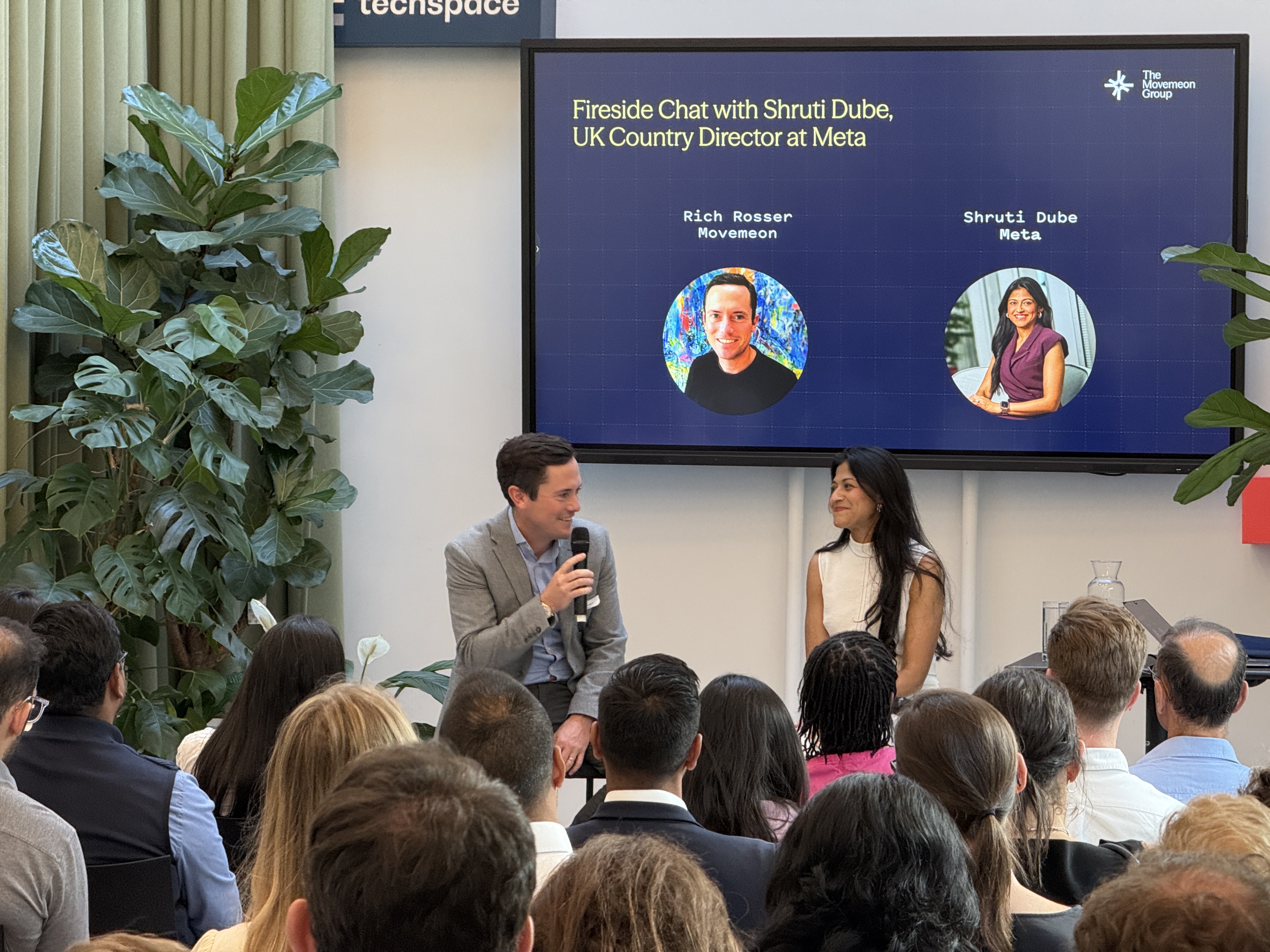
Meta UK's chief exec (ex-McKinsey, ex-Sequoia) shares a career framework built on rising complexity and expanding influence rather than titles, plus advice to stay close enough to real work to catch mistakes, including bad AI outputs. She ties this to Meta's strategy: WhatsApp agents aim to restore personal trust at scale, AI is expanding jobs rather than cutting them, and targeted fixes beat blanket bans.

Treten Sie unserem Ökosystem bei, um einzigartige Möglichkeiten und Ratschläge zu entdecken
90.000+