Demand for independent consultants and interim talent across PE and corporates drives the market to its highest level in over two-and-a-half years
The Strategy and Transformation Hiring Index closed Q2 2026 at 39 - its highest reading since October 2023. This has been driven primarily by freelance hiring demand in Private Equity, but momentum in corporate and advisory is also growing.
We’ve seen a structural shift in the composition of demand over those 2.5 years, with companies preferring to bring in expertise on an interim basis. A second shift is visible in the mandates themselves - a quarter of the roles that went live with us in Q2 2026 mention AI in the job description, against roughly one in six a year ago.


Understanding the numbers
At the heart of our analysis is the Movemeon Strategy and Transformation Hiring Index, a scale from 0 to 100 that measures the balance between candidate supply and employer demand in the strategy and transformation talent market. A higher index reflects more hiring demand, and a stronger market.
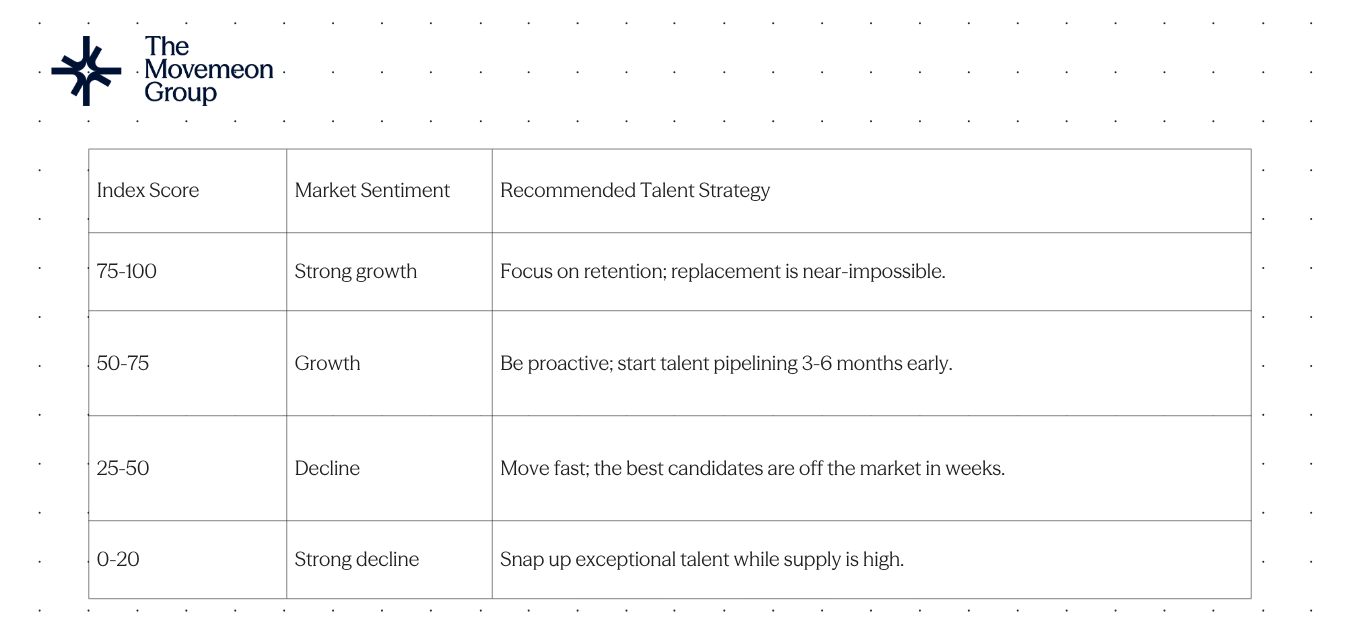
June's reading of 39 is the tightest since October 2023, driven by increased demand for freelance and independent consultants.
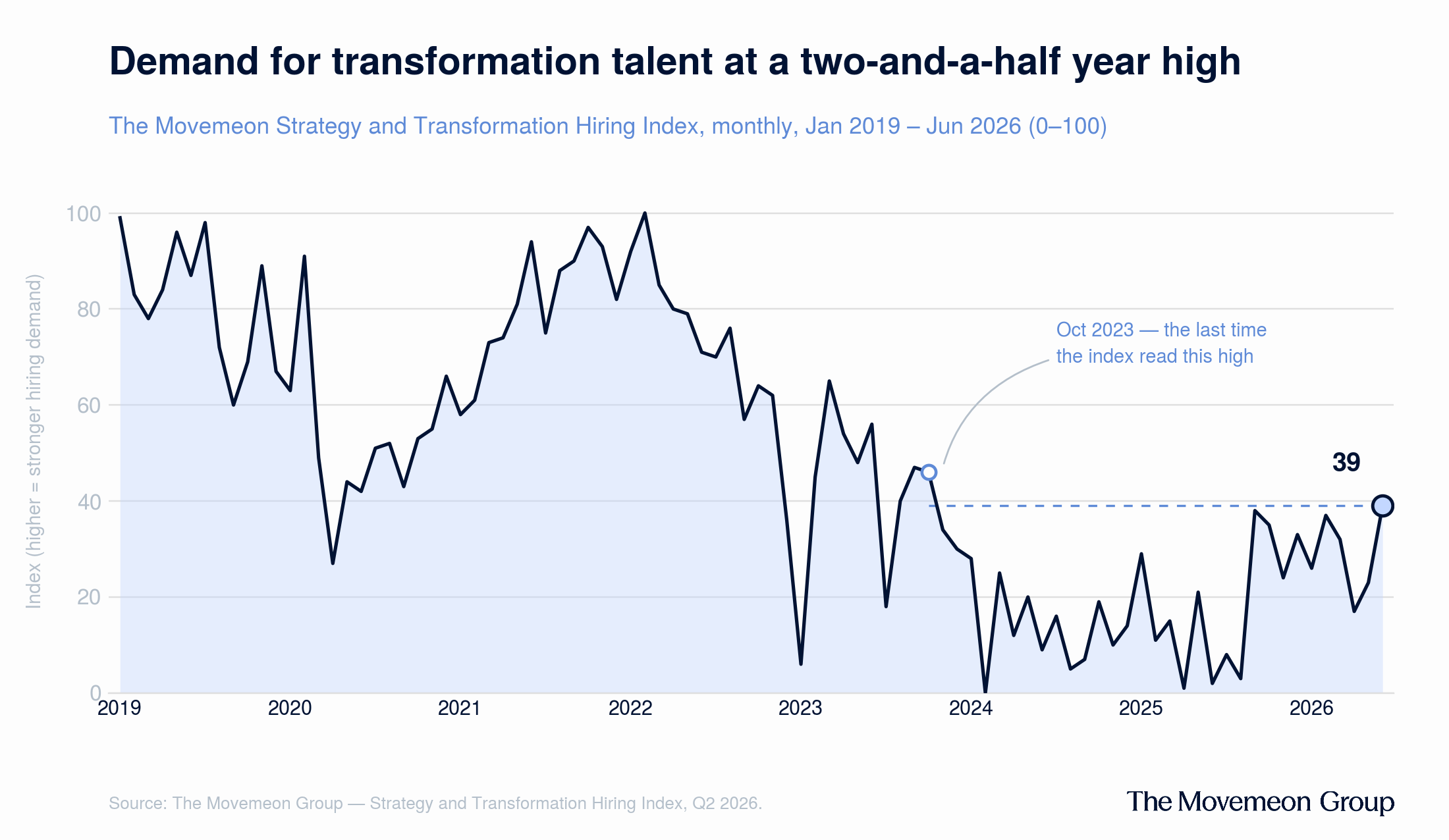
Green shoots – increase in on-demand talent in Private Equity, corporates and advisory
- The Strategy and Transformation Hiring Index closed the quarter at 39 – its tightest reading since October 2023. Demand shifted a lot over the quarter - April and May saw slightly lower demand than Q1, but there was a sharp reversal in June.
- An acute increase in interim and on-demand consulting. Freelance and independent consultant demand was the big driver of the increase; permanent remained flat in the last year.
- Private Equity continues to experience the highest demand, with corporates and advisory showing increased momentum on a curve similar to Private Equity 12 months ago.
- AI is now named in a quarter of new mandates. Not as a new job family - almost none of these are AI-focused job titles. Instead, existing transformation roles are being rewritten around it.
Employers are buying projects, not headcount
Organisations hiring consultant-calibre talent have spent two years being told the market is frozen, and the wider market data agrees: Bain’s first-quarter 2026 analysis found job postings down year on year across every major market and function it tracks, while actual employment held up considerably better (Global Job Market Trends, May 2026). On Movemeon, the supply of new roles rose through Q2 2026, against both the same quarter last year and Q1 of this year. The work has not come back as jobs - it has come back as projects.
The growth in Movemeon’s new roles is overwhelmingly freelance. Permanent postings are flat. This is not a quirk of one niche - the KPMG and REC UK Report on Jobs published in July 2026, found temporary billings growing at their fastest rate since April 2023, with recruiters attributing it directly to a preference for short-term staff and projects amid economic uncertainty and cost pressure.
Private Equity still accounts for over 40% of demand, but we've seen a sharp increase from corporates and advisory
Private Equity remains the main driver of demand for transformation talent. However, corporate demand also grew in Q2, reaching its highest level in more than a year.
Scale-ups and VC-backed companies are the exception, and the funding data explains why. Crunchbase's Q1 2026 figures show European venture deal volume down 40% year on year, with seed down 44% and early stage down 30% while late stage held broadly flat. PitchBook's Q2 2026 European Venture Report shows where the money went instead: AI absorbed 60.3% of European deal value in the first half, up from 37.9% across 2025, and mega-rounds above €100 million took more than half of all H1 deal value. Capital into the ecosystem is up; but what is being funded is human capital-light.
Focus on maximising EBITDA impact – short bursts of expertise, not impacting OPEX
What’s driving the increase in interim and independent consulting work? Two forces are working in combination:
(1) an increased focus on EBITDA growth, to offset the impact of the increase in cost of capital;
(2) a recognition that proven “operators” who have seen multiple “turns” can bring the most impact to organisations.
Bain’s Private Equity research puts hard numbers behind that first force. Its 2026 mid-year report describes roughly 32,000 unsold portfolio companies, holding periods stretched to about seven years and a fourth straight year of record-low distributions as a percentage of NAV.
According to McKinsey's 2026 Global Private Markets Report, for deals done between 2010 and 2022, leverage and multiple expansion delivered 59% of buyout returns - tailwinds it describes as largely spent. Operational value creation always accounted for the remaining 41%; what has changed is that it now has to drive all of it. McKinsey expects it to become the primary source of returns, and sponsors are resourcing accordingly, having more than doubled the size of their operating groups since 2021. On our own platform, that shows up as mandates asking for operators who can pull a specific lever at pace, rather than generalists overseeing governance.
The deployment of these independent consultants is aligned against the main functional levers to drive EBITDA impact:
- Strategy – M&A support (commercial due diligence, post-merger integration, opportunity scans) and value creation plan (VCP) development and implementation planning.
- Transformation and cost-out – VCP PMO and initiative tracking, org. design and target operating model work, procurement and supplier renegotiation, and AI/tech/ERP-led transformation.
- Commercial excellence and growth – pricing optimisation, go-to-market and marketing strategy and sales effectiveness.
The common thread is a focus on tangible impact. Companies are pulling more value creation levers, and increasingly rely on external expertise to do it. Independent consultants are proving to be both a cost-effective solution and one that can really drive value: deep operating experience combined with training in what drives value-creation.
AI has moved into the mandate itself
AI is fast becoming the sharpest of those levers. BCG’s 2026 survey of Private Equity investors found that digital and AI capability has moved from a bolt-on to the core of the value creation playbook: around 30% now build digital levers into diligence and a further 57% treat them as central to value creation planning. BCG also reports that portfolio companies systematically building AI capability across functions generate close to twice the return on invested capital of their peers. That is consistent with what we are seeing in our own data - a rising share of mandates aimed squarely at AI, tech and ERP-led Transformation, where firms reach for independent operators who have delivered it before rather than wait to build the capability permanently in-house.
A quarter of Q2 2026 roles mention AI, GenAI, LLMs, machine learning or artificial intelligence somewhere in the mandate. A year earlier it was roughly one in six; two years earlier, around one in seventeen. It is the highest share we have recorded, and a clear step up from Q1 2026 within the same year.
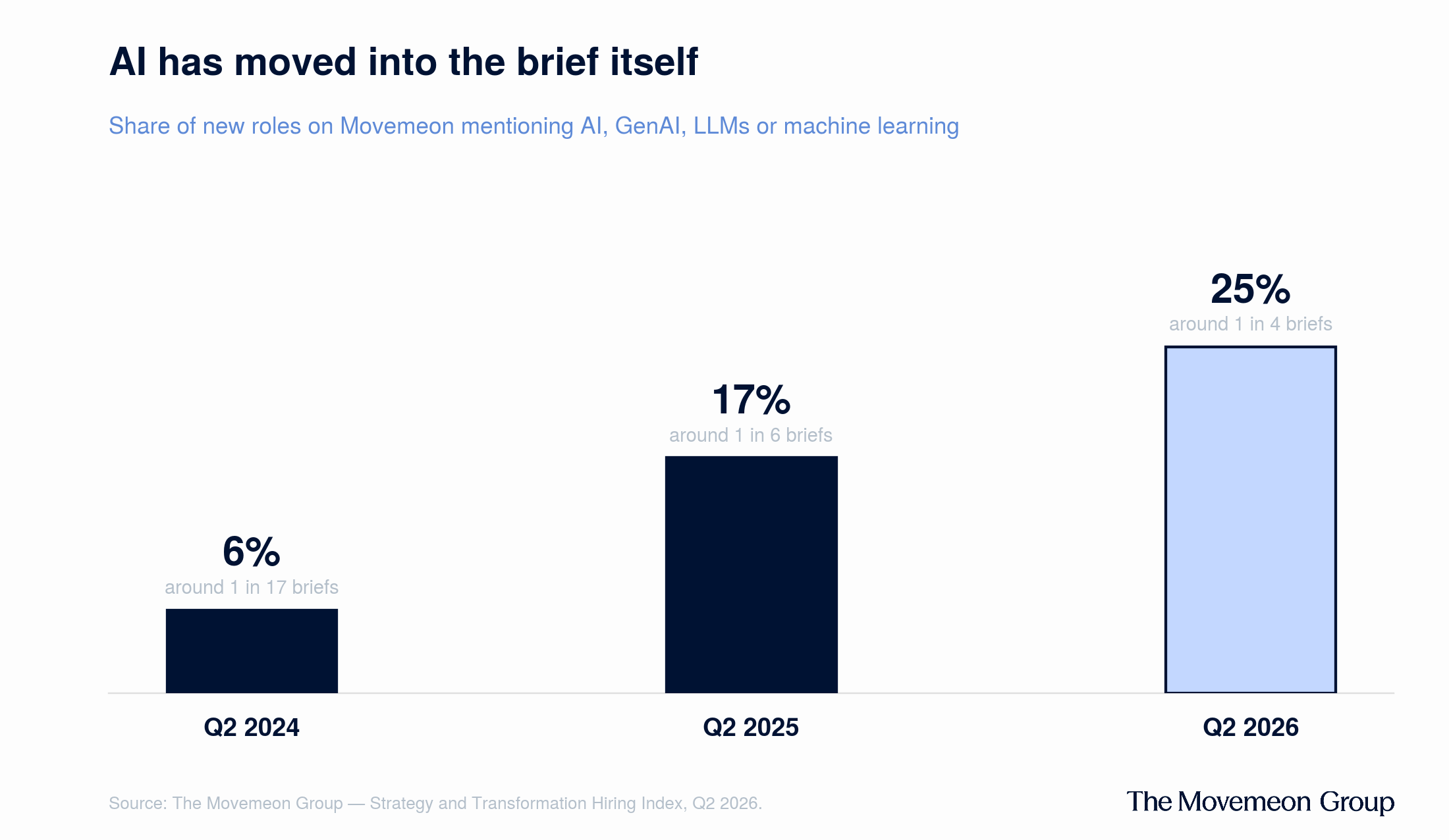
Two things about that matter more than the number itself. First, dedicated AI job titles remain rare - only a handful of Q2 mandates carry AI in the title. This is existing transformation, PMO, commercial and cost-out roles being rewritten rather than a new function being stood up. Second, the mentions are spread across permanent and freelance mandates alike, so this is not a feature of the interim market alone.
That pattern matches what the major firms are publishing. BCG’s fourth annual global AI at Work Survey (June 2026) found nearly half of respondents now spend more time managing and directing AI than doing the work themselves – jobs are changing faster than organisations are redesigning them. BCG Henderson Institute’s March 2026 analysis identifies where that lands hardest: in roles where AI substitutes for human tasks while demand keeps expanding, junior positions are the most exposed, while senior responsibilities persist and grow. McKinsey’s May 2026 work on early-career talent reaches the same conclusion from the other direction – the tasks being automated are precisely those through which junior people used to build judgement.
For employers, that is the practical link back to the rest of this quarter’s data: if the junior rung is thinning and AI is written into a quarter of mandates, what you are buying is judgement that already exists, in the smallest increment that delivers it. For candidates, being able to evidence that you have run something with AI in the delivery model (not that you hold an AI certificate) is now a differentiator in a quarter of the roles we advertise.
Taken together, the quarter tells a more useful story than "the market is back". Demand has returned, but as projects rather than permanent headcount - which is why the index has tightened while permanent postings sit flat. Private Equity is setting the pace, with corporates and advisory now tracking the same curve twelve months behind. In both cases the pressure to build value operationally, rather than through leverage or multiple expansion, is pulling hiring towards proven operators who can move a specific lever at speed. And AI has stopped being a separate conversation: it is written into a quarter of the mandates we advertise, inside existing transformation, commercial and cost-out roles rather than a new function alongside them.
To find out more about how independent consultants and interim talent could support your business, or more generally on hiring with The Movemeon Group, get in touch with our team.
Greg Caterer, Client and Consulting Director - greg@movemeon.com
Jamie Cameron, Head of Enterprise - jamiecameron@movemeon.com
Pete Clifton-Smith, General Manager, APAC - pete@movemeon.com
Where talent meets opportunity





Our latest articles

Fifty people, one former CEO of Xero, Apple Asia Pacific, Ninemsn and Microsoft ANZ. The Movemeon Group brought together a small group of clients, network members and friends of the firm in Sydney for a fireside chat between Steve Vamos and Movemeon co-founder Richard Rosser, introduced and closed by Pete Clifton-Smith (GM APAC, The Movemeon Group), with closing remarks from Richard Whiteoak (MD, Whiteoak Private Equity).
The brief was simple: what does it actually take to lead, and to lead well, through constant disruption? What followed was one of the clearest, most practical breakdowns of the CEO role that anyone in the room had heard.


Meta UK's chief exec (ex-McKinsey, ex-Sequoia) shares a career framework built on rising complexity and expanding influence rather than titles, plus advice to stay close enough to real work to catch mistakes, including bad AI outputs. She ties this to Meta's strategy: WhatsApp agents aim to restore personal trust at scale, AI is expanding jobs rather than cutting them, and targeted fixes beat blanket bans.

%20(1).jpg)
The Chief of Staff role has become a key early hire in PE-backed portfolio companies, helping CEOs create leverage in the critical post-acquisition phase. It plays a central role in driving Value Creation Plan execution, strengthening investor communications, and improving leadership team effectiveness. This article explores why demand for the role has increased and what good looks like in practice.

Join our ecosystem to discover unique opportunities and advice
100,000+