From consulting to Meta: Career lessons on making the leap, then actually doing the job
Meta UK's chief exec (ex-McKinsey, ex-Sequoia) shares a career framework built on rising complexity and expanding influence rather than titles, plus advice to stay close enough to real work to catch mistakes, including bad AI outputs. She ties this to Meta's strategy: WhatsApp agents aim to restore personal trust at scale, AI is expanding jobs rather than cutting them, and targeted fixes beat blanket bans.

Exec Summary
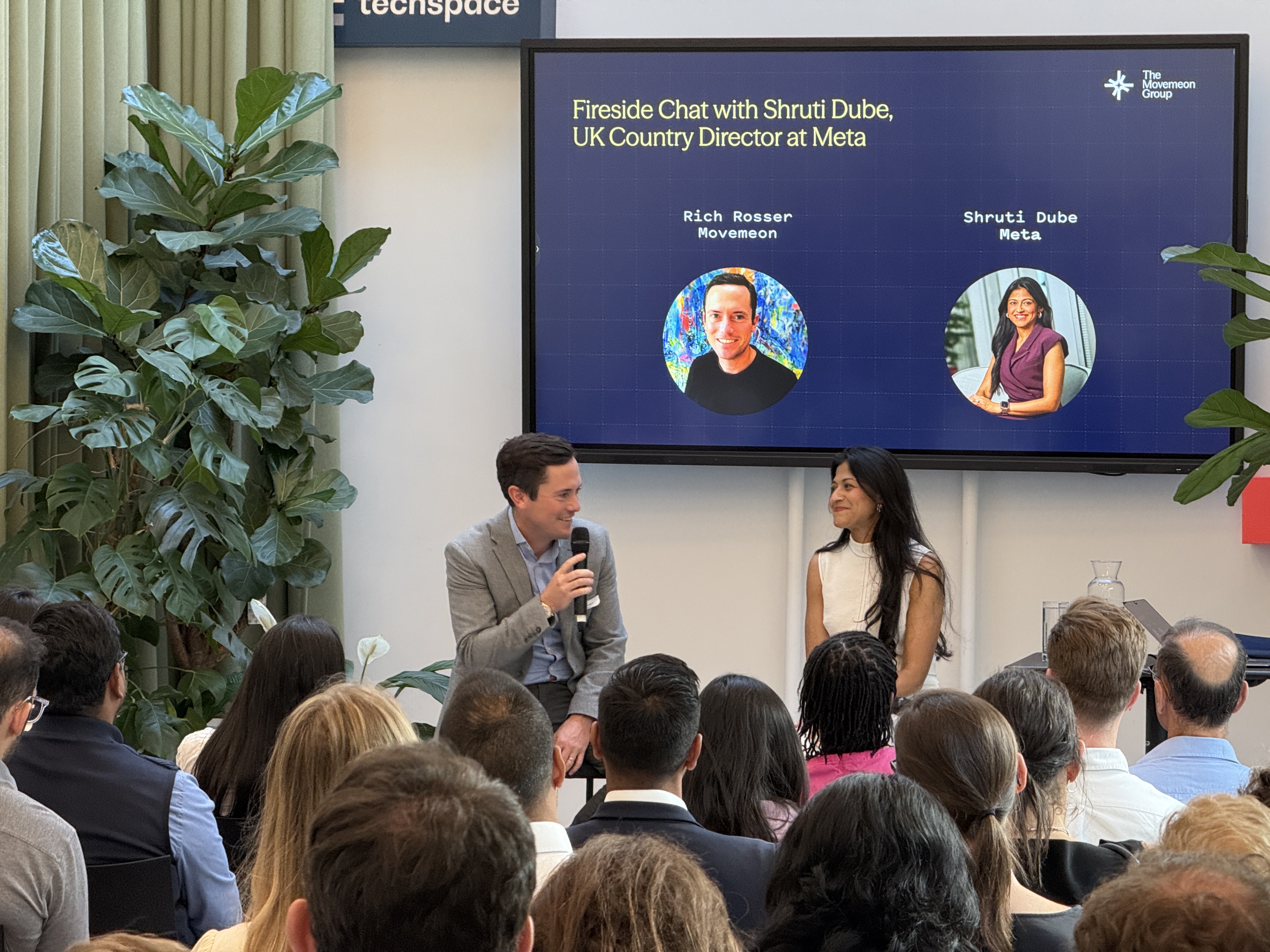
This draws on a fireside conversation with the executive who leads Meta's UK business, an ex-McKinsey consultant and Sequoia investor, on making the leap from consulting into industry and what she's learned since about leadership, AI and trust. The throughline: judge things by substance, not appearance, and don't let scale erase the individual. On career, that means picking moves for genuine complexity and reach rather than titles, and staying close enough to the actual work to still spot a bad brief or a wrong AI output. The same instinct drives Meta's product bets, WhatsApp's business agents aim to restore a "shopkeeper who knows your name" relationship at scale, capping an annoyance metric above revenue, and shapes her optimism that AI expands categories of work rather than erasing them, her preference for targeted fixes (like app-store age checks) over blunt bans, and her read on the UK: strong talent undercut by copyright uncertainty deterring investment. Her bet: trust, not just reach, will decide who wins next.
______________________________________
For anyone weighing a move from professional services into industry, the hardest part usually isn't landing the role, it's knowing how to evaluate the next one, and then adjusting to a world where nothing is mapped out the way it was at a consulting firm. A recent fireside conversation with the executive who leads Meta's UK business, herself an ex-McKinsey consultant and Sequoia investor, offered a genuinely useful framework for exactly that transition, followed by an unusually candid look at what a senior general management role actually involves day to day, and what she's learned about AI, platforms and trust along the way.
Evaluating your next move: two variables, not a fixed plan
Career advice tends to fall into one of two unhelpful extremes - vague ("follow your passion") or rigid (a fixed ladder with a fixed destination). The framework offered here is neither: reduce any potential next move to two questions.
- Is the complexity of the problem increasing? Are you doing something genuinely harder than before, or just a bigger version of the same thing?
- Is your circle of influence expanding? If you solve this problem, does it help more people, or a different kind of people, than your last role did?
Early-career moves can be engineered deliberately around a target profile. In this case: consulting first, then venture investing, specifically to build a financial-analysis skill set that consulting alone doesn't provide, before returning to consulting with a broader profile. Later, moves become harder to plan several steps ahead, the role she holds now didn't exist as an aspiration when she was mapping out her twenties. But the same two-variable test still works as a filter for evaluating an opportunity, even without a fixed destination in mind.
A smaller but genuinely practical insight from the same conversation: naming ambition out loud is often the actual bottleneck, not opportunity itself. Many people are uncomfortable stating what they want directly ("I'd like to lead a bigger team," "I want this promotion"). One workaround offered: frame the ask as a disclosure rather than a demand, "this is genuinely uncomfortable for me to say, but staying quiet about it would be a disservice to the work I'm doing." Naming the discomfort explicitly makes the ask easier to say and easier for a manager to actually hear.
The corporate-vs-startup decision, honestly examined
Given how often a McKinsey-and-MBA profile turns into a founder story, it's worth examining the reasoning of someone who deliberately chose not to go that route, not as a verdict on startups, but as a genuine fit question with criteria that transfer to anyone facing the same fork:
- Structure as a feature, not a constraint. Some people do better work with a broad-strokes structure to solve problems within, rather than needing to define that structure from scratch.
- Talent gravity. An established brand pulls in strong collaborators independent of personal reputation, which matters if what energises you is being surrounded by people whose default answer is "yes, let's figure it out" rather than "no."
- Risk tolerance is a legitimate preference, not a moral failing. Choosing certainty over the founder's grind doesn't require believing startups are wrong for everyone else, it's worth naming honestly rather than dressing up as strategic reasoning.
The research method used to reach this conclusion is directly repeatable by anyone facing the same choice: talk to as many people as possible in the roles you're actually considering, across industries, and ask specifically what a day in their life looks like, not what the job title implies from the outside.
The trap of losing touch with the actual craft
A theme that surfaces for almost anyone moving into a senior, "connect the dots" generalist role: it's tempting to stop doing hands-on work entirely once you're responsible for coordinating across teams rather than executing yourself. The argument against fully letting go is practical, not sentimental, if you can't do the underlying work yourself, you can't ask good questions, can't spot a bad brief, and increasingly, can't judge whether AI-assisted output from your team is actually correct. The discipline recommended: even in a senior role, deliberately carve out time to do the job yourself periodically, rather than assuming oversight alone is sufficient, a habit that becomes more important, not less, as AI changes what "doing the job" even means.
So what does the job actually look like? The unglamorous truth
Asked what a senior general management role is really like, prompted by a LinkedIn poll where over half of respondents said they aspired to a CEO, GM or MD title, the answer pushed back on the glamour directly. The role looks very different depending on which era of a company you're doing it in: in a fast-growing company it can be genuinely easy and full of the nicer parts of the job (client events, relationship-building), but in a mature, more constrained environment it's relentlessly data-driven, involves the same stress and uncertainty as everyone else in the organisation, and comes with far less control than it appears to from outside - you can help shape how something gets done, but rarely what gets done at a company level. The honest caveat: it's genuinely hard work with real accountability, better suited to people who draw energy from switching between relationship management, data, government engagement and internal strategy all in the same day, rather than people chasing the title for its own sake.
Staying grounded outside of work followed the same "no half measures" philosophy: being fully present in whatever you're doing, work or family, rather than trying to split focus evenly. It's not sold as an easy balance, it's described candidly as complicated and never straightforward, but as a source of genuine energy rather than depletion, precisely because both sides of the split get full attention when it's their turn.
Applying it in practice: the product bet behind the job
With that grounding in how she thinks about career and role, it's worth looking at what she's actually applying it to. A single idea kept resurfacing throughout the conversation: much of Meta's current AI strategy is an attempt to undo a trade-off the internet itself created, that reaching more customers meant treating them as an audience rather than as individuals. A shopkeeper who knows a regular customer's name doesn't scale, so platforms optimised for reach instead, and personal recognition got left behind.
WhatsApp's push into business agents - AI assistants that can sell, answer questions and support customers on a company's behalf, continuously - is framed as a chance to reverse that trade-off rather than deepen it: giving even the smallest business the equivalent of a tireless, always-on staff member who genuinely knows the customer. What makes the approach notable is the insistence that people's experience comes first: WhatsApp is treated as intimate, the place people talk to close friends and family, and negative feedback rate (how useful - or not - a user finds messages from a business) functions as a hard ceiling on monetisation that overrides revenue considerations entirely. It's a rare case of a trust metric being placed explicitly above a growth metric.
The same infrastructure is already proving itself in public services abroad, several Indian state governments run vaccine bookings, voter registration and grain rationing almost exclusively through WhatsApp because its read rates dramatically outperform SMS and email, hinting at where developed-market public services (UK schools included, according to one audience member drowning in 7,000 emails a day) may eventually head too.
Zooming out: AI, jobs, and what "the future of work" actually means
For an audience thinking hard about career trajectories, the AI-and-jobs question is a live one. Public debate tends to collapse into a binary, jobs will be destroyed, or they won't, but a more useful frame raised here: every previous wave of general-purpose technology has expanded the total amount of work available, even as it eliminated specific tasks, and early data on this wave appears to be following the same pattern.
The clearest illustration is radiology. AI reading medical scans was widely predicted to shrink demand for radiologists; what's actually happened looks closer to the opposite, because faster analysis has made preventative scanning viable at a scale that wasn't possible before. The mechanism generalises: making one part of a job cheaper and faster tends to increase demand for the whole category of work, not just automate a slice of it away. Companies that have invested heavily in generative AI are reportedly creating more entry-level roles than companies that invested less, cutting against the assumption that AI adoption and hiring necessarily move in opposite directions.
None of this erases near-term disruption for individuals whose specific role becomes redundant, including at Meta itself, which has both grown headcount in some areas and cut it elsewhere recently. The more useful question isn't "will AI take jobs," it's "which specific tasks get automated, and what new demand does that unlock." One structural consequence already visible: as AI compresses how much work one person can review, management ratios have stretched from roughly one manager per five people toward one per ten or twenty, because a single human reviewer can't remain the bottleneck for ten people's output.
Platform responsibility: bans, false positives, and trust at scale
The same "individuals over audiences" thesis reappears in how platform power gets governed. On the under-16 social media ban, speaking as a parent as much as an executive, the case against blanket bans was two-part: a ban doesn't remove teenagers from online spaces, it redirects them to platforms with weaker safety infrastructure, since determined teenagers find somewhere to go regardless, and the same platform isn't uniformly harmful across different teenagers, since one without a safe home may depend on an online community as their only source of support. The preferred alternative: age verification at the app-store level, applied consistently across categories.
On business accounts being wrongly disabled, false positives were acknowledged directly as a real failure mode, legitimate businesses sometimes penalised by moderation systems for infractions they didn't realise they'd committed. The stated goal is for AI to absorb straightforward cases so human reviewers can focus on appeals, on the logic that the platform and its business users share the same underlying incentive.
Reading the UK as a market
Two things can be true about a market simultaneously. The advantages cited were concrete: talent density, a strong university pipeline, and - perhaps counterintuitively - a lighter regulatory burden than the EU, making UK entry comparatively simpler for global platforms. It's Meta's largest engineering presence outside the US and often the first market new products reach ahead of the EU, with public-sector adoption offered as evidence rather than just talking points, the NHS and Cambridge AI labs using open models, the DVLA and Welsh Ambulance Service running citizen services through WhatsApp.
The friction was named just as directly: a domestic social media ban platforms don't support, and, more consequentially, unresolved copyright rules around AI training data, described as actively deterring data-centre investment. The mechanism matters: it's not necessarily that the rules are wrong, it's that the uncertainty itself is the deterrent, since companies can't commit capital to infrastructure when the legal ground might shift underneath a completed investment.
Where product is heading
Interfaces are visibly shifting from keypads to touchscreens to voice, accelerated by devices like smart glasses, and advertising is expected to follow - interactive ads you can speak to directly rather than static images you scroll past. Roughly half of Instagram's content is now video, and creator-led content converts substantially better than traditional ads (a 70% lift was cited when a genuine creator, not an influencer, is doing the selling). The strategic view is that video, product catalogues, creator partnerships and social commerce are converging into a single flywheel, with e-commerce, retail and travel already benefiting most, alongside the honest caveat that exactly which new companies emerge to fill specific niches is genuinely unclear, only that there's no better time to try.
This article synthesises themes from a live fireside conversation and audience Q&A at a UK business networking event.
Where talent meets opportunity





Our latest articles

The Strategy and Transformation Hiring Index closed Q2 2026 at 39 - its highest reading since October 2023. This has been driven primarily by freelance hiring demand in Private Equity, but momentum in corporate and advisory is also growing.
We’ve seen a structural shift in the composition of demand over those 2.5 years, with companies preferring to bring in expertise on an interim basis. A second shift is visible in the mandates themselves - a quarter of the roles that went live with us in Q2 2026 mention AI in the job description, against roughly one in six a year ago.


Fifty people, one former CEO of Xero, Apple Asia Pacific, Ninemsn and Microsoft ANZ. The Movemeon Group brought together a small group of clients, network members and friends of the firm in Sydney for a fireside chat between Steve Vamos and Movemeon co-founder Richard Rosser, introduced and closed by Pete Clifton-Smith (GM APAC, The Movemeon Group), with closing remarks from Richard Whiteoak (MD, Whiteoak Private Equity).
The brief was simple: what does it actually take to lead, and to lead well, through constant disruption? What followed was one of the clearest, most practical breakdowns of the CEO role that anyone in the room had heard.

%20(1).jpg)
The Chief of Staff role has become a key early hire in PE-backed portfolio companies, helping CEOs create leverage in the critical post-acquisition phase. It plays a central role in driving Value Creation Plan execution, strengthening investor communications, and improving leadership team effectiveness. This article explores why demand for the role has increased and what good looks like in practice.

Join our ecosystem to discover unique opportunities and advice
100,000+