The new age of talent: how organisations are rethinking transformation through flexible expertise
A structural shift in talent is enabling organisations to access senior operators and specialists on a flexible, project basis at scale. First-mover PE and enterprise clients are moving away from traditional consulting toward agile, workstream-based teams combining ex-MBB partners, operators, and experts to deliver lower cost and often higher-quality execution, while also embedding lightweight internal capability to retain momentum after delivery.

.jpg)
Enter your details and we'll take you straight to the download. We'll also email you a copy.
There is a quiet but profound shift underway in how organisations are thinking about transformation and, more broadly, how they access and deploy talent. As the rise of highly skilled independent professionals accelerates, both as a deliberate career choice and as a natural bridge between permanent roles, organisations are beginning to rethink traditional delivery models.
Rather than defaulting to large consulting firms for end-to-end support, a growing number of first-mover organisations are actively pioneering a different approach: assembling agile, high-calibre teams that flex around the needs of each transformation. In our work with these organisations, we’re seeing this model move quickly from emerging alternatives to preferred ways of delivering complex change.
Here's what's driving it, and why now.
The talent pool has structurally changed
The foundation of any consulting model is the people. And what has changed materially in recent years is not just the size of the talent pool available for project-based, flexible engagements, but its quality and composition. Organisations now have access to highly experienced professionals across a far broader range of seniority than before, including senior operators and leaders who would previously never have considered independent work, alongside deep specialists who bring significant track records from leading organisations.
Fifteen years ago, the freelance and interim market was relatively thin. Fewer than 20% of senior strategy and transformation professionals in our network expressed genuine openness to working outside permanent employment. Today, that figure stands at 44%.
This isn't a blip or a post-COVID anomaly - it's a structural shift, and it's worth understanding the two distinct things happening beneath the headline number.
The first is straightforward: there are simply more career freelancers. Experienced professionals who have consciously built a career around independent work, choosing projects over permanent roles, and often doing so with more impact and better earnings as a result.
The second movement is less visible but arguably more powerful: the rise of professionals who move fluidly between permanent and project work over the course of a career. Someone who has spent a decade as a Chief Procurement Officer, steps out for a 12–18 month project engagement, and then either returns to a permanent role or takes on another project. These people bring something a consulting firm simply cannot replicate: they have done the job. Not advised on it - done it, with operational accountability.
Together, these two seams have created a talent pool of sufficient scale and depth that you can now staff complex, multi-workstream transformation programmes with people who would previously have been unavailable, or accessible only through the intermediary of a large firm.
Demand for this model is accelerating across both private equity and large listed enterprises.
Private equity has been at the forefront of this shift. Fund economics have tightened significantly, with many now targeting ~12% annual EBITDA growth to deliver a 20% IRR, compared to closer to 5% a decade ago. That pressure has reshaped how transformation is resourced: internal generalist teams are increasingly complemented, and in some cases replaced, by senior functional experts who have solved the same problems repeatedly across pricing, go-to-market, procurement, and beyond.
At the same time, Fortune 500 and FTSE 100 organisations are moving in a very similar direction. We’re seeing more senior leadership teams engaging earlier to scope transformation SOWs, then deploying lean internal teams focused on direction-setting, with external specialists brought in on-demand for high-impact workstreams.
Enter your details and we'll take you straight to the download. We'll also email you a copy.
Want to talk about what this means for you?
Why the traditional model struggles
The consulting industry's challenges are well-documented. After the post-COVID hiring surge, the correction of 2022–23 exposed real structural weaknesses. Fees reached unsustainable levels. Delivery models - Partner part-time, EM plus two - were designed for strategy work, not complex multi-year implementation. Partners who had built careers inside consulting firms often lacked the operating experience that execution demands.
The client verdict has been stark. In a survey by Emergyn, 84% of executives said MBB firms were "no help at all" for transformation projects.
That is not an indictment of strategy work, where the large firms remain strong and the assurance they provide is often genuinely valuable. Large Cap PE funds still turn to McKinsey, BCG and Bain for due diligence and Value Creation Plan development. Boards still want that assurance for once-in-a-decade decisions.
But for the longer arc of implementation - standing up new operating models, driving commercial transformation, building out functional capabilities - the model breaks down. Fixed team sizes at the wrong time. Limited ability to bring in specialist depth when it's needed. Partners whose time is divided across multiple engagements.
What agile consulting makes possible
The agile consulting model addresses all of this directly.
Rather than a fixed team from day one to day last, you build around the project’s actual shape. To share a live client example: five workstreams - product innovation, operating model, go-to-market, commercial excellence, and data and analytics - each staffed with people who have genuine depth in their respective domains. A senior ex-MBB Partner and experienced operator provides structural rigour and executive assurance. Functional specialists are brought in when their expertise is needed, and rolled off when the work is complete.
The model typically delivers around 75% savings compared to traditional consulting engagements while accessing comparable or greater expertise. However, this isn't just more cost-effective - it's a fundamentally better fit for how transformation actually works.
Transformation is not linear. The problems that are obvious at the start are not the same as the problems you encounter at month eight. The talent you need to diagnose is not always the same talent you need to implement. An agile model lets you respond to that reality rather than being locked into a structure that was defined before the work began.
The talent pool now exists to make this work at scale. A 100,000-person network, with 44,000 individuals open to project-based engagement, means you can find a Chief Procurement Officer who has run the same transformation multiple times, a pricing specialist with experience across six sectors, or a go-to-market operator who knows exactly which levers move quickly and which require sustained effort.
Importantly, this model is also a key reason why it attracts and retains the highest quality independent talent. Based on our survey data, freelancers consistently point to two structural downsides of independent work: isolation and lack of a team environment, and the ongoing pressure to generate and manage their own pipeline of work. By operating within a curated network and embedding talent into cohesive, senior teams on real client engagements, this model directly addresses both, providing a strong sense of team and continuity, and a consistent flow of high-quality, pre-scoped work without the need for constant business development.
Crucially, this model also goes beyond delivery alone. Alongside flexible, senior expertise for defined workstreams, we can embed a light permanent capability within the organisation, ensuring that when external experts roll off, knowledge, operating rhythm, and ownership remain in-house. That combination of high-calibre external talent, a compelling operating model for independents, and retained internal capability is something traditional consulting models are not structurally designed to provide.
The bottom line
Strategy sets direction. Execution determines whether the journey is completed.
The consulting industry remains essential for the decisions that require deep analytical rigour and the assurance of institutional credibility. But the longer arc of implementation, the messy, human, operationally complex work of actually changing a business, is increasingly being delivered differently.
The structural shift in how senior professionals think about their careers has created a talent pool that makes this model viable at scale. The economic pressures facing PE and Enterprise clients have created the demand. And the track record of agile consulting teams, embedded operators, flexible team composition, genuine functional depth, is making the case more compellingly with every project.
The new age of consulting is already here. The question is whether you’re ready to tap into a transformation capability that already exists.
Where talent meets opportunity





Our latest articles
The Strategy and Transformation Hiring Index closed Q2 2026 at 39 - its highest reading since October 2023. This has been driven primarily by freelance hiring demand in Private Equity, but momentum in corporate and advisory is also growing.
We’ve seen a structural shift in the composition of demand over those 2.5 years, with companies preferring to bring in expertise on an interim basis. A second shift is visible in the mandates themselves - a quarter of the roles that went live with us in Q2 2026 mention AI in the job description, against roughly one in six a year ago.

Fifty people, one former CEO of Xero, Apple Asia Pacific, Ninemsn and Microsoft ANZ. The Movemeon Group brought together a small group of clients, network members and friends of the firm in Sydney for a fireside chat between Steve Vamos and Movemeon co-founder Richard Rosser, introduced and closed by Pete Clifton-Smith (GM APAC, The Movemeon Group), with closing remarks from Richard Whiteoak (MD, Whiteoak Private Equity).
The brief was simple: what does it actually take to lead, and to lead well, through constant disruption? What followed was one of the clearest, most practical breakdowns of the CEO role that anyone in the room had heard.
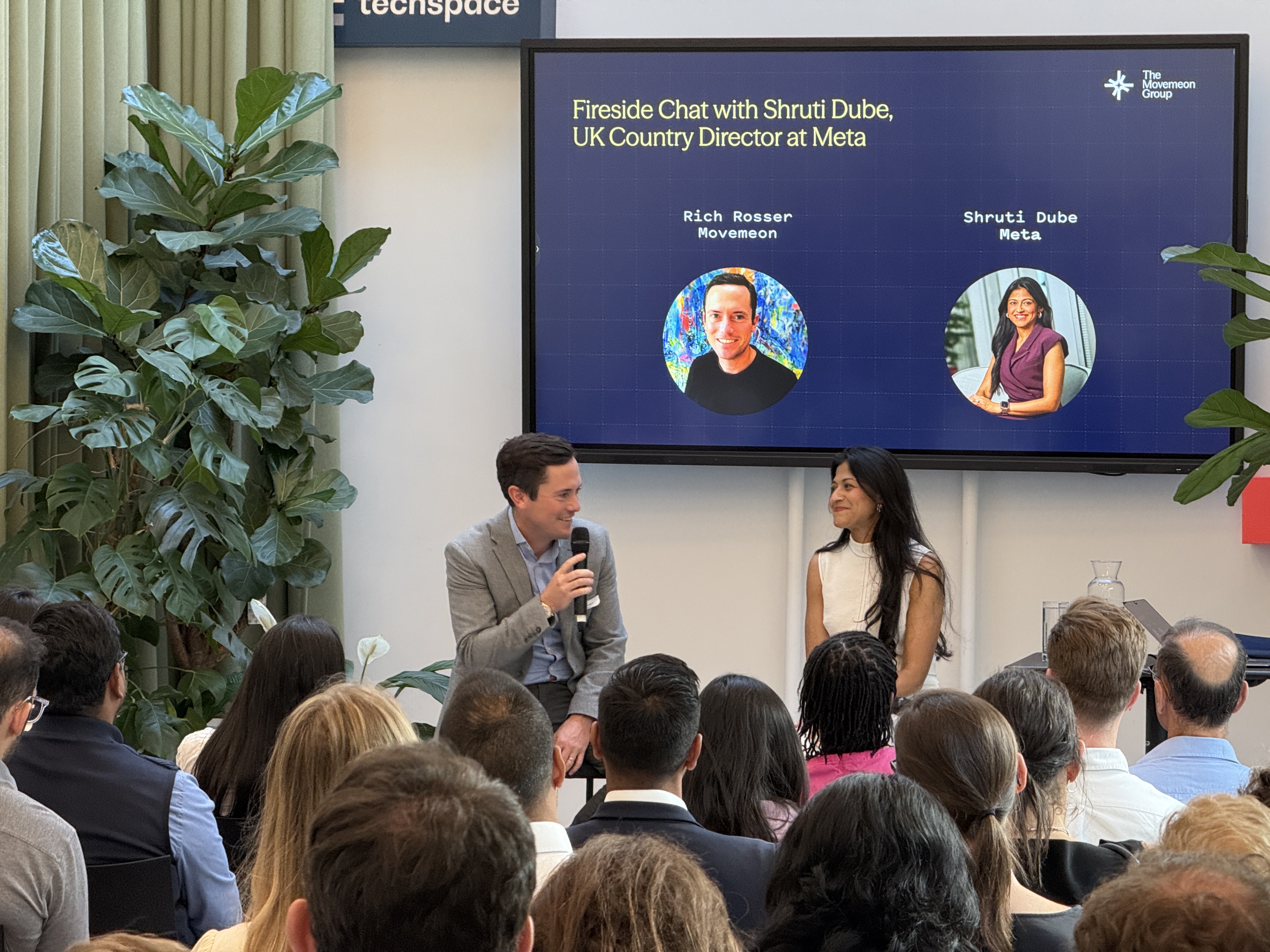
Meta UK's chief exec (ex-McKinsey, ex-Sequoia) shares a career framework built on rising complexity and expanding influence rather than titles, plus advice to stay close enough to real work to catch mistakes, including bad AI outputs. She ties this to Meta's strategy: WhatsApp agents aim to restore personal trust at scale, AI is expanding jobs rather than cutting them, and targeted fixes beat blanket bans.

Treten Sie unserem Ökosystem bei, um einzigartige Möglichkeiten und Ratschläge zu entdecken
90.000+