Alles was Sie brauchen, auf einen Blick
Unsere Erkenntnisse sind detailliert und gut recherchiert. Sie behalten den Überblick darüber, was auf dem Markt passiert, und ermöglichen es Ihnen, der Konkurrenz immer einen Schritt voraus zu sein.
Sign up to our newsletter to get exclusive insights and never miss an article.
The new shape of in-house strategy and transformation teams: Lean central functions, expert flex and on-demand firepower
This article explores how in-house strategy and transformation teams are shifting from large, generalist functions to lean, senior cores supported by on-demand interim expertise.

Over the past 18 months I’ve noticed something interesting inside in-house strategy and transformation teams.
Strategy and transformation teams are being redesigned; not quietly, but structurally. Where once the model was a sizable in-house strategy function with broad generalist capability, the emerging pattern is smaller, more senior teams that draw on external expertise and interim execution support as needed.
It’s not a ‘nice to have’ shift, it’s becoming the operating model of choice for companies that need to move faster than traditional headcount cycles, while keeping fixed costs low and flexing resources up or down as ROI dictates. This approach is especially popular in tougher economic climates.
Why the old model is under pressure
Corporate headcount processes are slow. Approving a director-level strategic hire can take months, involves multiple stakeholders, and, especially in tighter economic conditions, is increasingly viewed through a cost and risk lens: ‘Do we really need this role full-time and permanently?'
At the same time, the complexity of strategic work is rising. Pricing requires specialist competence. Go-to-market design now spans digital, sales enablement and RevOps. CDD-style market validation is no longer only relevant to private equity, corporates are now using it to justify investment, M&A and new product bets.
Matching that level of sophistication with a full-time team across every dimension is expensive, slow and, in most cases, unnecessary.
Why interim is no longer a compromise
Ten years ago, interim talent was seen as a stopgap. Today, that perception has flipped.
There is now a substantial and growing interim talent pool, ex-consultants, former BU leaders, transformation specialists, commercial operators, pricing experts, and industry CxOs who are choosing project-based work over permanent roles. The sheer quantity of high-quality professionals available for projects has fundamentally shifted the market, and their expertise often surpasses what corporate recruitment processes can surface within the same timeframe.
Three key factors driving the rise of interim and project-based work at senior levels:
- Career optionality: Many senior operators now prefer portfolio careers over permanent employment, embracing a mix of projects and permanent roles. The stigma of a “gap on your CV” has faded, moving between permanent and project work is increasingly seen as a valid, fluid career path, often serving as a “try before you buy.”
- Remote-first work: Geography no longer limits supply. Talent can now be sourced globally, giving companies access to the best people regardless of location.
- Demand sophistication and market dynamics: Corporations are far more precise in articulating what they need, e.g., “pricing diagnostic + packaging,” “CDD-style market sizing,” “RevOps strategy”, which maps perfectly to interim engagements. At the same time, more projects in the market create a virtuous circle: increased project opportunities attract more high-quality professionals to this way of working.
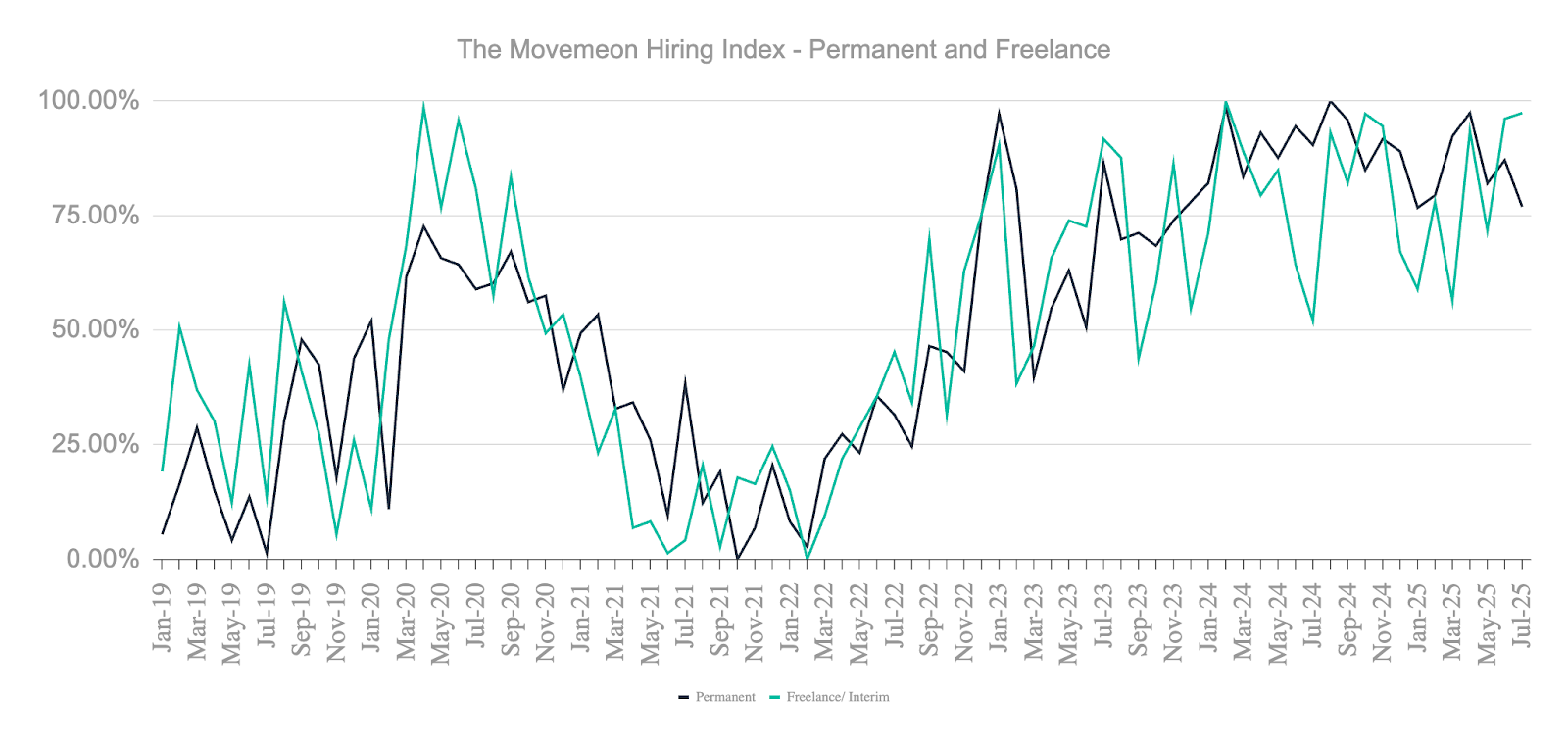
Movemeon Hiring Index shows that the freelance/interim talent market shows continued over-supply of high-quality professionals relative to roles. This reflects broader shifts we’ve documented in the market: many of the best consultants and operators are choosing project-based work for greater control over their careers, contributing to a deeper pool of available interim talent.
Today, interim talent isn’t simply a cheaper alternative to permanent hires, it’s the faster, more precise, lower-risk way to get specialist work done.
Many clients still underestimate how deep this talent pool is and how accessible it can be. Movemeon’s data shows that interim talent is highly cost-effective, there are no ramp-up periods or lengthy notice periods, just straight delivery, and access is rapid: clients can interview suitable professionals within 1–2 days, with many ready to start as soon as the following week.
Project-based work favours flexibility
There’s a structural point here that often gets missed: most high-value strategic and commercial work is project-based by nature.
Examples from real clients:
- Pricing reviews every 12-18 months
- Market entry or product expansion strategies every 2-3 years
- Commercial due diligence ahead of acquisitions or divestments
- Transformation PMOs aligned to specific value creation cycles
- GTM re-designs tied to one-off product launches
You would never build permanent teams to run these cycles continuously, unless you are a private equity fund or a global consulting firm. Corporates don’t, and shouldn’t, operate that way.
Cost efficiency over the annual planning cycle
A point that CFOs in particular appreciate: interim isn’t cheaper on a day-rate basis, but it is significantly cheaper over a full budget year versus FTEs.
The maths is straightforward. A corporate hiring a strategy director pays not just base salary, but NI, pension, bonus, LTIPs, managerial overhead and future redeployment risk. An interim team, even at premium day rates, disappears the moment the job is done.
Layer in the fact that strategic demand is irregular, and the logic becomes clearer: variable cost for variable work beats permanent cost for intermittent work.
A more modern operating model for strategy
The emerging structure we now see more and more:
1. A small, sharp internal strategy nucleus
- Typically 3–10 people
- Focused on enterprise priorities, capital allocation, annual strategy, board engagement, and mobilisation
- High internal connectivity, high context
2. Modular access to specialist expertise
Brought in for spikes in specific domains such as:
- Pricing and monetisation
- Commercial due diligence
- GTM strategy and sales enablement
- Customer and product strategy
- Digital and data strategy
- Restructuring and cost transformation
3. Temporary horsepower for execution
When volume matters more than niche expertise (e.g. transformation PMO, market sizing workstreams, integration projects).
This model does three things that corporates increasingly need:
Moves fast, maintains quality, and avoids adding permanent cost.
Where Movemeon fits
This is precisely the model we’re helping global corporates build, not just by supplying talent, but by advising on how best-in-class organisations structure strategy and transformation.
We do that in three ways:
1. Access to specialist expertise
Targeted specialists for very specific strategic problems, pricing, CDD, GTM, operating model design, digital & AI strategy, and transformation PMO, drawn from ex-MBB, Big 4 and senior industry operators across sectors and geographies.
Examples:
- A global media group bringing in a market analysis specialist for a 6-week sprint to size a new growth vertical.
- A major restaurant chain engaging a partnerships expert for a 4-week project to design and prioritise strategic alliances.
- A B2B SaaS scale-up appointing a pricing specialist for a 3-month engagement to redesign packaging and monetisation.
- A large logistics business bringing in an operations transformation lead for a 6-month programme during a major cost and service transformation.
2. Access to horsepower
On-demand teams of ex-MBB / Big 4 / boutique consultants to execute time-bound strategy and transformation work at pace, from growth strategy builds and PMI execution to market entry sprints and board-level strategy refreshes.
Examples:
- A Tier 1 telco deploying a small team of generalist strategy freelancers to support a board-level strategy refresh under tight timelines.
- A PE-backed industrials group standing up a temporary strategy pod to support PMI delivery across multiple workstreams post-acquisition.
- A global consumer business mobilising a sprint team to build a market entry strategy and execution roadmap for a new geography.
3. Advisory on operating model design
Insights on how the best corporate strategy functions are evolving- headcount, structure, and where interim makes sense.
The outcome is not a new buzzword, it’s simply a more modern way to run strategy: leaner, faster, and tuned to how work actually gets done.

A record quarter for Private Equity deals sees a sharp hardening in the hiring market
Talent supply tightens as PE demand surges: Inside Q4’s hardest hiring market in two years, where Private Equity accelerates, scale-ups hold steady, and Large Enterprises struggle to attract strategy and transformation talent.

This report marks the fourth installment of Movemeon’s Quarterly Hiring Analysis, a regular update designed to help hiring managers and candidates stay ahead of the market across Private Equity, VC-backed scale-ups and large Enterprise businesses. Our insights are powered by over 2.2 million data points from the Movemeon platform, giving you a clear picture of how candidate interest and hiring demand are shifting.
At the heart of this analysis is the Movemeon Hiring Index, a scale from 0 to 100 that reflects how attractive the job market is for employers. In short: a higher index means higher candidate interest per role. When the economy slows, candidate supply tends to rise, pushing the index up. When hiring demand picks up and candidate availability falls, the index drops.
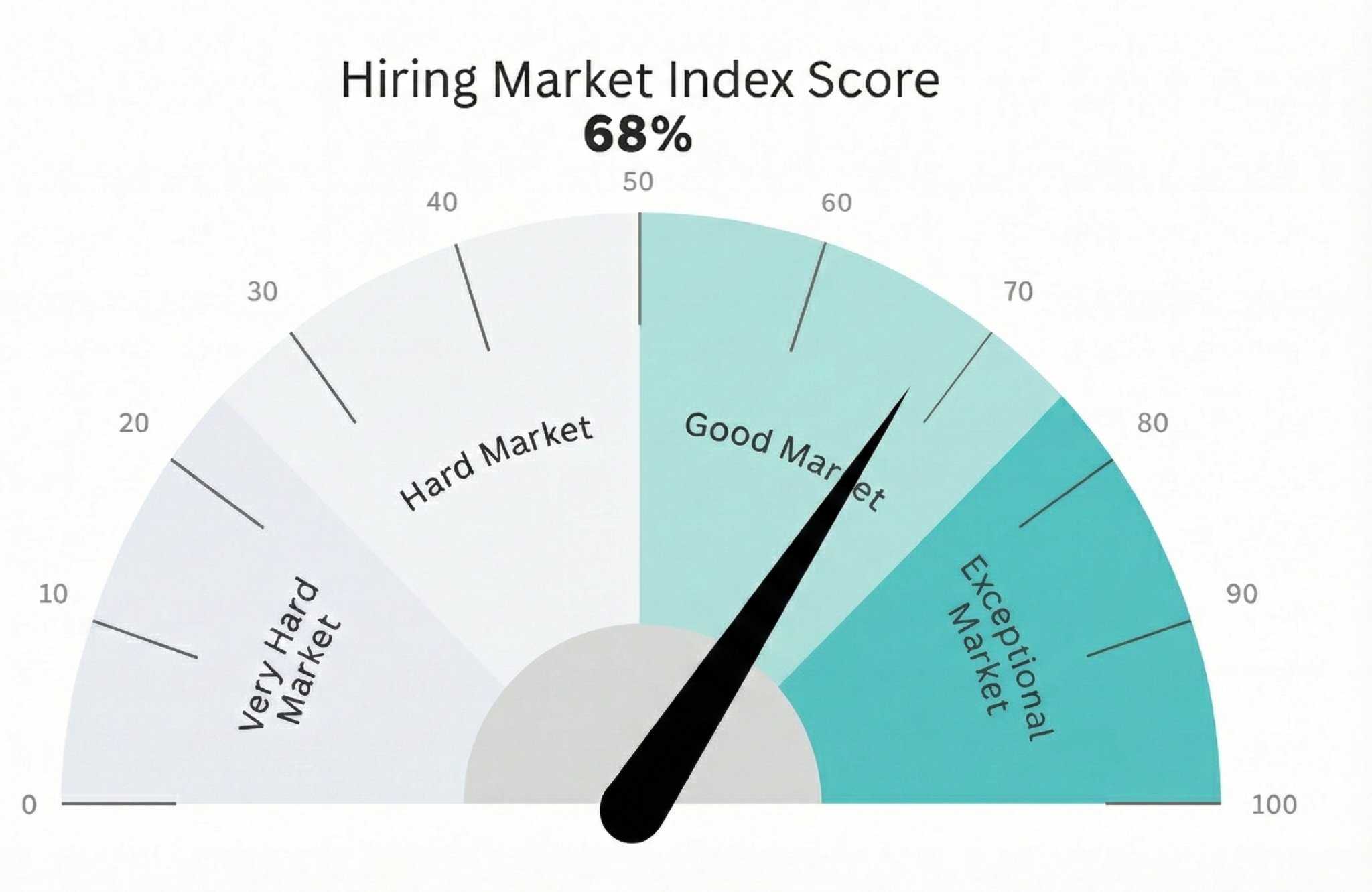
The Strategy and Transformation Hiring Index dropped to 68% this quarter. This is the lowest value, signalling the hardest market to hire in, that we’ve seen for two years.
The driver of this hardening of the market seems to be two fold. Firstly, there has been a sharp uptick in demand for talent from Private Equity. The combination of an increase in deals (Q3 was a record), and the increasing focus on using talent as a key driver of Portfolio business performance, has resulted in the increase in demand. Secondly, we’ve seen candidates less attracted to working in Large Enterprise businesses, resulting in a harder market for Corporates to hire.
We conclude the article by reflecting on what we think might happen next. In short, given the amount of PE Funds awaiting to be deployed, we find it highly unlikely things will abate. If anything we expect this market to continue to harden into Q1.
The Movemeon talent index
The Index is designed to give employers a read on the talent market: is it competitive? Are candidates open to new roles? Are certain industries or job types seeing more traction than others?
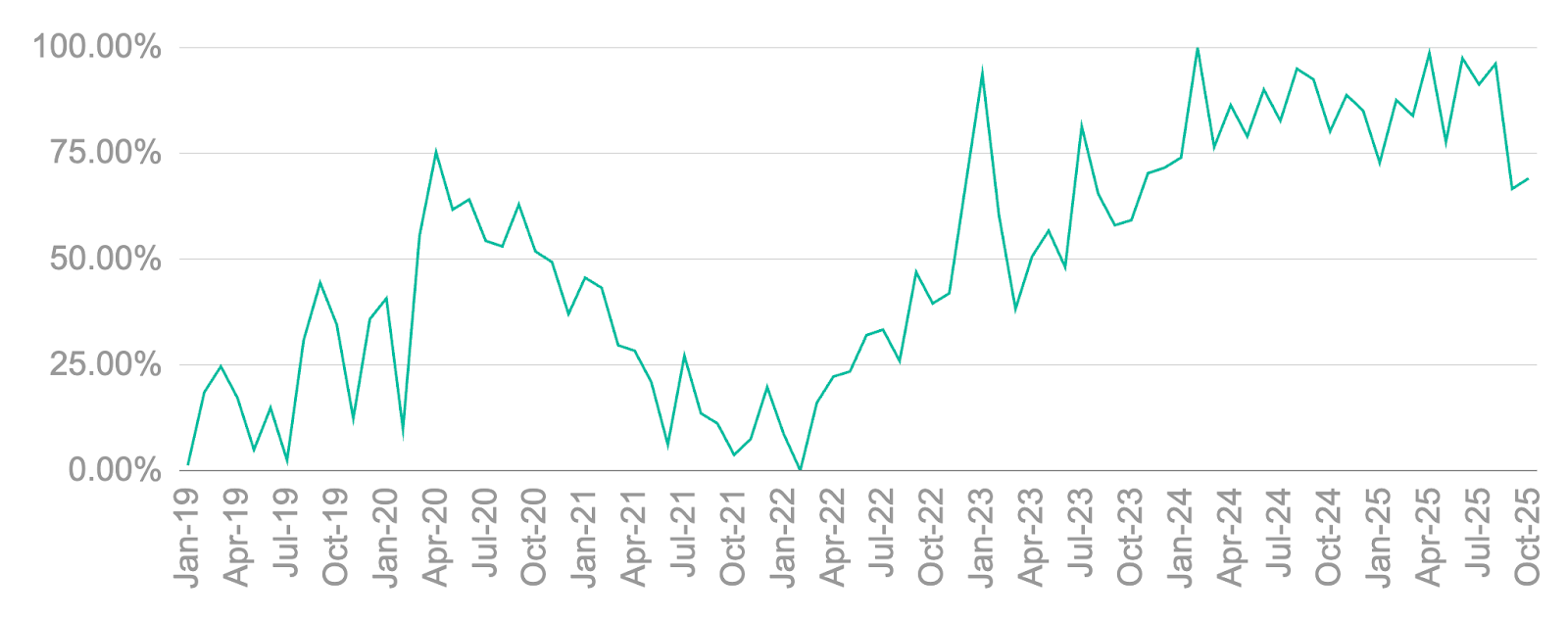
Below is how the index has changed over the last five years. For context, it's worth understanding who the Movemeon community are:
- It’s global: our 90k members are based across the world, with our main hubs in the UK, France, DACH, the Middle East, APAC and the US
- Everyone has worked in a leading consulting or accounting firm: 45% are ex-McKinsey, BCG and Bain; 30% are leading strategy firms; the remainder are the Big4
- They are future leaders and Board members: consultancies make up six of the top eight "CEO factories" (companies whose alumni become CEOs of the largest businesses). And this isn't constrained to just large businesses, with a disproportionate number of unicorns founded by consulting alumni
In terms of interpreting the numbers:
- 0-25: a very hard market to hire in. Focus on retention, as replacing people is going to be hard.
- 25-50: a hard market to hire in. Be proactive and start talent pipelining for key positions.
- 50-75: a good market to hire in. Start looking to take advantage of the market, and strengthen key positions.
- 75-100: an exceptional market to hire in. Look to bring in exceptional talent that you’ll only get a few chances to snap up.
Demand now outstrips supply as the market tightens
The hiring index has fallen to 68%, the lowest level since October 2023, signalling the most challenging hiring environment in nearly two years.
For the past 12 months, the index had held stubbornly above 75%. In our last quarterly analysis, we noted that this resilience persisted even as hiring activity increased, suggesting there was still an oversupply of candidates in the market.
So what has shifted in Q4 2025?
To unpack this change, we analysed the hiring index by company type to understand the underlying dynamics driving the tightening.
Private Equity is driving a surge in hiring demand
A hiring index of 68% is the lowest we’ve seen since October 2023, signalling the hardest market to hire in for 2 years.
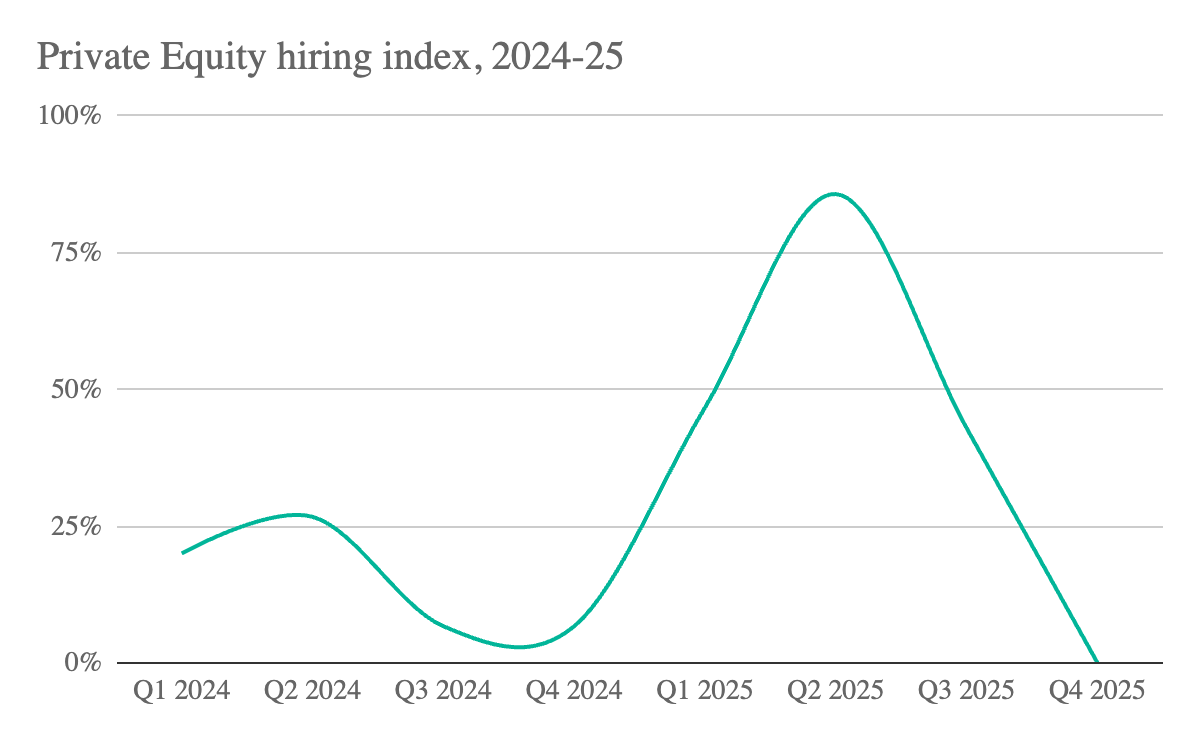
Whilst we’ve seen some variability in the PE hiring index, the difference over two quarters has been profound. Moving from 80% (a good market to hire in) to 4% (a very hard market to hire in) in just 6 months, shows how quickly the market can shift.
What’s driven the rapid turnaround in PE. We believe it’s two-fold:
- Q3 was a record of capital deployed in PE
- Continued focus on talent to drive operational improvement across the deal lifecycle

Large Enterprises/ Corporates
We’ve also seen the market tighten for strategy and transformation talent within Large Enterprises and Corporates.
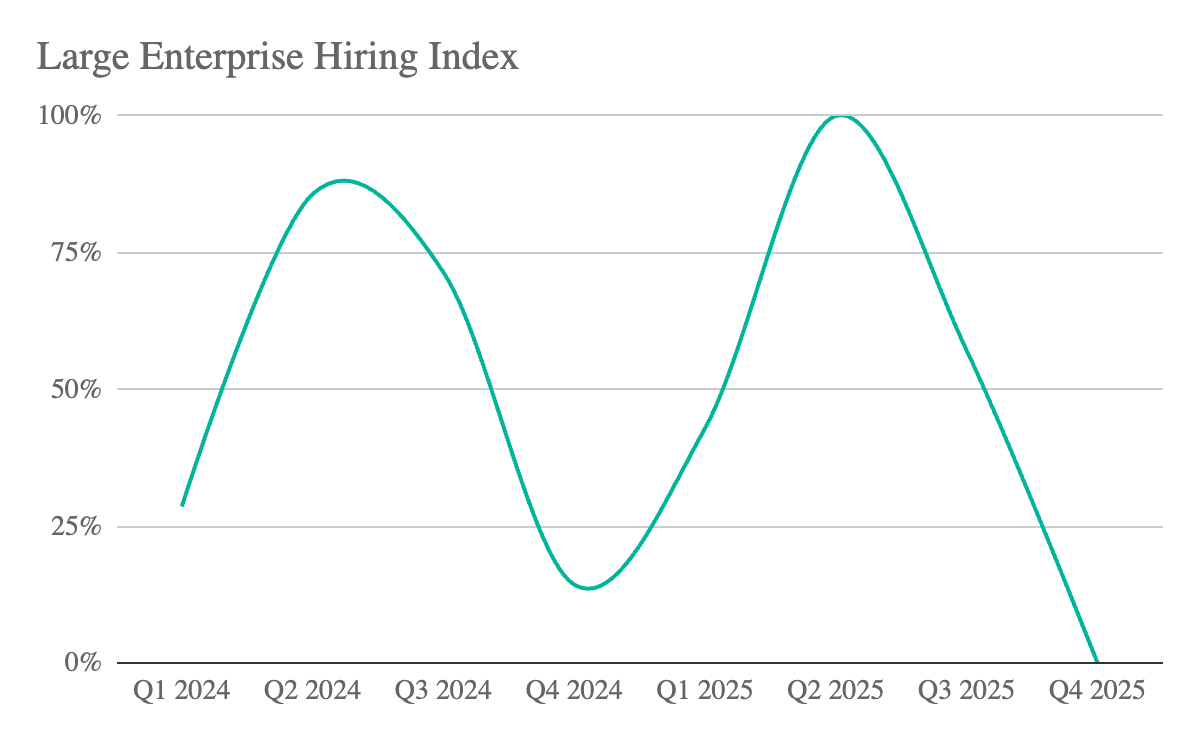
For Enterprise businesses, the sharp reduction in the hiring index appears to be driven less by increased hiring demand and more by a decline in candidate interest.
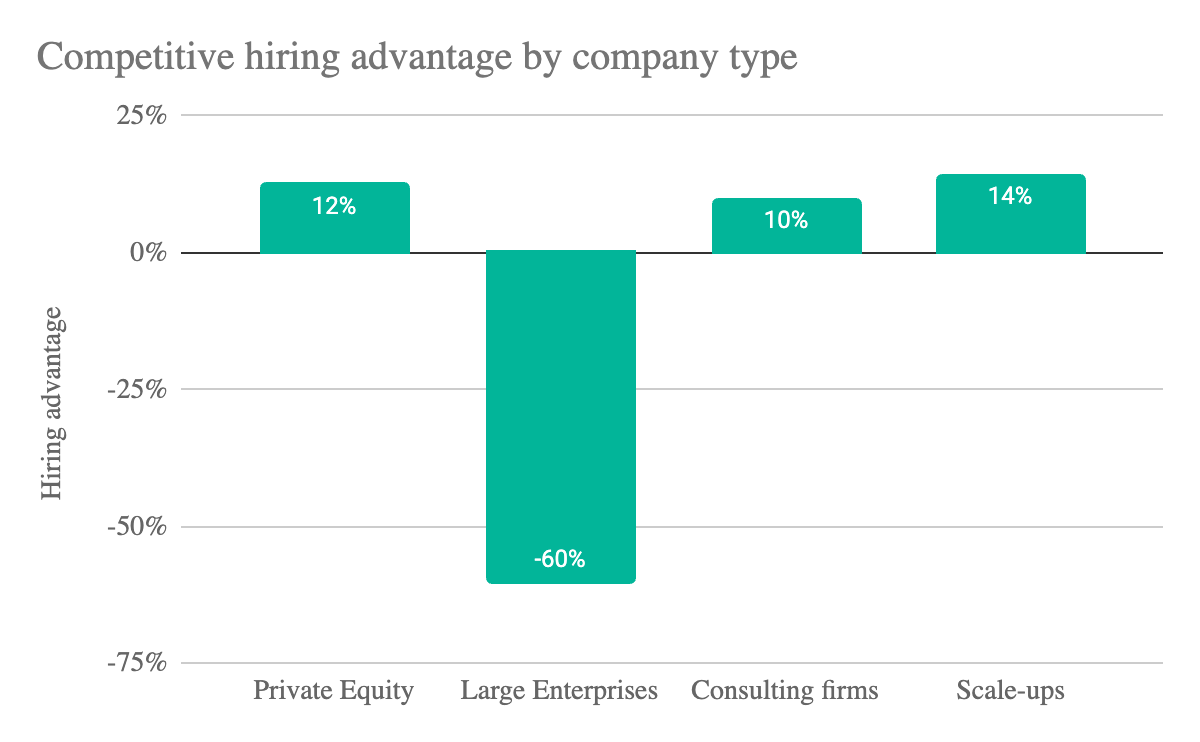
Our analysis of the hiring index by company type, a useful proxy for how attractive different organisations are to candidates, shows a clear pattern. While scale-ups, PE firms and consulting businesses perform similarly, Large Enterprises face a significant disadvantage when it comes to attracting strategy and transformation talent.
What’s next
Given the amount of Private Equity funds ready to be deployed, we find it very unlikely that things are going to slow down for the foreseeable future. If anything, given the number of Funds we’ve been speaking to who have mentioned deals on cusp of closing, things are likely to accelerate into Q1 next year.
To find out more about hiring with Movemeon get in touch with our team here.
.jpg)
Bringing a refreshing approach to hiring in the US: An interview with Movemeon’s General Manager
Movemeon’s US GM on his career journey and how the firm is redefining hiring in the consulting and PE market.

Can you tell us a bit about your own career journey and what led you to take on the role of General Manager for Movemeon in the US?
I began my career working in the experiential marketing world, delivering experiences for some of the worlds largest brands and sports properties. We aimed to deliver best in class experiences for fans, consumers, and clients. I was very fortunate to work with many leading marketeers, whose attention to detail and client handling skills have been a strong foundation throughout my career. Since then, I have been leading and scaling disruptive teams and businesses, predominantly at the intersection of HR and technology, often working alongside first class ex-consulting minds.
Prior to Movemeon, I relocated to the US to launch and scale a high performance team at a fast growing UK tech company. I knew of Movemeon as they sourced some incredible candidates and placed some pivotal roles for the firm. When I heard they were hiring a GM, and looking to expand into the US, it felt like the perfect opportunity to draw upon so much of my experience and skillset as well as provide some cultural translation.
What was the vision behind bringing Movemeon (with its specialist hiring, consulting & interim services) to the US market?
I’m very lucky - Movemeon has an incredible track record, candidate network, list of clients and brand recognition in Europe. The team had already spent a few years laying the groundwork in the US by building out our candidates and getting global referrals to clients. Given the success of the business in Europe, expanding into the largest and most mature consulting market was a matter of ‘when’ not ‘if’.
In your experience, what does Movemeon do differently or better than traditional hiring / consulting firms in the US?
What sets Movemeon apart is our engaged network of over 100,000 candidates globally in a very specialist area - current and former strategy consultants. On top of that, our tech driven delivery model means we can engage with better candidates faster than traditional methods.
Can you share some case studies or stories from US companies that illustrate how Movemeon solved a tough hiring or consulting problem?
On a recent call with the Head of Talent for a well known large cap PE firm, they mentioned they were currently hiring for a very specific role on the operating team and gave a one line description of a candidate they were looking for. Within 72 hours we had surfaced the perfect candidate whose background and resume literally “wrote the job description”.
In another recent scenario, a client rang us to say they’d been struggling with a very important role for almost a year, whilst it was slightly outside of our wheelhouse, we were able to agree a model that worked for both sides, and through our network, pull together a very strong shortlist within two weeks. We currently have a candidate in the final round for the role.
If you had to sum up in one sentence what companies in the US should expect if they work with Movemeon, what would that be?
A refreshing approach to a traditionally antiquated industry, through a high-touch and personal service, driven by a tech delivery model.
Looking ahead, what are your ambitions for Movemeon in the US over the next few years - whether that’s new services, industries, or ways of working with clients?
The US is Movemeon’s fastest growing market globally, both on the candidate and client side, and it’s only going to continue accelerating. We’re particularly seeing huge growth in the Private Equity vertical and we’re already growing the team to support, watch this space!
Looking for the best talent in the US? Let us help.
.png)
The new age of consulting - how client demands are changing
Consulting disrupted: Clients demand flexibility, execution expertise, and lower fees as traditional firms face competition from interim executives and agile consulting teams.
Consulting is going through a seismic shift. After years of double-digit growth, the combination of a tough macro-economic climate and more alternatives in the form of independent consultants and in-house ex-consulting talent is challenging the very foundations consulting is built on.
In this article, we talk through how we’re seeing client demands for consulting and advisory support shifting, and what this means in terms of a new landscape of advisory support.
If you’d like to know any more about how you’d deploy either model, or would like to see some example projects get in touch with our team here.
Is consulting no longer recession-proof?
The old adage explains that you need consultants in the good times and the bad. As such the industry had historically been seen as largely recession-proof. This "professional services” resilience has resulted in an interest from private capital markets over the last few years, but is this being challenged in the consulting market?
Ten years ago, HBR first referenced “consulting on the cusp of disruption”. The post-COVID boom resulted in pay rises, over-hiring and an increasing reliance on non-core strategy work. This meant few in the industry were prepared for the correction in 2022-23.
We highlighted what we saw in the industry, both from a client perspective and in the consulting firms:
On the client side:
- There’s increased need for deep industry experience
- Fees have reached unsustainable levels and typical delivery models are too rigid
- Quality isn’t what it used to be
Which has started to have knock-on effects to the consulting industry:
- Top performing partners leaving to launch boutiques
- Rise of quality in the freelancer market
- Change from AI on the horizon
How is the market now responding?
The growth of consulting firms in the post-COVID era was driven by providing more advice outside of the core of strategy. Clients had found returns on bringing in expertise to help drive implementation, analytics and new products/ services. By January 2023, the Kennedy Research Reports found that strategic advisory had fallen to just 10% of the consulting industry’s revenue - from 17% just five years earlier.
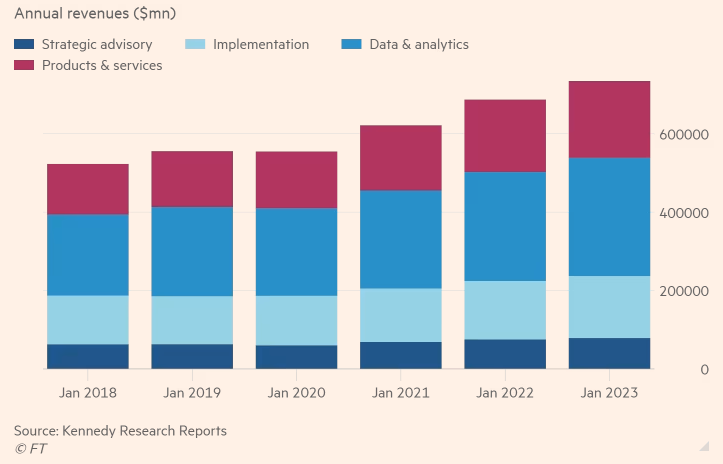
The 10% of strategy work, which grew very little over the last five years, is seeing less disruption: Large Cap PE funds are still turning to McKinsey, BCG and Bain for due diligence, and development of the Value Creation Plan; the Boards of large corporates and enterprises are still choosing to get the assurance of one of these firms on the once in a decade decisions.
However, for longer-term implementation, transformation projects and new market entry projects, we’re seeing a shift away from the traditional firms. PE and Enterprise clients are conscious they don’t have the capability or capacity to deliver these in-house. They are also aware that experts who have overseen similar projects countless times will help them avoid the pitfalls and maximise ROI. However, they are unwilling to spend the fees commanded by the traditional firms - especially when the delivery models designed around strategy projects (Partner only part-time; EM+2 team) are so rarely flexible, and the Partners at these firms often don’t have real operating experience.
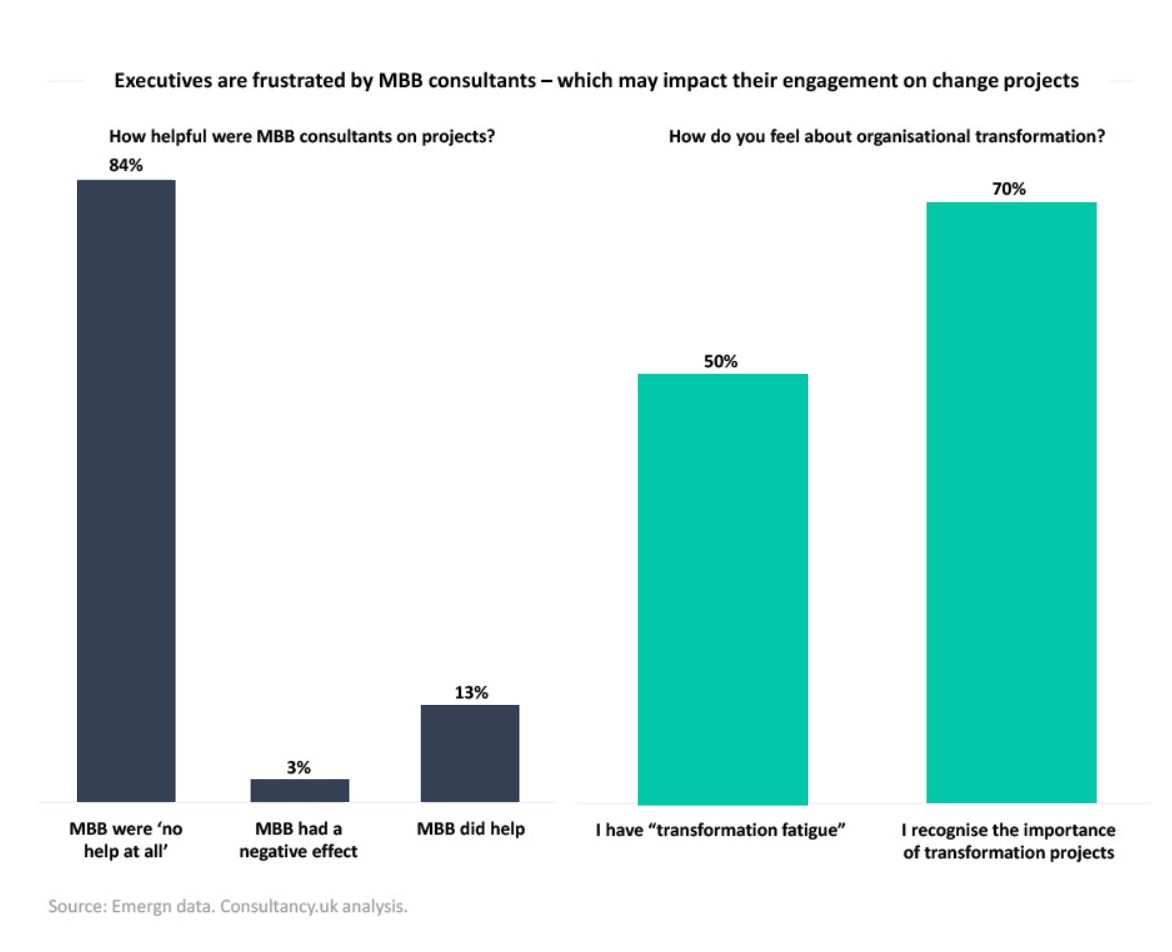
This has meant that very few believe MBB defend their cost when implementing large change programs - 84% of executives saying that MBB were “no help at all” in a recent Emergn survey about change projects:
A new breed of competition and the risk of marketing myopia
Theodore Levit is often quoted by consultants. They’ve explained to many clients that focusing on delivering value must always usurp the pressures of continuing to sell current products and services. Kodak and Blockbuster are often cited as examples of not doing so.
It’s definitely time the consultants heed their own advice. Consulting for many years has been able to defend its price point through exceptional solutions and effective communication of these. There’s almost a bit of magic about how they get there. However, it is fundamentally a people business. And we’re increasingly seeing clients shifting towards other ways to access these people.
Twenty years ago the consulting alumni world was still pretty small. The firms were growing but not many had been through their intense training and coaching. As they’ve continued to grow, the alumni networks and number of “consulting trained” experts has grown exponentially. We’ve seen rapid growth for two types of advice: interim experts and agile consulting teams.
Interim experts - embedded senior executives with deep operating experience
Typical roles and cost: The majority of the demand we find for interim executives are either roles responsible for overseeing a change (Chief Transformation Officers / Head of PMO) or are bringing in deep expertise (Chief Procurement Officer, Head of Pricing / Sales Excellence). The transformation roles tend to be 6-18 months in length; the experts normally 3-5 months.
Typical profiles: A combination of ex-top tier consulting (ensures they can effectively work alongside the executive team) and deep operating experience. They’ve typically worked in industry in a senior or executive role for 5-10 years. This means they know what it takes to deliver real change. Day rates will vary a lot on profile and length of project, but are typically £1.5k - £4k.
What they offer that a consulting firm can’t: There are two main drivers: time and “operating experience”. For time, interim executives are the equivalent of a “Partner” on a consulting project. Typically with Partners, they are spread between multiple projects and as such you likely only get 1-2 days of their time a week. With an interim executive, you get them 100% of the time. Secondly, they all bring deep “operating” experience. Many consulting Partners have worked their way up through consulting, without having held senior roles in PE or Industry.
Agile consulting teams: flexible, specialist, end-to-end
As part of our own consulting offering, we’re seeing client demand and ex-MBB Senior Partner supply converge across a number of specialism areas as outlined below.
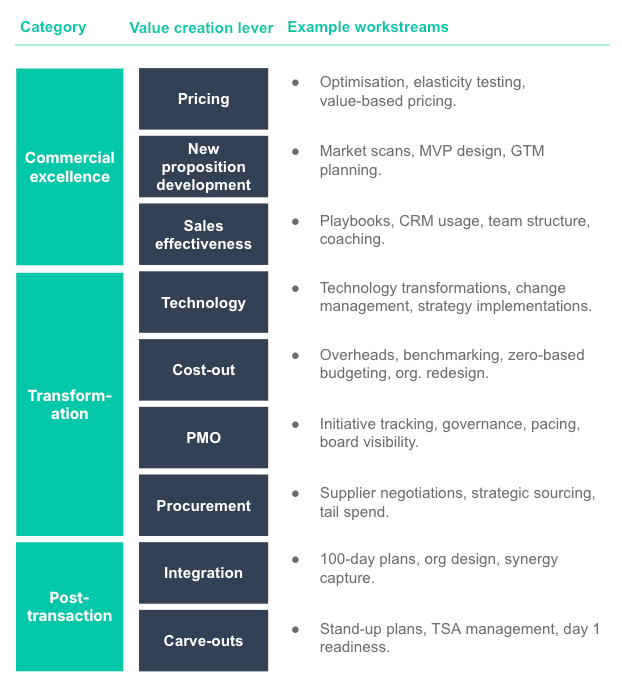
Typical projects and cost: Complex decisions that need deep expertise. They are typically the main 2-3 initiatives post strategy development, and include new market entry, operational improvement, organisational design, procurement review, pricing strategy etc. They are high-impact projects that often have a big bottom-line impact. Cost varies on team composition, but typically ranges between £20-50k per week.
Typical profiles: Agile consulting firms are often led by an ex- senior Partner from McKinsey, BCG, Bain or equivalent, who leverages deep functional expertise from interims (as above).
What they offer that a consulting firm can’t: While the ex-MBB Partners ensure the same level of assurance that you’d see with one of the large consulting firms, they are able to offer much more flexible models and deeper industry / operating experience. The flexibility starts with themselves, with potential to be anywhere between 100% staffed on a project to hardly involved - and they will flex up and down the team over the project lifetime. They also offer deep industry expertise, and are able to assemble an exceptional team of interims with backgrounds spanning a plethora of consulting firms and with the requisite functional / industry operating experience.
If you’d like to know any more about how you’d deploy either model, or would like to see some example projects get in touch with our team here.
Agile consulting delivering value in practice
To expand on this with some concrete examples from our own work, we’ve summarised some key challenges we’ve recently seen from clients and outlined why the agile consulting approach worked below:
Operational improvement for a PE-backed manufacturing business
A nationwide UK manufacturer, owned by a £50bn AUM PE fund, needed rapid EBITDA uplift across its product portfolio. An agile consulting team was assembled by Movemeon Consulting to deliver impact within 2 months, with a team comprising:
- Partner: Ex-McKinsey Senior Partner with over 20 years’ experience in operational improvement and manufacturing diagnostics;
- Engagement Manager: 5 years at McKinsey, followed by senior strategy and PE-backed operational roles;
- Associate: Ex-Bain Manager with deep regulated manufacturing experience;
- Analysts: Ex-LEK and Bain, both with operating experience and strong financial modelling / PE exposure.
The challenge: Performance varied widely across sites, with underperformance dragging on overall profitability. The client needed a clear diagnostic and pragmatic turnaround roadmap, executed at speed.
The outcome: The team’s diagnostic identified 7 underperforming sites, developed tailored turnaround plans, and began embedding operational workstreams. The impact was so strong that the client permanently hired the EM from the agile team to continue the transformation.
Why agile consulting worked: This bespoke mix of ex-MBB consultants and operators, led by a senior industry expert, gave the client tier-one insight at pace and cost-efficiency, without the overhead of a traditional consulting firm.
The result: Sustainable operational improvement, delivered by a right-sized, high-calibre team.
Commercial strategy and PMI for a global consumer business
A $5bn consumer business, carved out by a $100bn+ AUM PE fund, required a new commercial strategy and seamless post-merger integration to set up the business for growth. A lean, agile consulting team was assembled to deliver across 12 months, consisting of:
- Sales Excellence & Transformation Director: 20 years’ operating experience at Expedia and Whitbread, with deep expertise in sales excellence, transformation, and commercial operations.
- Senior Consultant: Former BCG Senior Consultant with 5 years’ operating experience in high-growth tech businesses, notably having led PMI for consumer-focused businesses in 20+ countries.
The challenge: The carve-out created a need to stand up commercial functions from scratch, while simultaneously implementing a robust sales excellence strategy to accelerate performance across global markets.
The outcome: The agile team successfully established commercial functions, delivered a scalable sales excellence strategy, and ensured seamless integration across units. The impact was lasting - the client made a permanent hire of the Sales Excellence & Transformation Director to continue driving results post-project.
Why agile consulting worked: By combining a former BCG strategist with a seasoned transformation operator, the client gained a tailored, high-impact team able to deliver both strategic clarity and operational execution - faster and more effectively than a traditional consultancy.
The bottom line
Transformation isn’t just about ideas - it’s about embedding change. Strategy may set the direction, but execution decides whether the journey is completed.
Consulting firms are built around making the key and critical strategic decisions. And they are extremely effective at doing so. However, when it comes to driving the change and transformation, the operational expertise and flexibility offered by interim talent and agile consulting teams is increasingly out-competing the consultancies.
If you’d like to know any more about how you’d deploy either model, or would like to see some example projects get in touch with our team here.

An AI-driven boom for advisory firms? What’s going on
Advisory hiring is surging despite AI’s disruption: large firms and boutiques see rising demand, while clients seek guidance on integrating AI and redefining workforces.
The death of consulting? Not according to the hiring data
It’s clear that AI poses existential threats to the current consulting operating model. At the core of the consulting proposition is synthesising complex data, market intelligence and driving to clear recommendations. All things that AI will be able to do better than humans. It’s not an if; it’s a when.
Our quarterly market index highlights how hiring trends are evolving, with a particular focus on the near-term outlook for advisory roles.”
In our September analysis, we were very surprised to see that Advisory businesses hiring demand is outstripping that we’re seeing in Large Enterprises. Interestingly, it is also outstripping the demand we’re seeing in scale-ups (a market you’d expect to be seeing a boom from AI).
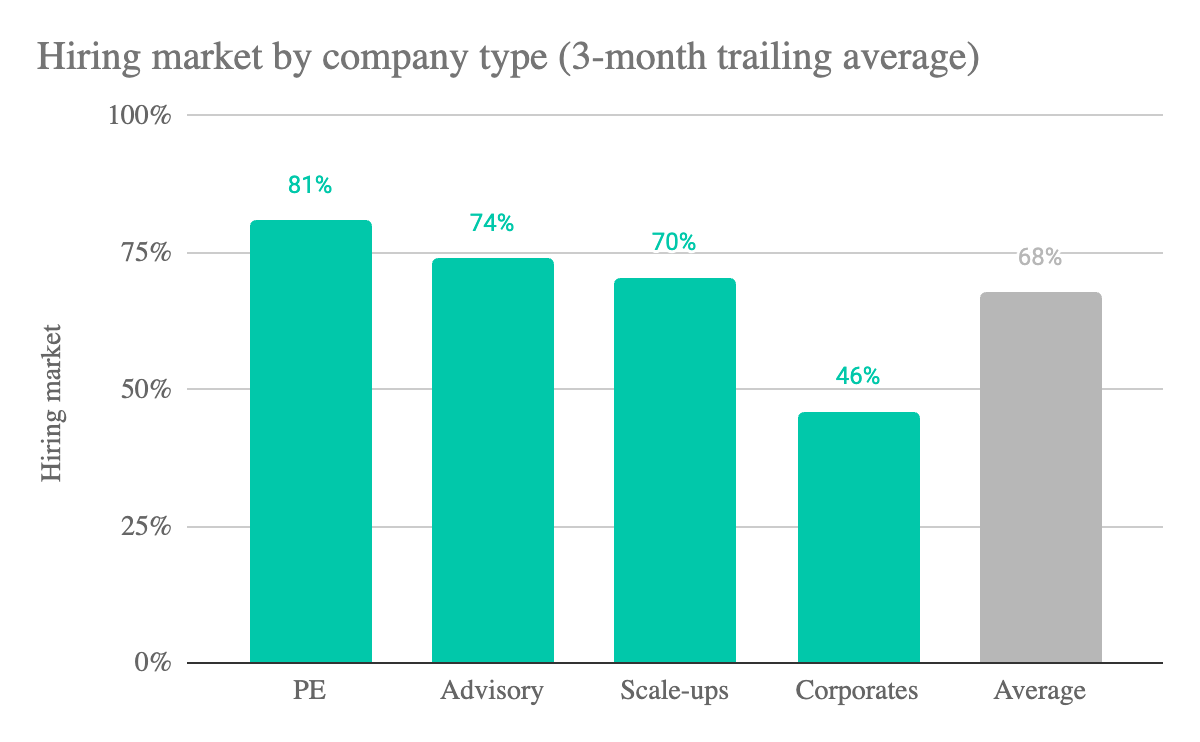
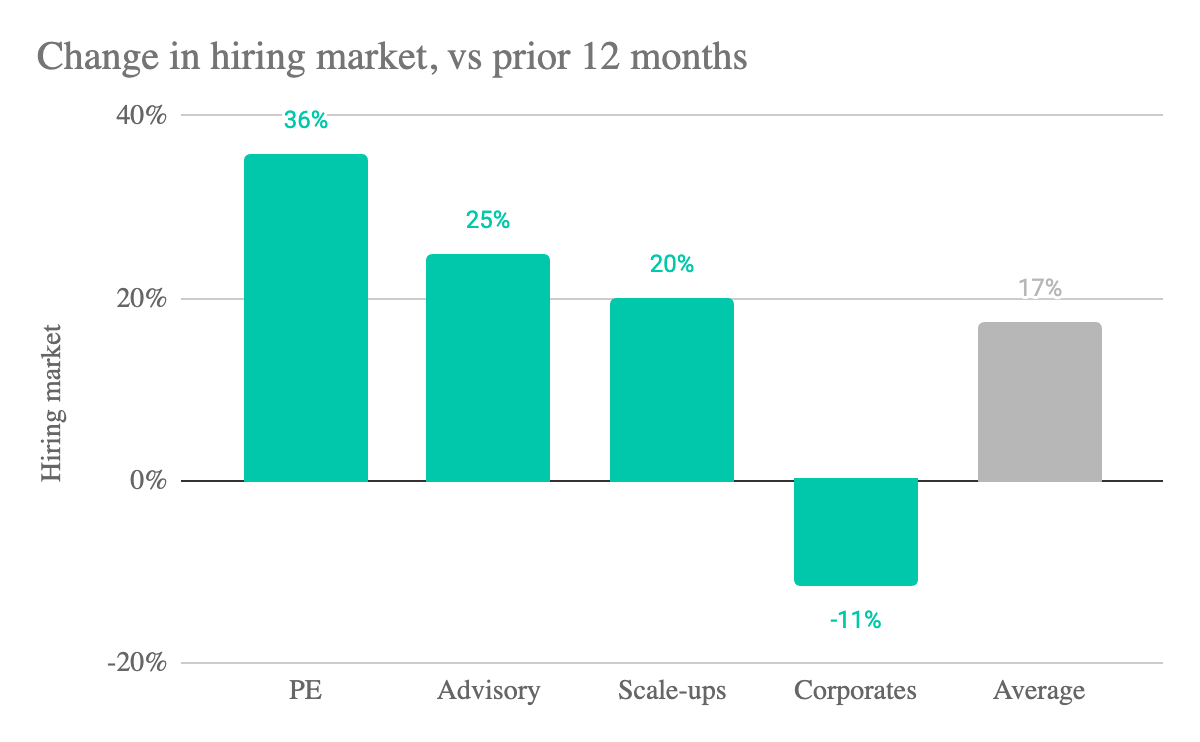
So what’s going on?
The risks posed to consulting by AI are widely discussed, and for good reason: At the heart of the consulting proposition lies the ability to synthesise complex data, interpret market intelligence and drive towards clear, actionable recommendations, precisely the areas where AI is advancing fastest. It’s not a question of if AI can outperform humans in these tasks, but when.
This advancement raises existential questions about the industry’s current operating model, particularly for leaders thinking about project staffing, protecting margins, and developing the next generation of partners. The immediate concern for many is how this is impacting talent in, or looking to join consulting firms- why hire more people if AI can do the same things more cheaply?
But this isn’t what we’re seeing. In fact, hiring demand is up within consulting.
Despite the noise around disruption, our data shows a very different short-term story. Hiring demand across the advisory sector has been rising sharply compared to last year. Initially, we hypothesised that this growth was concentrated in boutique firms, smaller, more agile players pivoting to build AI-focused propositions. If true, this would suggest not a real increase in overall demand, but rather a talent migration away from large consulting firms into specialist boutiques.
However, the numbers told a different story. Hiring demand has risen by 21 percentage points in large firms, and by a more modest but still significant 9 percentage points in boutiques. In other words, demand is not confined to specialists, it’s happening across the board.

Why? Clients are grappling with the same questions about the impact of AI
This trend points to a critical dynamic: The immediate impact of AI on consulting has been overstated. For many firms, the boom is being fuelled by client demand for guidance on exactly the issues senior leaders are worrying about themselves:
• How to integrate AI into core operations.
• What it means for workforce design and resourcing.
• Where value creation opportunities lie in an AI-enabled world.
Implications for consulting leaders
This raises three important considerations for leaders in the consulting industry:
1. Delivery models are shifting, but they’re not collapsing
While AI will automate traditional “analyst tasks,” the near-term demand is for advisory capacity, client guidance, and operating model design. This creates space for firms to rethink the shape and scale of delivery teams, rather than fearing their wholesale replacement.
2. Margins are still defensible, but only when value add is clear
Clients are willing to invest in external expertise, but expectations are shifting. Firms must be ready to demonstrate the distinctive value of human insight alongside AI-driven efficiency, ensuring pricing models reflect both. We see this playing out in the mandates we see from consulting clients, most of whom are looking for deep expertise in a specific functional or industry area, not general capacity augmentation.
3. Talent development cannot be an afterthought
If the AI evolution continues as expected, the real long-term risk is not staffing cuts, it’s a potential skills gap. If AI erodes the traditional training ground of junior consultants, firms will need to ensure the next generation develops judgement, nuanced thinking, client relationship development skills and leadership capability.
Is this a temporary uptick, or a longer term hiring trend?
The jury’s still out on whether this demand surge is a short-lived reaction to AI uncertainty or the beginning of a new growth curve for consulting. But one thing is clear, in the short term, the consulting sector is experiencing a boom, not a bust.
Consulting leaders should resist the temptation to over-correct. Instead, they should focus on building hybrid models, protecting margins through clear value articulation, and reimagining training for future leaders.
What’s certain is that AI will reshape consulting, but for now it’s fuelling demand, not reducing it.
Redefining networking: How to build lasting career momentum
In this article, ou co-founder Rich breaks down 8 simple, practical tips to reconnect with your network, build trust, and stay front of mind for opportunities, all while giving as much as you gain.

Most of us dread “networking”, the awkward small talk, the forced introductions, the feeling of wanting to disappear under the canapé table. But Movemeon’s co-founder, Rich, argues that this isn’t networking at all. Find his advice below!
Picture the scene.
You've just arrived at a corporate venue. You've picked up your name badge. You're thrust into a room full of people you don't know.
You feel obliged to try & scurry around introducing yourself to folks you'll probably never see again. If you're honest with yourself, you're tempted to hide under the canapé table. And you'll definitely find an excuse for an early exit.
This is what most people picture when we use the term "networking". And it understandably makes most of us want to run a mile.
What's more, it's almost totally ineffective. These aren't people who know you. So how can they trust you or advocate for you?
So what is a better definition?
"Keeping in touch with people who know your capabilities & will advocate for you."
Typically these are people you've worked or partnered with in the past. Probably peers or former bosses. People who know you & like you. Or they might be people that those people have introduced you to with their backing.
When you reframe networking like this, your shoulders relax. In fact, you can picture that re-connecting with these people might actually be quite enjoyable.
It's the network of their network where most opportunity lies.
Don't get me wrong. If you keep up with this group, it's not uncommon that one of them will give you a call at some point and ask you to join their team. (The timing might not be right. The opportunity might not be right. But it's always great to be asked).
Much more likely is that they'll think of you when someone in their network is chatting to them. It could be that their friend wants an expert point of view. Or a supplier recommendation. Or that they're building a new team and asking for suggestions. Either way, you'll be front of mind for an introduction.
So what are my 8 tips for re-booting your networking and making it both sustainable & impactful?
- Write a short list. 15-30 people who know your capabilities (ideally peers or seniors).
- Put them in a spreadsheet / Trello board / other type of simple tracker.
- Don't be scared to get back in touch with people you've lost touch with - you'll be surprised just how many are happy to hear from you.
- Make a simple, realistic goal. E.g, meet 1 person per month (assuming you're in a full time job; stretch this target if you're actively job seeking).
- Don't be transactional. This is about building trusted relationships.
- Do be intentional. People who know & trust you are happy advise or support you.
- Be resilient & systematic. If they didn't reply to your first message, follow up 1 week later (it's not because they dislike you; it's because they're busy & forgot to email back).
- Give as well as take. Make thoughtful connections for these people. And lean into people trying to network with you. Remember how you feel about that person who is only in touch with you when they want something (we all know one). Don't be that person. Instead, "pay it forward" - good karma quickly comes around.
Implement these 8 simple tactics to make networking easy, enjoyable & accelerate your career.
About Rich and how you can work together
Rich started his career at McKinsey before working as a freelance consultant alongside co-founding Movemeon. Over 15 years he's helped over 5,000 organisations to hire - organisations of all sizes in all industries, globally - and developed a unique overview of what works to build successful, happy careers right up to CEO level.
He has always given advice via LinkedIn message to anyone who's asked for it. And in 2025 - encouraged by his network - he formalised this through the creation of OnUpBeyond .
The 2025 pilot of his career advisory sessions was massively oversubscribed, despite a price point in the thousands 000's. Those who managed to grab a place consistently reviewed the experience as 5*.
In July 2025, he relaunched his support in a truly accessible way via The Career Momentum Hour.
- Ask your questions for expert advice tailored to you.
- Weekly advisory sessions - listen in live or catchup in your own time via recordings.
- Regular senior guest speakers from CEOs, to Investment Directors to startup Founders to Exec Search bosses.
- Peer mentorship - your champion & trusted sounding board.
.jpg)
The job market heats up: Hiring demand hits an 18-month peak
Hiring demand surges, talent supply shrinks: Inside Q2’s shifting job market where Private Equity booms, advisory hiring accelerates, scale-ups rebound, and corporates face mounting pressure to compete
Q2 market index reveals shifting dynamics in talent demand
Hiring demand for permanent roles is at its highest we’ve seen for 18 months. We saw an initial strengthening in the market last quarter, but expected this to have dropped given the macroeconomic environment and the impact of tariffs.
However, after a small initial dip in May, the hiring market has continued to grow, reaching its 18-month peak in Q2 2025. As the hiring market has strengthened, the talent index (measuring the supply of great talent on the market) has started to drop. Between Q1 2024 and Q2 2025, the market index averaged at an all time high of 90, before dropping to 75 in July 2025. This is only slightly above the average for 2023 (70), when companies were still struggling to hire post COVID and the Great Resignation.
In this article we look at how different types of companies are being affected by these broader trends. We find that Private Equity is seeing a boom in demand for talent, driven by an increase in deals and an increased focus on operational improvement across ever larger portfolios. We were also surprised to see, despite the coverage that AI is already disrupting the advisory market, that there has been strong growth in hiring across consulting firms.
Finally, we look at the different dynamics of the freelance and permanent markets: Whilst the permanent market has definitely tightened, with visibly less supply, freelance is still a high supply market for talent. We hypothesise that this is more driven by the broader freelance revolution, and a sharp increase in freelancers/ interims available who have chosen to freelance for more control over their work life (which projects they do; hours worked etc.). This might also be contributing to the righter permanent market.
The Movemeon talent index
The Index is designed to give employers a read on the talent market: is it competitive? Are candidates open to new roles? Are certain industries or job types seeing more traction than others?
Below is how the index has changed over the last five years. For context, it's worth understanding the Movemeon community:
- It’s global: our 90k members are based across the world, with our main hubs in the UK, France, DACH, the Middle East, APAC and the US
- Everyone has worked in a leading consulting or accounting firm: 45% are ex-McKinsey, BCG and Bain; 30% are leading strategy firms; the remainder are the Big4
- They are future leaders and Board members: consultancies make up six of the top eight "CEO factories" (companies whose alumni become CEOs of the largest businesses). And this isn't constrained to just large businesses, with a disproportionate number of unicorns founded by consulting alumni
In terms of interpreting the numbers:
- 0-25: a very hard market to hire in. Focus on retention, as replacing people is going to be hard.
- 25-50: a hard market to hire in. Be proactive and start talent pipelining for key positions.
- 50-75: a good market to hire in. Start looking to take advantage of the market, and strengthen key positions.
- 75-100: an exceptional market to hire in. Look to bring in exceptional talent that you’ll only get a few chances to snap up.
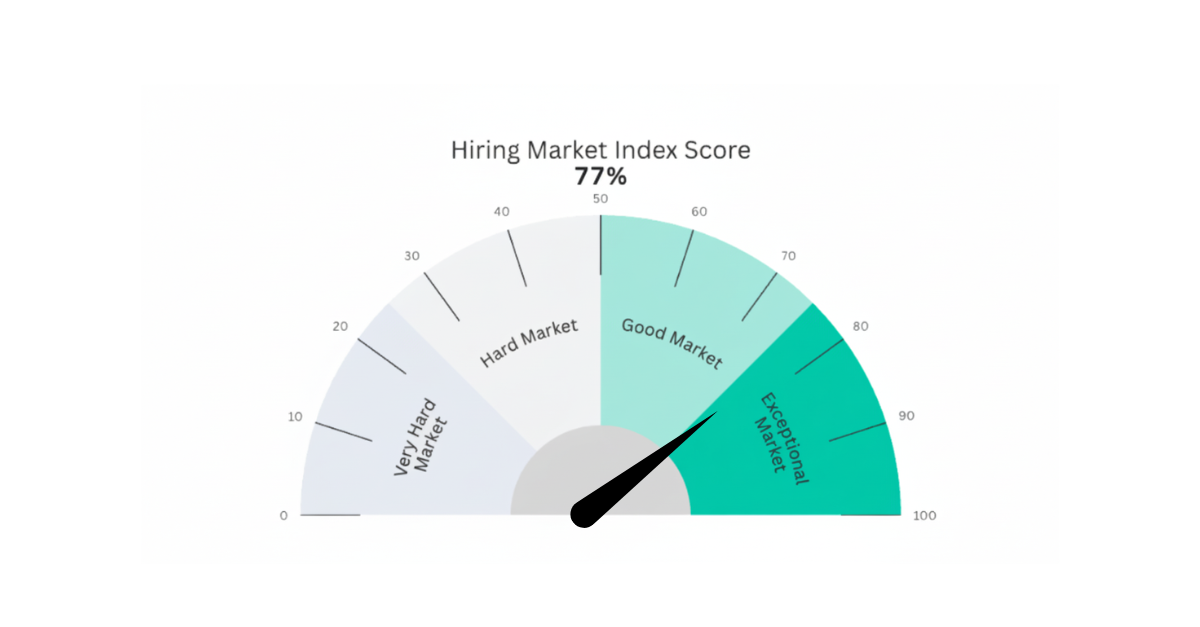
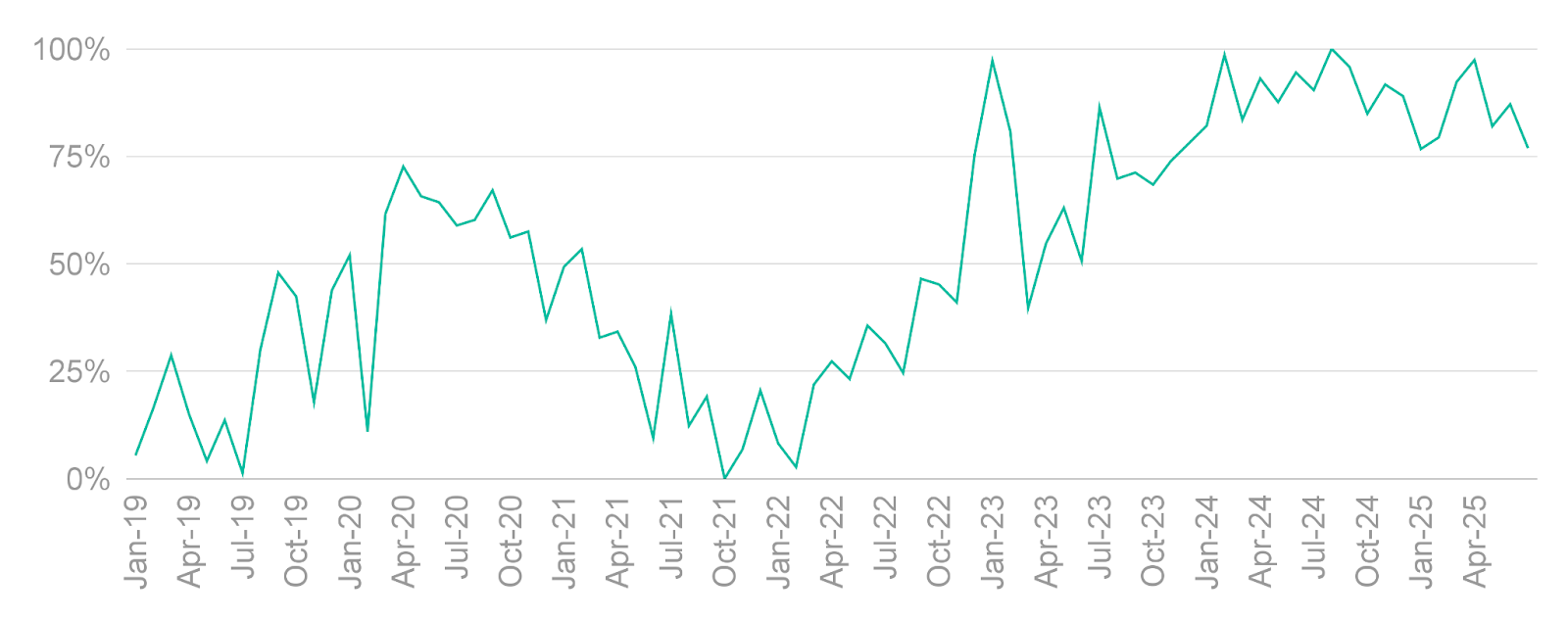
The Talent Index has dropped from 80% last quarter to 77% this quarter. This is considerably below the average over the preceding 12 months of 90, and suggests it is getting harder for companies to hire the talent they need - in other words, demand is increasing as supply decreases. For a point of comparison, it is now at the average level of 2023, where a number of companies were still struggling to hire post COVID and the Great Resignation.
To understand the drivers of this, we are looking into the changes to hiring demand across different company types.
We’ve seen a real strengthening of the hiring market
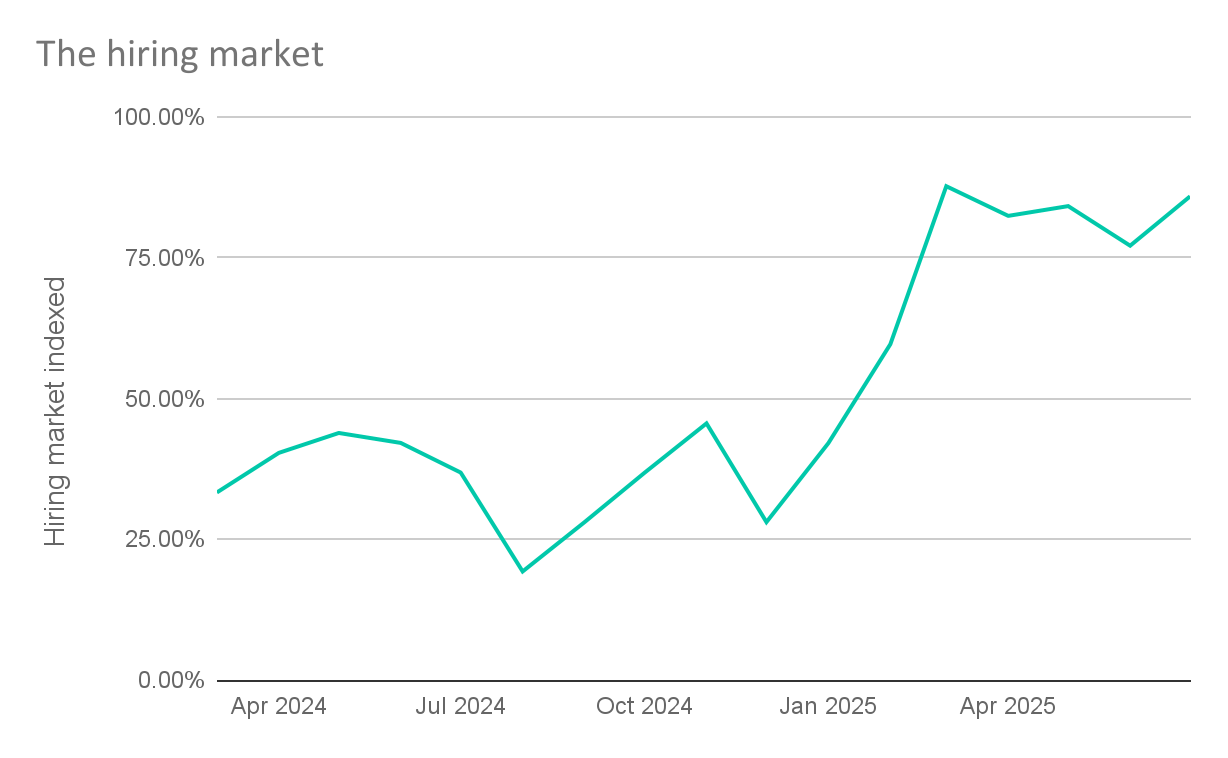
There has been a very clear strengthening in the hiring market since January 2025. We’ve seen hiring activity broadly double over the past 6 months, although this has been very varied by company type.
Whilst Private Equity, Advisory and Scale-ups are fuelling demand in the hiring market, Corporates and Large Enterprises are continue to lag. When we compare the current hiring market with the previous 12 months an even clearer picture emerges: Private Equity funds and portfolio companies have seen sustained growth, whilst hiring across Corporates and Large Enterprises has declined.
Sharp increase in hiring demand for PE-backed companies
There are two primary drivers for hiring demand for PE-backed businesses - the number of new deals and the requirement for portfolio operations support.
New deal activity: There’s been a modest increase in PE deal activity in H1 of this year. This can be shown by EY’s market pulse: there were 275 deals over $100mn vs. 200 in H1 2024. However, this is a long way short of the 400 that were averaged in 2021, and analysing the amount of dry powder in the market, it feels like these are still depressed numbers. Interestingly, based on conversations with funds over the summer period, we’ve noticed a large uptick in deals which we are confident will carry on into H2, so are expecting PE deal activity becoming an increasingly strong driver of hiring demand. This is further supported by EY’s pulse survey, with an overwhelming majority (68%) expecting an uptick in deployment.

Portfolio operations support: The requirement of portfolio operations support is driven by the size of the portfolio and the transformation requirement to achieve the VCP. We believe the increased requirement of support has been the main driver of the increased demand in H1. As funds have held onto portfolio companies for longer, there has been a multiplier effect on the support required. Not only are there more portfolio companies to support, longer holding periods require more frequent chnage to VCPs, often with more hands-on transformation/ operational support. This is against a backdrop of an increased focus on operational improvement, as interest rates have risen and financial leverage has become less effective.
An AI-driven boom for advisory firms? What’s going on
The risks posed by AI to consulting have been widely written about.
It’s clear that AI poses existential threats to the current consulting operating model. At the core of the consulting proposition is synthesising complex data, market intelligence and driving to clear recommendations. All things that AI will be able to do better than humans. It’s not an if; it’s a when.
However, we’ve seen strong growth in hiring for advisory firms. So what’s going on?
Our initial hypothesis was that boutique advisory firms pivoting to focus on AI were growing fast and therefore needing to hire. This would suggest that rather than the advisory segment growing, that it was more a case of people moving from large consulting firms to smaller ones. However, when we ran the numbers, it became clear that hiring demand was coming from both both boutique and large advisory firms.
What this suggests is that the short-term impact of AI on consulting talent has been over-played. It might also indicate another trend at play: Consultancies going through a period of growth as their clients invest in getting to grips with what AI means for them and their operating model. What remains to be seen is if this is a temporary blip, or the future of consulting.
Return of scale-up hiring - AI driven uptick, or return to normal levels?
The scale-up market has been depressed since the 2020-21 VC-driven bubble. The focus has increasingly been on the bottom line, and for many this has meant going into survival mode to elongate runways or drive towards cash-flow positive business models.
There has understandably been a big focus on AI scale-ups, and there is an increasing concern among many that there may be a new bubble forming around AI. But when we look at the hiring demand we’ve seen, it’s been broad and feels like more a return to normal levels.
When we look at the increase in hiring demand, alongside the change in the Talent Index, it’s interesting to see that despite the growth in hiring there is still a lot of supply; the Talent Index remains stubbornly at 94%, well above average in the market. This suggests that this is still a market where there is a lot of talent looking - driven by 2-3 years of depressed hiring.

In Large Enterprises, hiring levels are still low, but for those hiring, it’s hard to find the very best talent
Large Enterprise hiring is trailing well below the growth we’re seeing across Private Equity, Advisory and Scale-ups. Not only is it below the average demand it’s seen over the last 18 months, it’s also reduced in growth over the last three months.
What’s interesting is that this doesn’t mean there’s oversupply in the market. We were expecting to see a very high Talent Index - indicating there’s a lot of talent in the market looking for new roles. However, at just 58%, Large Enterprises and Corporates have the lowest value of any of our different company types. This suggests there is a real attraction challenge - the growth of PE, and to some extent scale-ups, is taking talent away from more traditional routes like joining the Strategy team of a well-recognised, large, global business.
If Private Equity and Scale-ups continue their growth - we foresee this being a hard part of the market to hire in for the foreseeable future. It’s for this reason that we’re starting to see an increase in freelance and interim demand across Large Enterprises.
Is the Freelance Revolution driving more supply in the freelance/ interim market
Whilst the Talent Index has tightened for permanent roles, it appears to be more resilient in the freelance market, where a continued over-supply of talent persists.

We’ve seen broadly consistent demand across freelance and permanent roles on the hiring side, so it feels like there is something a bit more fundamental at play on the supply side. We have written extensively on the freelance revolution that we are witnessing in the market - some of the very best talent choosing to enter the freelance market to have more control over the work they do, and their lifestyle. The more resilient talent index suggests that very strong supply on this side of the market could be the main driver. It might also help explain why we’re seeing the dip in the permanent market.
To find out more about hiring with Movemeon get in touch with our team here.
The return of the “war for talent”? It depends where…
Talent tightens, demand returns: How shifting market dynamics are creating new opportunities — and pressures — across hiring landscapes
This report marks the second instalment of Movemeon’s Quarterly Hiring Analysis — a regular update designed to help hiring managers and candidates stay ahead of the market across Private Equity, VC-backed scale-ups and large Enterprise businesses. Our insights are powered by over 1.8 million data points from the Movemeon platform, giving you a clear picture of how candidate interest and hiring demand are shifting.
At the heart of this analysis is the Movemeon Hiring Index — a scale from 0 to 100 that reflects how attractive the job market is for employers. In short: a higher index means higher candidate interest per role. When the economy slows, candidate supply tends to rise, pushing the index up. When hiring demand picks up and candidate availability falls, the index drops.
To find out more about hiring with Movemeon get in touch with our team here.
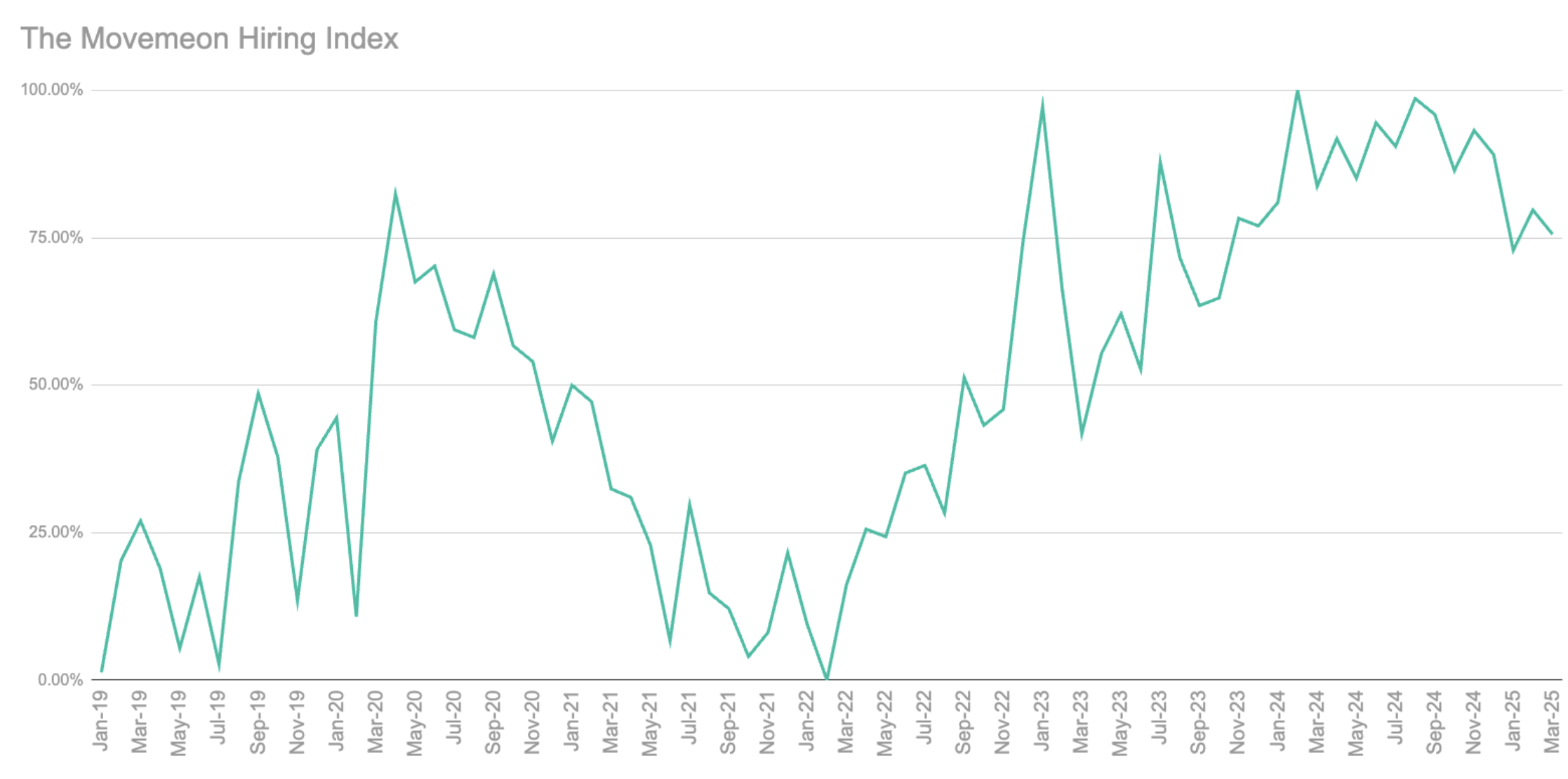
This quarter, we’ve seen a strengthening in the hiring market.
After 6 months in the second half of last year with a value between 90 and 100 (the highest values we’d seen, indicating high interest in new roles), the index dropped to 75 in January and 80 in February.
We look at the drivers of this change, highlighting how a drop in the freelance market index pre-empted a drop in the permanent market index. We then look at how these trends have varied depending upon industry, finding that Private Equity is starting to lose it’s talent edge, just as there has been increased demand for hiring in the market.
We conclude that all the drivers are there for a war for talent, but that this is likely to be localised initially to Private Equity backed-companies where we’re seeing both higher hiring demand coupled with a slight decrease in candidate supply. We forecast this to further expand into consulting and potentially corporates, driven by increased demand and reduced supply respectively.
-
The Movemeon talent index
The Index is designed to give employers a read on the talent market: is it competitive? Are candidates open to new roles? Are certain industries or job types seeing more traction than others?
Below is how the index has changed over the last five years. For context, it's worth understanding who the Movemeon community are:
- It’s global: our 90k members are based across the world, with our main hubs in the UK, France, DACH, the Middle East, APAC and the US
- Everyone has worked in a leading consulting or accounting firm: 45% are ex-McKinsey, BCG and Bain; 30% are leading strategy firms; the remainder are the Big4
- They are future leaders and Board members: consultancies make up six of the top eight "CEO factories" (companies whose alumni become CEOs of the largest businesses. And this isn't constrained to just large businesses, with a disproportionate number of unicorns founded by consulting alumni
-

-
The freelance and permanent markets have broadly mirrored one another, although freelance has moved first and seen more rapid fluctuations
The freelance and interim market has broadly mirrored the permanent one, but tends to shift first — reacting more quickly to changes in business needs and macroeconomic signals. This can be seen by the permanent having a slight lag from the freelance index, as well as often slightly dampened highs and lows.

-
-
When we look at the index at a company level, we can see hiring is the hardest it has been for the past year, especially in consulting and corporates
Candidate interest in consulting and corporate roles is now at a one-year low. These sectors are beginning to feel the effects of tightening supply. In contrast, PE-backed companies — where hiring demand remains strong — are still benefiting from relatively high candidate availability, but that gap is closing thanks to slight increases in interest in start-ups/scale-ups as well as consulting.


Is the war for top talent about to heat up again?
-
The phrase “war for talent” was first coined by McKinsey in the late ’90s and resurfaced in 2022 during the Great Resignation and post-COVID hiring boom. Are we seeing a resurgence?
The answer lies in the balance between:
- Candidate supply (captured by our Hiring Index captures)
- Employer demand (based on volume and growth of roles posted)
What we’re seeing is clear: Q1 2025 was the busiest hiring quarter since early 2022. This suggests that overall demand is returning — and it’s being led by Private Equity.
In fact, PE’s share of total hiring demand has grown significantly over the past two years. As deal volume picks up and portfolio businesses push ahead with transformation plans, the ‘war for talent’ is likely to intensify, albeit localised at first.

-
Whilst we expect this war for talent to be highly localised to Private Equity initially, we are forecasting that it will expand into consulting and corporates over the course of the next year. The expansion into consulting will predominantly be demand led: increased deal flow will result in more consulting work, which will mean more hiring in a slightly dampened market. For corporates the challenge will be supply led: their historic disadvantage in hiring ex-consulting talent compared with PE or consulting has further widened, meaning a small increase in demand will have a big impact.
To find out more about hiring with Movemeon get in touch with our team here.
The most popular career paths after consulting
Consultants often leave due to "up or out" models, lifestyle, and desire to own impact; find out what career paths are the most well-trodden.
Leaving consulting for other industries is more common than staying. Many consultants move on after a few years, whether for career progression, better work-life balance, or the opportunity to take on ownership roles. If you're wondering about jobs after consulting, here’s what you need to know.
Looking for expert coaching to support your career transition? Visit OnUpBeyond for tailored career advice and coaching resources.
Why Do Consultants Leave?
From our discussions with Movemeon users and insights from our jobs board, these are the key reasons consultants transition to new roles:
- Up or out model: The traditional consulting pyramid structure pushes many professionals to leave after a few years.
- Career stepping stone: Many enter consulting with the intention of leaving once they’ve gained skills and built a network.
- Work-life balance: Long hours and frequent travel can make consulting unsustainable in the long run.
- Transferable skills: Consultants develop highly sought-after skills that are valuable across industries, from startups to private equity.
- Desire to execute: Many consultants want to move beyond advising and start executing strategies themselves.
Related Reading
- Post-Consulting Opportunities: What Pays Best?
- How to write a consulting resume - tips from an ex-consultant
Best Jobs After Consulting
Based on over 20,000 applications on Movemeon, here are the top industries for ex-consultants:
1. Corporate & Enterprise
Large companies actively recruit former consultants, often placing them in higher-level roles than their non-consulting peers. The most common functions include:
- Strategy & Transformation (Internal Strategy, Corporate Development)
- Operations & Supply Chain Management
- Growth and Business Development
- Corporate Finance
- Technology & Digital Transformation
Why consultants are a good fit:
- Experience in market research, competitor analysis, and operational improvements translates well into strategy roles.
- Consultants are skilled at navigating cross-functional teams and driving strategic initiatives.
- These roles offer a better work-life balance while still leveraging a consulting background.
Find out more about how to thrive in the corporate environment in our interviews with leaders.
2. Startups & Growth Companies
Startups offer a fast-paced, dynamic environment for consultants looking to apply problem-solving skills in a hands-on way. Ex-consultants often join startups as:
- Founders or Co-Founders
- COOs or Strategy Leads
- Chief of Staff
- Product or Growth Managers
Why consultants are a good fit:
- Consultants thrive in fast-paced, high-growth environments with shifting priorities.
- Experience in scaling operations, business development, and fundraising is highly valuable.
- Ability to identify growth opportunities and operational efficiencies makes them strong startup leaders.
- Exposure to digital transformation projects provides a foundation for tech-driven environments.
Find out what it's like to be a Chief of Staff in our interview with Penfold CoS, Aidan Curran.
3. Freelance & Boutique Consulting
For those who enjoy consulting but want more flexibility, freelancing or starting a boutique firm can be a great path. Benefits include:
- Autonomy over projects
- Higher earning potential per engagement
- Ability to specialise in a niche industry
Why consultants are a good fit:
- Broad expertise across industries makes consultants versatile for short-term strategic projects.
- Companies seek independent consultants for executive-level advisory and transformation work.
- Freelancing provides a flexible career path with strong earning potential.
4. Private Equity & Venture Capital
Many ex-consultants transition into private equity (PE) or venture capital (VC) due to their strong financial and strategic skills. Typical roles include:
- Investment Associate or Principal
- Portfolio Operations Manager
- Strategy or Due Diligence Lead
Why consultants are a good fit:
- Consultants excel at financial modeling, due diligence, and market analysis, all essential in investment decisions.
- Strong experience working with C-suite executives makes them well-suited for portfolio company strategy.
- Ability to structure ambiguous problems and make data-driven recommendations aligns with PE/VC deal-making.
Common Challenges When Leaving Consulting
1. Adapting to Corporate Hierarchies
Consultants used to flat structures may find corporate bureaucracy challenging. To navigate this, they should focus on building internal relationships, understanding decision-making processes, and adapting to longer project timelines. Seeking mentors within the organisation and leveraging their problem-solving skills to improve efficiency can also help ease the transition.
2. Adjusting to Execution-Oriented Roles
Unlike consulting, where advising is the focus, industry roles require direct ownership and execution. Former consultants can ease this transition by:
- Prioritising hands-on experience early
- Learning operational intricacies of their new industry
- Collaborating closely with teams to drive outcomes
3. Managing Work-Life Balance
Some industries, like startups and PE, can be as demanding as consulting, requiring careful career planning. Former consultants should set clear work boundaries and seek roles that align with their lifestyle goals.
FAQs
What functions within big corporates attract ex-consultants the most?
- Internal strategy, corporate development, operations, product management, and digital transformation teams commonly hire consultants.
- The choice depends on personal interests, industry trends, and networking.
What’s the biggest difference between consulting and startups?
- Consulting firms are structured and process-driven, while startups are dynamic and fast-moving.
- Consultants transitioning to startups should develop technical skills, embrace ambiguity, and be prepared for hands-on work.
How do I choose the right career path?
- What energises you? Do you prefer structured environments (corporate strategy) or high-risk, high-reward roles (startups/VC)?
- Do you want financial stability or flexibility? PE and corporate roles offer strong salaries, while freelancing provides greater independence.
- What industries excite you? Consider which sectors align with your interests and skill set.
Check out Movemeon member, Jonny's story of leaving consulting, joining a startup and going through IPO.
Find Your Next Role
Looking for your next step after consulting? Explore current opportunities on Movemeon.com.
Build Your Career with Movemeon:
- Solve a business challenge – Hire a Movemeon professional
- Advance your career – Coaching and courses for ex-consultants
- Join 40,000+ followers – Get insights on careers after consulting from our Co-Founder, Rich

Consulting careers - 11 insights on why people leave consulting & what they leave for
Our LinkedIn polls reveal consultants often leave for better work-life balance, targeting P&L roles or startups.
Every fortnight or so I run a poll on my LinkedIn. Given my area of expertise, the polls explore consulting careers (in and after consulting) - why people start, why they leave and what they leave for. Typically 600-1,200 people join in (a pretty decent sample size) and overall, these polls have been viewed by over 500,000 people with more than 15,000 participants.
Why do I do these polls about post consulting careers?
Well, unlike many more linear careers, most consulting careers involve leaving consulting. So for a consultant, plotting a career is a bit of a minefield. And if you're trying to hire consulting-trained professionals, how best to attract them can be equally mind-boggling. So, I find the results of these polls particularly enlightening. Why?
- For employers (HR and hiring managers inside and outside of consulting firms), they unlock the secret sauce in retaining or attracting consulting-trained professionals (into roles like strategy, transformation, project management, commercial development, chief of staff etc) by shining a light on how most people think about their consulting careers.
- For consultants, they shed light on how others in the consulting industry feel and behave and accordingly, give you clear references for plotting your consulting career - either in or away from consulting itself.
In this article, I've collated 11 recent polls into 3 topics:
- Firstly: "Starting a consulting career - why?"
- Secondly: "Leaving consulting - why?"
- And finally: "Leaving consulting - what for?"
So, let's get into the data...
Starting a consulting career - why?
Summary: simply put, the majority of people who start a consulting career...
- Don't regret the time spent in consulting (83%);
- Didn't join intending for a lifelong consulting career (88%) / did join as a means to an end (skills, network);
- Don't regret leaving consulting (93%) and;
- Would have been more likely to stay / would return if pay, progression and, especially, working hours improved (80%).
Consultants & former consultants - do you regret the time you spent / are spending in consulting?
Results: (link to data)

When you joined a consulting firm, was it as a "means to an end", or did you envisage a whole career in a consulting firm?
Results below (link to original data)

Do you regret leaving consulting?
Results below (link to original data)

What's the main reason you'd consider switching consulting firms / moving back to consulting?
Results below (link to original data)

Leaving consulting - why?
Summary: simply put, the majority of people leave a consulting career (i.e, leave a permanent role in a consulting firm) in order to...
- Improve their work-life balance / working hours which has..,.
- Deteriorated further during / thanks to covid
What's the main reason you left / would consider leaving consulting?
Results below (link to original data)

Leaving consulting - was work-life balance the main reason (or would it be, if you were to leave in the future)?
Results below (link to original data)

Consultants - how has your work-life balance changed through covid? I'm working..
Results below (link to original data)

Leaving consulting - what for?
Summary: simply put, consultants transition their careers out of consulting along the following lines...
- Scale-ups are the most sought-after company type, but the full range of organisations is appealing (the consulting skill set is extremely transferable so most options are open)
- Most consultants want their career to end up in a P&L or operational leadership role (CEO/COO track) - the most successful companies at hiring ex-consulting talent can show a path to these (typically using strategy / transformation teams as a stepping stone / leadership talent pipeline)
- Freelance consulting is becoming increasingly popular
- Current & former consultants want more data when it comes to choosing post-consulting careers, especially regarding compensation and work-life balance. We're on a mission to provide that - check it out here.
Consultants - what company type do you find most appealing (as a post consulting home)?
Results below (link to original data)

Current & former consultants - what job type would you most like your career to lead to (or for more senior folk, which has it lead to)?
Results below (link to original data)

Freelancing - Are you more of less likely than 12 months ago to consider doing some freelance work?
Results below (link to original data)

Would it be helpful to know which post-consulting careers have the best pay, working hours & job satisfaction?
Results below (link to original data)

Popular Resources
If you're trying to assess your options for a post-consulting career, here are some popular resources:

Private Equity Firms: what questions should you ask?

Subscribe to our newsletter to receive our exclusive insights and career tips straight into your inbox every month:
Given the intense competition, receiving an offer to join a private equity firm is quite a significant achievement, and the temptation to accept the offer as soon as you receive it without having done any proper due diligence is thus huge. Overlooking this crucial step of the job-hunting process can lead to serious disappointment in the future and the fast-moving private equity industry is no exception in that respect.
Below are 29 questions that you should ask to ensure you make an enlightened decision.
Fund strategy & positioning
- How many funds and/or product lines does the firm operate?
More and more Private equity firms are diversifying their activity to include hedge funds (i.e. public market investing) or debt vehicles. Each business line requires a particular approach and investment strategy. As a consequence, this can give you a feel for the variety of the work (in terms of investment type) that you will face. Beware though; like any organisation, a firm that spreads across too many lines is likely to feel a bit disorganised. - What kind of assets does the company invest in? There are primarily two types of assets in private equity: companies and infrastructure. Again, referring to the first post of my series, the nature of the work differs between those two environments.
- What is the fund's investment strategy? Each fund will more or less strictly position itself within a spectrum going from "distressed" (i.e. underperforming and close to bankruptcy) to "glamorous" or "high-growth" assets. The price paid but more importantly, the type of work and situations you will encounter will depend on the strategy. In a distressed fund, you should expect to be involved in heavy restructuring and cost-cutting programs. In a growth context, you will spend much of your time finding ways to develop the business' top-line.
- What is the size of the fund? What is the fund's sweet spot in terms of enterprise value or equity cheque? As mentioned in the first post of this series, the type of work you will do will significantly differ if you join a small-cap (<$250m roughly), mid-cap ($250m to $1bn) or large-cap fund. The equity cheque (i.e. the amount the fund itself invests in a given company) is intimately linked to the fund size since a fund will typically make between 8 and 20 investments as well as to the enterprise value sweet spot since roughly 50% of the acquisition price will be paid by raising debt.
- Which stage of the company's lifecycle does the fund invest in? As mentioned in an earlier post, private equity funds as a whole cover the entire company lifecycle, from birth (seed or VC) to maturity (LBO). You should expect VCs to be more "gut-feel" based whereas LBOs require deeper due diligence and involve a significant amount of financial structuring (absent in VCs which very often can only raise equity).
- Where is the fund present? Where does the fund invest? On one hand, a global fund will limit country-specific risk exposure. On the other hand, the more global the fund, the more you will have to travel - especially if the office network is relatively loose, e.g. only one office to cover the whole of Europe.
Practically speaking, the geographical remit is defined in two ways. First, investors sign a term sheet that formally defines the areas where the General Partners (or "GPs", i.e. the members of the private equity firm) can and cannot invest. Second, and more importantly, GPs have their own "comfort zone", which is often a subset of the theoretically authorised area. This question is important for you as it will determine the amount of travel you can expect from this job as well as the extent of the cultural gap you may face when meeting with management teams. - What kind of industries does the fund invest in? The majority of funds are "sector-agnostic" and will invest indifferently in all industries. Some (most often smaller ones) have specialised in one or a handful of industries, typically Retail or Tech.
- Does the fund do minority and/or majority deals? By definition, if the fund only does minority deals it will rarely be able to exert full control over the company and therefore you should expect more time to be spent on the due diligence - to ensure that the business "as it is" is a good one. This situation is relatively rare in private equity as opposed to hedge funds
- Is the fund committed or raised on a deal-by-deal basis? A committed fund will offer more stability and less dependence on market conditions. Furthermore, a firm seeking investor funding on a deal-by-deal basis may feel the pressure to invest regularly to keep momentum with investors, even if the climate or opportunities are not optimal.
Track record
- When did the firm raise funds for the last time? This question will give you a feel for the type of work you will be doing. If the fund is recent (less than 2-3 years), you should expect to spend most of your time sourcing deals and executing investments for this new fund. If the fund is older, portfolio management ("harvesting") should take a growing share of your bandwidth.
- Has the firm raised more than one fund? First-time funds can appear attractive because of their entrepreneurial nature and their subsequent potential. If the first fund is successful the second will be larger and the team will grow, potentially creating "upward gaps". However, growth in private equity is more often achieved through external hiring rather than internal promotion, so you should always consider career upside potential with a bit of caution.
- How does the actual fundraising amount compare with the fundraising target? In the current environment, with liquidity being more than abundant, a fund not meeting its fundraising target has run out of favour with investors and such momentum is very difficult to reverse, so I advise you to stay away. Some funds exceed their target, but many will stop when they reach it in order not to overstretch their teams.
- How does the latest actual fundraising amount compare with previous actuals? Fund growth is a clear indicator of momentum and expected team size evolution. In particular, if the firm has been raising a decreasing amount of money, it means investors are less and less convinced and, unless the firm manages to come up with a series of mind-blowing investments, you should expect the trend to continue and therefore the team to keep shrinking.
- How have previous funds performed? Given the illiquid and long-term nature of private equity (funds have a 10-year lifespan), it takes time for struggling funds to be entirely wiped out of the market. An early indicator consists of benchmarking the latest funds' IRR. If those IRRs are disappointing, it will only be a matter of time before investors are free to switch their funds to another destination.
- Has the fund made recent investments? A fund may decide to slow or fasten its investment pace depending on market conditions. However, a fund that has not put any money to work over the last 18 months is more likely struggling to source interesting deals and this should raise a flag.
- How fragmented is the Limited Partner (or "LPs", i.e. investor) base? I am always concerned with "one-LP" funds where one investor has the practical right of life and death over the fund. I believe this not only creates uncertainty about the future of the fund in case of headwinds (both at fund and investor level) but also there is a risk of seeing the LP interfering with investment decisions (creating useless friction).
Operating model
- How large is the firm globally? In London? A classic question. All funds started with very small teams and an entrepreneurial spirit, but some have grown so much that this early flavour may have disappeared quite significantly.
- Are there other offices? If so, where? Where are the headquarters? What is the role of London? The worst case for you is to join a US-based fund which considers London (and Europe in general) as non-core to their strategy and as such does not give you a lot of consideration and does not involve you in the investment decisions. Fortunately, London is a strong financial place and such situations are rare (at least rarer than if you were applying in Paris or Madrid).
- Are there investment committee members based in London? Building on the previous question, a negative answer will likely indicate that the office has been primarily set up to perform local sourcing and execute deals when told by the headquarters, which reduces the amount of autonomy you will enjoy and subsequently the interest of the job.
- How is staffing decided? Are there teams dedicated to particular geographies/industries/product lines? This question will help you assess whether you are going to develop particular expertise or whether you are going to remain quite a generalist. Both approaches have their own pluses and minuses, but in any case, you would like to ensure that your prospective employer does not plan to specialise you in an industry you do not fancy.
- Is there a dedicated operations team? If so, how large is it, what are its remit and background? If an operations team exists, you should expect to be consequently less involved in commercial and operational aspects of the due diligence and/or portfolio management.
People & culture
- Where do people come from? PE professionals typically come from a mix of investment banking, consulting, accountancy/Transaction Services and Corporate. The way of approaching investments is influenced by this background.
- How would you define the fund's culture? Some funds have an American culture, which as a Frenchman I would define as direct and energetic, others have a more British inclination, softer and possibly more political. This does not mean that one is generally better than the other but you need to make sure that the culture fits your way of working and interacting with others.
- How many (net) additions to the team have there been in the last 24 months? In the investment team alone? The "fund size evolution" question, should help you assess the momentum the firm is benefiting from. A shrinking team is almost always a bad sign - the fund is losing momentum or struggling to attract talents to fill the gaps.
- How many people have left the fund over the last 24 months? If you exclude "defined-length" contracts (such as the Associates program), churn should be low: jobs in private equity are rare, and people tend to stick to their seats if their role is interesting and if they believe the firm has decent future prospects. If churn is high (say more than 30% of the firm was renewed over the last 2 years), at least one of the two previously mentioned conditions was broken.
- Who are the senior sponsors of the fund? Each private equity fund is chaired and/or advised by highly respected individuals within the investment industry. Such personalities act as a stamp of approval and tend to facilitate fundraising. Conversely, you should proceed carefully with not or weakly endorsed funds.
- Can I meet the rest of the team? Private equity firms are small companies and the personal fit is even more important than in consulting - imagine that you will spend many years working with the same people on a series of projects. I thus encourage you to meet as many team members as possible to assess this fit.
Compensation and career path
- Who has access to carried interest? How is carried interest computed? Carried interest (i.e. the performance fee that general partners receive when their investments generate an IRR in excess of a certain threshold) amounts to a very significant share of your compensation, especially at senior level. Always useful to know when you will be entitled to receive a share of the pie. Most often carried interest is computed and shared at fund level; however, a few funds (e.g. CVC Capital Partners) are famous for their "deal-by-deal carry structure".
- What is the typical career path? You need to understand whether there is a "glass ceiling" that you will never be able to go through. Many US funds have formal fixed-term Associate programs which imply that you will need to leave after 2-3 years. Other funds may encourage investment professionals to leave once they reach a given tenure if there is no room for additional senior managers or partners. In any case, you should feel free to ask for specific examples.
FAQs
- What are the potential drawbacks or challenges associated with joining a private equity fund that has recently raised funds (less than 2-3 years old), and how might the job responsibilities differ in comparison to joining a more established fund?
Joining a private equity fund that has recently raised funds (less than 2-3 years old) may involve a greater emphasis on sourcing deals and executing investments for the new fund. This could mean a higher focus on building the fund's portfolio and establishing its presence in the market. The nature of the work may lean more towards the early stages of fund management, with portfolio management gaining prominence as the fund matures over time. - How can I assess the cultural fit within a private equity firm, especially considering the different cultural inclinations between American and British-founded funds mentioned in the post?
Assessing cultural fit within a private equity firm involves understanding the underlying cultural dynamics, such as American or British inclinations. For instance, American cultures might be characterized as direct and energetic, while British cultures may be perceived as softer and possibly more political. You should consider your own working style and preferences to ensure alignment with the cultural nuances of the firm, as this can significantly impact job satisfaction and collaboration. - In the context of private equity fund size and fundraising, what are the implications for my career progression and job responsibilities based on whether the fund exceeds its fundraising target, stops at the target, or falls short of the target?
The fundraising performance of a private equity fund can influence career progression and job responsibilities. If a fund exceeds its fundraising target, it might indicate strong investor confidence and potential team growth, creating upward career opportunities. Conversely, a fund that falls short of its target may face challenges, potentially leading to a shrinking team. Understanding the fund's fundraising success provides valuable insights into its momentum and the trajectory of the team, helping candidates make informed decisions about their long-term career prospects.
Continue reading the private equity series:
- 12 usual activities of a private equity associate
- The double-edged sword of working in private equity
- 9 principles to help you break in
- All private equity funds were not created equal
- When to look for the boarding gate?
Subscribe to our newsletter below to receive our exclusive insights and career tips straight into your inbox every month:
Explore jobs at Private Equity Firms on our free platform - it takes 2 minutes to sign up here
.jpg)
.png)
Advisory hiring is surging despite AI’s disruption: large firms and boutiques see rising demand, while clients seek guidance on integrating AI and redefining workforces.
The death of consulting? Not according to the hiring data
It’s clear that AI poses existential threats to the current consulting operating model. At the core of the consulting proposition is synthesising complex data, market intelligence and driving to clear recommendations. All things that AI will be able to do better than humans. It’s not an if; it’s a when.
Our quarterly market index highlights how hiring trends are evolving, with a particular focus on the near-term outlook for advisory roles.”
In our September analysis, we were very surprised to see that Advisory businesses hiring demand is outstripping that we’re seeing in Large Enterprises. Interestingly, it is also outstripping the demand we’re seeing in scale-ups (a market you’d expect to be seeing a boom from AI).
So what’s going on?
The risks posed to consulting by AI are widely discussed, and for good reason: At the heart of the consulting proposition lies the ability to synthesise complex data, interpret market intelligence and drive towards clear, actionable recommendations, precisely the areas where AI is advancing fastest. It’s not a question of if AI can outperform humans in these tasks, but when.
This advancement raises existential questions about the industry’s current operating model, particularly for leaders thinking about project staffing, protecting margins, and developing the next generation of partners. The immediate concern for many is how this is impacting talent in, or looking to join consulting firms- why hire more people if AI can do the same things more cheaply?
But this isn’t what we’re seeing. In fact, hiring demand is up within consulting.
Despite the noise around disruption, our data shows a very different short-term story. Hiring demand across the advisory sector has been rising sharply compared to last year. Initially, we hypothesised that this growth was concentrated in boutique firms, smaller, more agile players pivoting to build AI-focused propositions. If true, this would suggest not a real increase in overall demand, but rather a talent migration away from large consulting firms into specialist boutiques.
However, the numbers told a different story. Hiring demand has risen by 21 percentage points in large firms, and by a more modest but still significant 9 percentage points in boutiques. In other words, demand is not confined to specialists, it’s happening across the board.
Why? Clients are grappling with the same questions about the impact of AI
This trend points to a critical dynamic: The immediate impact of AI on consulting has been overstated. For many firms, the boom is being fuelled by client demand for guidance on exactly the issues senior leaders are worrying about themselves:
• How to integrate AI into core operations.
• What it means for workforce design and resourcing.
• Where value creation opportunities lie in an AI-enabled world.
Implications for consulting leaders
This raises three important considerations for leaders in the consulting industry:
1. Delivery models are shifting, but they’re not collapsing
While AI will automate traditional “analyst tasks,” the near-term demand is for advisory capacity, client guidance, and operating model design. This creates space for firms to rethink the shape and scale of delivery teams, rather than fearing their wholesale replacement.
2. Margins are still defensible, but only when value add is clear
Clients are willing to invest in external expertise, but expectations are shifting. Firms must be ready to demonstrate the distinctive value of human insight alongside AI-driven efficiency, ensuring pricing models reflect both. We see this playing out in the mandates we see from consulting clients, most of whom are looking for deep expertise in a specific functional or industry area, not general capacity augmentation.
3. Talent development cannot be an afterthought
If the AI evolution continues as expected, the real long-term risk is not staffing cuts, it’s a potential skills gap. If AI erodes the traditional training ground of junior consultants, firms will need to ensure the next generation develops judgement, nuanced thinking, client relationship development skills and leadership capability.
Is this a temporary uptick, or a longer term hiring trend?
The jury’s still out on whether this demand surge is a short-lived reaction to AI uncertainty or the beginning of a new growth curve for consulting. But one thing is clear, in the short term, the consulting sector is experiencing a boom, not a bust.
Consulting leaders should resist the temptation to over-correct. Instead, they should focus on building hybrid models, protecting margins through clear value articulation, and reimagining training for future leaders.
What’s certain is that AI will reshape consulting, but for now it’s fuelling demand, not reducing it.
In this article, ou co-founder Rich breaks down 8 simple, practical tips to reconnect with your network, build trust, and stay front of mind for opportunities, all while giving as much as you gain.
Most of us dread “networking”, the awkward small talk, the forced introductions, the feeling of wanting to disappear under the canapé table. But Movemeon’s co-founder, Rich, argues that this isn’t networking at all. Find his advice below!
Picture the scene.
You've just arrived at a corporate venue. You've picked up your name badge. You're thrust into a room full of people you don't know.
You feel obliged to try & scurry around introducing yourself to folks you'll probably never see again. If you're honest with yourself, you're tempted to hide under the canapé table. And you'll definitely find an excuse for an early exit.
This is what most people picture when we use the term "networking". And it understandably makes most of us want to run a mile.
What's more, it's almost totally ineffective. These aren't people who know you. So how can they trust you or advocate for you?
So what is a better definition?
"Keeping in touch with people who know your capabilities & will advocate for you."
Typically these are people you've worked or partnered with in the past. Probably peers or former bosses. People who know you & like you. Or they might be people that those people have introduced you to with their backing.
When you reframe networking like this, your shoulders relax. In fact, you can picture that re-connecting with these people might actually be quite enjoyable.
It's the network of their network where most opportunity lies.
Don't get me wrong. If you keep up with this group, it's not uncommon that one of them will give you a call at some point and ask you to join their team. (The timing might not be right. The opportunity might not be right. But it's always great to be asked).
Much more likely is that they'll think of you when someone in their network is chatting to them. It could be that their friend wants an expert point of view. Or a supplier recommendation. Or that they're building a new team and asking for suggestions. Either way, you'll be front of mind for an introduction.
So what are my 8 tips for re-booting your networking and making it both sustainable & impactful?
- Write a short list. 15-30 people who know your capabilities (ideally peers or seniors).
- Put them in a spreadsheet / Trello board / other type of simple tracker.
- Don't be scared to get back in touch with people you've lost touch with - you'll be surprised just how many are happy to hear from you.
- Make a simple, realistic goal. E.g, meet 1 person per month (assuming you're in a full time job; stretch this target if you're actively job seeking).
- Don't be transactional. This is about building trusted relationships.
- Do be intentional. People who know & trust you are happy advise or support you.
- Be resilient & systematic. If they didn't reply to your first message, follow up 1 week later (it's not because they dislike you; it's because they're busy & forgot to email back).
- Give as well as take. Make thoughtful connections for these people. And lean into people trying to network with you. Remember how you feel about that person who is only in touch with you when they want something (we all know one). Don't be that person. Instead, "pay it forward" - good karma quickly comes around.
Implement these 8 simple tactics to make networking easy, enjoyable & accelerate your career.
About Rich and how you can work together
Rich started his career at McKinsey before working as a freelance consultant alongside co-founding Movemeon. Over 15 years he's helped over 5,000 organisations to hire - organisations of all sizes in all industries, globally - and developed a unique overview of what works to build successful, happy careers right up to CEO level.
He has always given advice via LinkedIn message to anyone who's asked for it. And in 2025 - encouraged by his network - he formalised this through the creation of OnUpBeyond .
The 2025 pilot of his career advisory sessions was massively oversubscribed, despite a price point in the thousands 000's. Those who managed to grab a place consistently reviewed the experience as 5*.
In July 2025, he relaunched his support in a truly accessible way via The Career Momentum Hour.
- Ask your questions for expert advice tailored to you.
- Weekly advisory sessions - listen in live or catchup in your own time via recordings.
- Regular senior guest speakers from CEOs, to Investment Directors to startup Founders to Exec Search bosses.
- Peer mentorship - your champion & trusted sounding board.
Hiring demand surges, talent supply shrinks: Inside Q2’s shifting job market where Private Equity booms, advisory hiring accelerates, scale-ups rebound, and corporates face mounting pressure to compete
Q2 market index reveals shifting dynamics in talent demand
Hiring demand for permanent roles is at its highest we’ve seen for 18 months. We saw an initial strengthening in the market last quarter, but expected this to have dropped given the macroeconomic environment and the impact of tariffs.
However, after a small initial dip in May, the hiring market has continued to grow, reaching its 18-month peak in Q2 2025. As the hiring market has strengthened, the talent index (measuring the supply of great talent on the market) has started to drop. Between Q1 2024 and Q2 2025, the market index averaged at an all time high of 90, before dropping to 75 in July 2025. This is only slightly above the average for 2023 (70), when companies were still struggling to hire post COVID and the Great Resignation.
In this article we look at how different types of companies are being affected by these broader trends. We find that Private Equity is seeing a boom in demand for talent, driven by an increase in deals and an increased focus on operational improvement across ever larger portfolios. We were also surprised to see, despite the coverage that AI is already disrupting the advisory market, that there has been strong growth in hiring across consulting firms.
Finally, we look at the different dynamics of the freelance and permanent markets: Whilst the permanent market has definitely tightened, with visibly less supply, freelance is still a high supply market for talent. We hypothesise that this is more driven by the broader freelance revolution, and a sharp increase in freelancers/ interims available who have chosen to freelance for more control over their work life (which projects they do; hours worked etc.). This might also be contributing to the righter permanent market.
The Movemeon talent index
The Index is designed to give employers a read on the talent market: is it competitive? Are candidates open to new roles? Are certain industries or job types seeing more traction than others?
Below is how the index has changed over the last five years. For context, it's worth understanding the Movemeon community:
- It’s global: our 90k members are based across the world, with our main hubs in the UK, France, DACH, the Middle East, APAC and the US
- Everyone has worked in a leading consulting or accounting firm: 45% are ex-McKinsey, BCG and Bain; 30% are leading strategy firms; the remainder are the Big4
- They are future leaders and Board members: consultancies make up six of the top eight "CEO factories" (companies whose alumni become CEOs of the largest businesses). And this isn't constrained to just large businesses, with a disproportionate number of unicorns founded by consulting alumni
In terms of interpreting the numbers:
- 0-25: a very hard market to hire in. Focus on retention, as replacing people is going to be hard.
- 25-50: a hard market to hire in. Be proactive and start talent pipelining for key positions.
- 50-75: a good market to hire in. Start looking to take advantage of the market, and strengthen key positions.
- 75-100: an exceptional market to hire in. Look to bring in exceptional talent that you’ll only get a few chances to snap up.
The Talent Index has dropped from 80% last quarter to 77% this quarter. This is considerably below the average over the preceding 12 months of 90, and suggests it is getting harder for companies to hire the talent they need - in other words, demand is increasing as supply decreases. For a point of comparison, it is now at the average level of 2023, where a number of companies were still struggling to hire post COVID and the Great Resignation.
To understand the drivers of this, we are looking into the changes to hiring demand across different company types.
We’ve seen a real strengthening of the hiring market
There has been a very clear strengthening in the hiring market since January 2025. We’ve seen hiring activity broadly double over the past 6 months, although this has been very varied by company type.
Whilst Private Equity, Advisory and Scale-ups are fuelling demand in the hiring market, Corporates and Large Enterprises are continue to lag. When we compare the current hiring market with the previous 12 months an even clearer picture emerges: Private Equity funds and portfolio companies have seen sustained growth, whilst hiring across Corporates and Large Enterprises has declined.
Sharp increase in hiring demand for PE-backed companies
There are two primary drivers for hiring demand for PE-backed businesses - the number of new deals and the requirement for portfolio operations support.
New deal activity: There’s been a modest increase in PE deal activity in H1 of this year. This can be shown by EY’s market pulse: there were 275 deals over $100mn vs. 200 in H1 2024. However, this is a long way short of the 400 that were averaged in 2021, and analysing the amount of dry powder in the market, it feels like these are still depressed numbers. Interestingly, based on conversations with funds over the summer period, we’ve noticed a large uptick in deals which we are confident will carry on into H2, so are expecting PE deal activity becoming an increasingly strong driver of hiring demand. This is further supported by EY’s pulse survey, with an overwhelming majority (68%) expecting an uptick in deployment.
Portfolio operations support: The requirement of portfolio operations support is driven by the size of the portfolio and the transformation requirement to achieve the VCP. We believe the increased requirement of support has been the main driver of the increased demand in H1. As funds have held onto portfolio companies for longer, there has been a multiplier effect on the support required. Not only are there more portfolio companies to support, longer holding periods require more frequent chnage to VCPs, often with more hands-on transformation/ operational support. This is against a backdrop of an increased focus on operational improvement, as interest rates have risen and financial leverage has become less effective.
An AI-driven boom for advisory firms? What’s going on
The risks posed by AI to consulting have been widely written about.
It’s clear that AI poses existential threats to the current consulting operating model. At the core of the consulting proposition is synthesising complex data, market intelligence and driving to clear recommendations. All things that AI will be able to do better than humans. It’s not an if; it’s a when.
However, we’ve seen strong growth in hiring for advisory firms. So what’s going on?
Our initial hypothesis was that boutique advisory firms pivoting to focus on AI were growing fast and therefore needing to hire. This would suggest that rather than the advisory segment growing, that it was more a case of people moving from large consulting firms to smaller ones. However, when we ran the numbers, it became clear that hiring demand was coming from both both boutique and large advisory firms.
What this suggests is that the short-term impact of AI on consulting talent has been over-played. It might also indicate another trend at play: Consultancies going through a period of growth as their clients invest in getting to grips with what AI means for them and their operating model. What remains to be seen is if this is a temporary blip, or the future of consulting.
Return of scale-up hiring - AI driven uptick, or return to normal levels?
The scale-up market has been depressed since the 2020-21 VC-driven bubble. The focus has increasingly been on the bottom line, and for many this has meant going into survival mode to elongate runways or drive towards cash-flow positive business models.
There has understandably been a big focus on AI scale-ups, and there is an increasing concern among many that there may be a new bubble forming around AI. But when we look at the hiring demand we’ve seen, it’s been broad and feels like more a return to normal levels.
When we look at the increase in hiring demand, alongside the change in the Talent Index, it’s interesting to see that despite the growth in hiring there is still a lot of supply; the Talent Index remains stubbornly at 94%, well above average in the market. This suggests that this is still a market where there is a lot of talent looking - driven by 2-3 years of depressed hiring.
In Large Enterprises, hiring levels are still low, but for those hiring, it’s hard to find the very best talent
Large Enterprise hiring is trailing well below the growth we’re seeing across Private Equity, Advisory and Scale-ups. Not only is it below the average demand it’s seen over the last 18 months, it’s also reduced in growth over the last three months.
What’s interesting is that this doesn’t mean there’s oversupply in the market. We were expecting to see a very high Talent Index - indicating there’s a lot of talent in the market looking for new roles. However, at just 58%, Large Enterprises and Corporates have the lowest value of any of our different company types. This suggests there is a real attraction challenge - the growth of PE, and to some extent scale-ups, is taking talent away from more traditional routes like joining the Strategy team of a well-recognised, large, global business.
If Private Equity and Scale-ups continue their growth - we foresee this being a hard part of the market to hire in for the foreseeable future. It’s for this reason that we’re starting to see an increase in freelance and interim demand across Large Enterprises.
Is the Freelance Revolution driving more supply in the freelance/ interim market
Whilst the Talent Index has tightened for permanent roles, it appears to be more resilient in the freelance market, where a continued over-supply of talent persists.
We’ve seen broadly consistent demand across freelance and permanent roles on the hiring side, so it feels like there is something a bit more fundamental at play on the supply side. We have written extensively on the freelance revolution that we are witnessing in the market - some of the very best talent choosing to enter the freelance market to have more control over the work they do, and their lifestyle. The more resilient talent index suggests that very strong supply on this side of the market could be the main driver. It might also help explain why we’re seeing the dip in the permanent market.
To find out more about hiring with Movemeon get in touch with our team here.
Talent tightens, demand returns: How shifting market dynamics are creating new opportunities — and pressures — across hiring landscapes
This report marks the second instalment of Movemeon’s Quarterly Hiring Analysis — a regular update designed to help hiring managers and candidates stay ahead of the market across Private Equity, VC-backed scale-ups and large Enterprise businesses. Our insights are powered by over 1.8 million data points from the Movemeon platform, giving you a clear picture of how candidate interest and hiring demand are shifting.
At the heart of this analysis is the Movemeon Hiring Index — a scale from 0 to 100 that reflects how attractive the job market is for employers. In short: a higher index means higher candidate interest per role. When the economy slows, candidate supply tends to rise, pushing the index up. When hiring demand picks up and candidate availability falls, the index drops.
To find out more about hiring with Movemeon get in touch with our team here.
This quarter, we’ve seen a strengthening in the hiring market.
After 6 months in the second half of last year with a value between 90 and 100 (the highest values we’d seen, indicating high interest in new roles), the index dropped to 75 in January and 80 in February.
We look at the drivers of this change, highlighting how a drop in the freelance market index pre-empted a drop in the permanent market index. We then look at how these trends have varied depending upon industry, finding that Private Equity is starting to lose it’s talent edge, just as there has been increased demand for hiring in the market.
We conclude that all the drivers are there for a war for talent, but that this is likely to be localised initially to Private Equity backed-companies where we’re seeing both higher hiring demand coupled with a slight decrease in candidate supply. We forecast this to further expand into consulting and potentially corporates, driven by increased demand and reduced supply respectively.
-
The Movemeon talent index
The Index is designed to give employers a read on the talent market: is it competitive? Are candidates open to new roles? Are certain industries or job types seeing more traction than others?
Below is how the index has changed over the last five years. For context, it's worth understanding who the Movemeon community are:
- It’s global: our 90k members are based across the world, with our main hubs in the UK, France, DACH, the Middle East, APAC and the US
- Everyone has worked in a leading consulting or accounting firm: 45% are ex-McKinsey, BCG and Bain; 30% are leading strategy firms; the remainder are the Big4
- They are future leaders and Board members: consultancies make up six of the top eight "CEO factories" (companies whose alumni become CEOs of the largest businesses. And this isn't constrained to just large businesses, with a disproportionate number of unicorns founded by consulting alumni
-
-
The freelance and permanent markets have broadly mirrored one another, although freelance has moved first and seen more rapid fluctuations
The freelance and interim market has broadly mirrored the permanent one, but tends to shift first — reacting more quickly to changes in business needs and macroeconomic signals. This can be seen by the permanent having a slight lag from the freelance index, as well as often slightly dampened highs and lows.
-
-
When we look at the index at a company level, we can see hiring is the hardest it has been for the past year, especially in consulting and corporates
Candidate interest in consulting and corporate roles is now at a one-year low. These sectors are beginning to feel the effects of tightening supply. In contrast, PE-backed companies — where hiring demand remains strong — are still benefiting from relatively high candidate availability, but that gap is closing thanks to slight increases in interest in start-ups/scale-ups as well as consulting.
Is the war for top talent about to heat up again?
-
The phrase “war for talent” was first coined by McKinsey in the late ’90s and resurfaced in 2022 during the Great Resignation and post-COVID hiring boom. Are we seeing a resurgence?
The answer lies in the balance between:
- Candidate supply (captured by our Hiring Index captures)
- Employer demand (based on volume and growth of roles posted)
What we’re seeing is clear: Q1 2025 was the busiest hiring quarter since early 2022. This suggests that overall demand is returning — and it’s being led by Private Equity.
In fact, PE’s share of total hiring demand has grown significantly over the past two years. As deal volume picks up and portfolio businesses push ahead with transformation plans, the ‘war for talent’ is likely to intensify, albeit localised at first.
-
Whilst we expect this war for talent to be highly localised to Private Equity initially, we are forecasting that it will expand into consulting and corporates over the course of the next year. The expansion into consulting will predominantly be demand led: increased deal flow will result in more consulting work, which will mean more hiring in a slightly dampened market. For corporates the challenge will be supply led: their historic disadvantage in hiring ex-consulting talent compared with PE or consulting has further widened, meaning a small increase in demand will have a big impact.
To find out more about hiring with Movemeon get in touch with our team here.

Consultants often leave due to "up or out" models, lifestyle, and desire to own impact; find out what career paths are the most well-trodden.
Leaving consulting for other industries is more common than staying. Many consultants move on after a few years, whether for career progression, better work-life balance, or the opportunity to take on ownership roles. If you're wondering about jobs after consulting, here’s what you need to know.
Looking for expert coaching to support your career transition? Visit OnUpBeyond for tailored career advice and coaching resources.
Why Do Consultants Leave?
From our discussions with Movemeon users and insights from our jobs board, these are the key reasons consultants transition to new roles:
- Up or out model: The traditional consulting pyramid structure pushes many professionals to leave after a few years.
- Career stepping stone: Many enter consulting with the intention of leaving once they’ve gained skills and built a network.
- Work-life balance: Long hours and frequent travel can make consulting unsustainable in the long run.
- Transferable skills: Consultants develop highly sought-after skills that are valuable across industries, from startups to private equity.
- Desire to execute: Many consultants want to move beyond advising and start executing strategies themselves.
Related Reading
- Post-Consulting Opportunities: What Pays Best?
- How to write a consulting resume - tips from an ex-consultant
Best Jobs After Consulting
Based on over 20,000 applications on Movemeon, here are the top industries for ex-consultants:
1. Corporate & Enterprise
Large companies actively recruit former consultants, often placing them in higher-level roles than their non-consulting peers. The most common functions include:
- Strategy & Transformation (Internal Strategy, Corporate Development)
- Operations & Supply Chain Management
- Growth and Business Development
- Corporate Finance
- Technology & Digital Transformation
Why consultants are a good fit:
- Experience in market research, competitor analysis, and operational improvements translates well into strategy roles.
- Consultants are skilled at navigating cross-functional teams and driving strategic initiatives.
- These roles offer a better work-life balance while still leveraging a consulting background.
Find out more about how to thrive in the corporate environment in our interviews with leaders.
2. Startups & Growth Companies
Startups offer a fast-paced, dynamic environment for consultants looking to apply problem-solving skills in a hands-on way. Ex-consultants often join startups as:
- Founders or Co-Founders
- COOs or Strategy Leads
- Chief of Staff
- Product or Growth Managers
Why consultants are a good fit:
- Consultants thrive in fast-paced, high-growth environments with shifting priorities.
- Experience in scaling operations, business development, and fundraising is highly valuable.
- Ability to identify growth opportunities and operational efficiencies makes them strong startup leaders.
- Exposure to digital transformation projects provides a foundation for tech-driven environments.
Find out what it's like to be a Chief of Staff in our interview with Penfold CoS, Aidan Curran.
3. Freelance & Boutique Consulting
For those who enjoy consulting but want more flexibility, freelancing or starting a boutique firm can be a great path. Benefits include:
- Autonomy over projects
- Higher earning potential per engagement
- Ability to specialise in a niche industry
Why consultants are a good fit:
- Broad expertise across industries makes consultants versatile for short-term strategic projects.
- Companies seek independent consultants for executive-level advisory and transformation work.
- Freelancing provides a flexible career path with strong earning potential.
4. Private Equity & Venture Capital
Many ex-consultants transition into private equity (PE) or venture capital (VC) due to their strong financial and strategic skills. Typical roles include:
- Investment Associate or Principal
- Portfolio Operations Manager
- Strategy or Due Diligence Lead
Why consultants are a good fit:
- Consultants excel at financial modeling, due diligence, and market analysis, all essential in investment decisions.
- Strong experience working with C-suite executives makes them well-suited for portfolio company strategy.
- Ability to structure ambiguous problems and make data-driven recommendations aligns with PE/VC deal-making.
Common Challenges When Leaving Consulting
1. Adapting to Corporate Hierarchies
Consultants used to flat structures may find corporate bureaucracy challenging. To navigate this, they should focus on building internal relationships, understanding decision-making processes, and adapting to longer project timelines. Seeking mentors within the organisation and leveraging their problem-solving skills to improve efficiency can also help ease the transition.
2. Adjusting to Execution-Oriented Roles
Unlike consulting, where advising is the focus, industry roles require direct ownership and execution. Former consultants can ease this transition by:
- Prioritising hands-on experience early
- Learning operational intricacies of their new industry
- Collaborating closely with teams to drive outcomes
3. Managing Work-Life Balance
Some industries, like startups and PE, can be as demanding as consulting, requiring careful career planning. Former consultants should set clear work boundaries and seek roles that align with their lifestyle goals.
FAQs
What functions within big corporates attract ex-consultants the most?
- Internal strategy, corporate development, operations, product management, and digital transformation teams commonly hire consultants.
- The choice depends on personal interests, industry trends, and networking.
What’s the biggest difference between consulting and startups?
- Consulting firms are structured and process-driven, while startups are dynamic and fast-moving.
- Consultants transitioning to startups should develop technical skills, embrace ambiguity, and be prepared for hands-on work.
How do I choose the right career path?
- What energises you? Do you prefer structured environments (corporate strategy) or high-risk, high-reward roles (startups/VC)?
- Do you want financial stability or flexibility? PE and corporate roles offer strong salaries, while freelancing provides greater independence.
- What industries excite you? Consider which sectors align with your interests and skill set.
Check out Movemeon member, Jonny's story of leaving consulting, joining a startup and going through IPO.
Find Your Next Role
Looking for your next step after consulting? Explore current opportunities on Movemeon.com.
Build Your Career with Movemeon:
- Solve a business challenge – Hire a Movemeon professional
- Advance your career – Coaching and courses for ex-consultants
- Join 40,000+ followers – Get insights on careers after consulting from our Co-Founder, Rich

Insider tips for consultants to craft a standout CV, highlight skills, and impress recruiters.
A lot of CVs get sent through applications via Movemeon. Especially CVs from consultants and former consultants (given our membership)! Here are a few insider tips and tricks:
Make every word count
In the UK, your CV should ideally fit nicely onto 1 page. If it’s a real squash, go for 2, but never more than that. You’re probably past needing to write about being a school prefect or captaining the tennis team. Companies receive a huge number of applications and typically your CV will be reviewed on an average of 6 seconds. Remember, your CV is a conversation starter. It’s a tool to get you to interview, where you can share more details. It should leave the reader wanting more. If you write too much detail, you may make it more difficult to strike up interesting dialogue at interview.
Don't structure your CV by project
If you are a consultant, writing a few lines/bullets about a selection of projects is NOT a reader-friendly format. You are thereby requiring the reader to draw their own conclusions about your key skills. Instead, try structuring your CV by key skill (‘analysis’, ‘team leadership’, ‘finance’, ‘stakeholder management’ etc) and writing a few / lines bullets to substantiate each of these – drawing from a range of projects for each skill. Put the skills in bold as mini titles. Even more, adapt the skills you list to reflect the exact skills – even the language – of the employer’s job post. That way, the reader can scan through your CV and tick all their boxes in seconds.
Write a personal summary
This is 2-3 lines at the top of the page saying “this is me, what I want to do and why that’s a perfect fit for this job”. The combination of personal summary & the bold list of skills is all the reader needs to know.
Make it easy to navigate: first impressions count, so it needs to look attractive. A “busy” CV intimidates the reader while a good, clear format is your best friend: use section titles and bullet points to divide into bite-sized chunks and avoid long passages of text. Resist the temptation to reduce the size of your margins – whoever reads your CV will want somewhere to make notes. The reader will have specific “boxes that you need to tick” so the easier you make it for them to find this information, the better.
Talk about results
Don’t just describe what you did. Your achievements – particularly at work – will seem more impressive if you get across the impact that your actions had. Use numbers where possible (e.g., generated 9% sales growth YoY, delivered £92m efficiency savings).
Don't miss iff your interests
Often what you do outside of work is what can differentiate you from another consultant/ex-consultant with similar experience. It shows you’re an active, interesting person and often provides a comfortable ice breaker at interview.
Get friends to proofread
Your CV is very personal, so you will find it impossible to be objective. Send it to a few friends and take their advice. Headhunters will often have useful tips too. It might involve a few iterations but it will get better with each one.
Never send your CV to a headhunter or recruitment agent without a draft not for distribution watermark
You may not know this but recruitment agencies may blanket email out your CV to loads of companies without your knowledge. If they get a bite, they will then contact you and try to talk you into applying for a role. This can make you look really uncoordinated if you’ve applied for a role at the same company directly in the meantime. If a recruiter asks for a copy of your CV, say no until they provide you with an exact job description that interests you and is live. Even then, send a pdf version of your CV clearly stating exactly which role and company this CV is to be used for.
Even a great CV benefits from a cover letter
If you think a job sounds amazing, you can be sure that others like you think the same. Your application will not stand out unless you write a compelling cover letter. What’s the point in spending hours revamping your CV for it to be overlooked as your application lacks a cover letter?! For help on this, why don’t you have a look at our article about the importance of cover letters?
At Movemeon, we connect (ex) consultants and freelancers with tailored job opportunities, industry insight & events. Register now to view and apply to jobs and for networking and events.
Click here to view insider tips on how to be successful on Movemeon from our success managers

Chief of Staff roles suit ex-consultants, vary by firm size, and offer paths to leadership.
Are you looking to hire a Chief of Staff? In this article Movemeon’s co-founder Rich shed light on how this role can be different depending on the size of your organisation, what salary you need to pay and the most important thing to get right when hiring a Chief of Staff.
The Chief of Staff role is a perfect fit for the consulting skill set. Beyond strategy & transformation teams, it’s a common home for consultants making their first job move out of consulting and into “industry”. It’s a role that can exist in everything from startups to multinationals to public sector organisations, and it’s very commonplace in Private Equity backed portfolio companies too.
1. What alternative job titles are there for a Chief of Staff?
The job title “Chief of Staff” is enough to put some people off hiring one. Let’s face it: the title is very vague, somewhat grandiose, and conjures up images of the West Wing. That’s why many organisations prefer to use a more descriptive job title, like “Right Hand to the CEO”, for the purpose of marketing this opportunity.
Plenty of larger organisations also have a “Right Hand to” for various senior team members, like the COO, CFO etc. In smaller organisations, the Chief of Staff can be a shared resource for the leadership team (rather than purely for the CEO / Founder).
What alternative job titles are there for a “Chief of Staff” or “Right Hand to”?
Other job titles I’ve seen used include:
- “Strategic Assistant to”
- “CEO’s / Founder’s Associate”
- “CEO Office Lead” / “Head of the CEO’s Office”
Equally, roles such as “Head of Special Projects” or “Head of Strategic Initiatives” tend to have very similar remits. In itself, the “Chief of Staff” job title tends only to be used in larger organisations (including the public sector).
The job title “Chief of Staff” is very vague, that’s why many organisations prefer to use a more descriptive job title, like “Right Hand to the CEO”.
2. Startups & scaleups – Why hire a Chief of Staff?
It has become very commonplace for a growing business to hire a Chief of Staff. In these types of startup businesses, the title “Right Hand to” or “Strategic Assistant to” is more widely used, particularly outside of the US (where Chief of Staff is more usual).
The main reason startups and scaleups hire a Chief of Staff is to give the CEO / Founder and senior leadership team more bandwidth. Typically, these organisations are not yet big enough (e.g, 25-250 people) for a fully-fledged strategy or transformation or special projects team. Therefore, the Chief of Staff fulfills that remit and typically, as the organisation grows, goes on to lead a larger team within a more established / formal organisational structure (commonly COO, Strategy & Innovation Director).
The main responsibility of the Chief of Staff is to take ownership of important projects that the members of the leadership team don’t have capacity to deliver, but are important enough to be on the CEO’s to-do list. These projects can range from researching new market entry, to creating organisational processes, to developing an early insights-type function.
In smaller startups the CEO tends to do multiple roles as the team is not big enough to hire a dedicated COO / CFO / Head of Insight etc, and if there is a Co-Founder, they tend to be technical (i.e, focused on the product). So the Chief of Staff becomes a “mini me”, helping the CEO / Commercially Oriented Founder deliver across all these areas. Simply puts it doubles the CEO’s capacity.
The main reason startups & scaleups hire a Chief of Staff is to give the CEO / Founder and senior leadership team more bandwidth.
3. Startups & scaleups – How much do they pay a Chief of Staff and what experience do they look for in candidates?
Startups favour a more junior hire for Chief of Staff than larger organisations. In our experience of supporting 1,000s of startups hires through Movemeon, someone with ~2-5 years of consulting experience is what startup Founders and CEOs look for.
In joining a startup, consultants are happy to make a sideways (or sometimes slight downwards) move in terms of basic salary. So, in the UK, the basic salary for a startup Chief of Staff is normally between £70,000 – £100,000, depending on the seniority desired.
Equity / options are very much expected for a Chief of Staff and the startups able to recruit the highest potential talent will have these in place. After all, the Chief of Staff often goes on to become a future leader as the business continues to grow (e.g, Commercial Director, Country Manager, Chief Strategy Officer etc).
Startups favour a more junior hire for Chief of Staff than larger organisations. In the UK, the basic salary for a startup Chief of Staff is normally between £70,000 – £100,000, depending on seniority desired.
4. Large organisations – Why do they hire a Chief of Staff?
In larger Private Equity-backed businesses, large domestic corporations and multinationals, the Chief of Staff role is typically aimed at a more senior candidate (although hiring for a more junior “strategic assistant” is not uncommon, perhaps in combination with a true “Chief of Staff”). While an element of “special projects” remains, a larger part of the role is to act on behalf of, or deputise for the CEO. The role involves a lot of stakeholder management of other senior colleagues and, as such, CEOs and other Execs hiring for a Chief of Staff typically seek candidates with ~7-15 years of experience.
In the largest organisations, the Chief of Staff will normally manage a team within the “CEO Office”, including analysts to support project delivery & research (to give the Chief of Staff bandwidth). It’s important to note that the Chief of Staff is not typically in charge of the CEO diary and there would be a separate Executive Assistant in that role (not to be confused with the “Strategic Assistant” – a common job title for a more junior Chief of Staff).
Chief of Staff is normally a stepping stone role performed for 12-24 months before moving into a commercial or operational leadership position. In this way, and similar to how strategy teams can be used for talent acquisition, hiring a Chief of staff every 1-2 years is a way to create a pipeline of high potential “future leader” talent.
In large organisations, the Chief of Staff role is typically aimed at a more senior candidate. Hiring a Chief of staff every 1-2 years is a way to create a pipeline of high potential “future leader” talent.
5. Large organisations – how much do they pay a Chief of Staff?
Chief of Staff is not a role confined to the private sector, as it is also commonplace in other types of large organisations (e.g, government, public & charitable sectors). While pay may be lower within non-private-sector organisations, typically the annual basic salary for a Chief of Staff in the UK is between £120,000-175,000. The Chief of Staff would expect a performance bonus in line with other colleagues at the same seniority and to benefit from a long term incentive plan (as is common for leadership tiers within big businesses).
Typically the annual basic salary for a Chief of Staff in the UK is between £120,000-175,000
6. What’s the most important thing in hiring the right Chief of Staff or accepting this position?
Here at Movemeon we support 100s of organisations in hiring a Chief of Staff or similar. We’re fortunate to have kept in touch with candidates and CEOs after they have started in the role and here’s a great summary from the horse’s mouth of the things to think about when hiring / interviewing.
The piece of advice we are given more than any other is to make sure you get on well with the person you are hiring / CEO you’ll be working with. The nature of the role means that this is a very close working relationship. You’ll be spending lots of time together and in that environment any friction can quickly build into an extremely unhealthy working relationship. So take your time in the interview process, ask lots of questions and make sure you spend some “non interview” time together before making / accepting the job offer.
The nature of the Chief of Staff role means that this is a very close working relationship, make sure you get on well with the person you are hiring
In einer zunehmend digitalisierten Welt ist die Rolle des Chief Technology Officers (CTO) für Unternehmen von entscheidender Bedeutung. Der CTO ist ein Schlüsselspieler in der Tech-Strategie und Entwicklung des Unternehmens. In diesem Artikel werden wir uns genauer ansehen, warum es für Unternehmen unerlässlich ist, einen CTO einzustellen und wie diese Position einen entscheidenden Beitrag zum Erfolg leisten kann.
Die Technologie als Herzstück: Die Bedeutung eines CTO
In der heutigen Geschäftswelt ist Technologie das Herzstück erfolgreicher Unternehmen. Egal, ob es sich um die Entwicklung neuer Produkte, die Verbesserung von Geschäftsprozessen oder Datensicherung handelt - Technologie spielt eine Schlüsselrolle. Hier kommt der Chief Technology Officer ins Spiel. Der CTO ist verantwortlich für die Gestaltung und Umsetzung der technologischen Vision eines Unternehmens.
Innovation und Wettbewerbsfähigkeit: Ein CTO treibt Innovation voran
Innovation ist ein entscheidender Faktor für den langfristigen Erfolg eines Unternehmens. Ein erfahrener Chief Technology Officer verfügt über das Wissen und die Fähigkeiten, um innovative Technologielösungen zu entwickeln, die das Unternehmen voranbringen. Dies kann die Einführung neuer Produkte und Dienstleistungen, die Optimierung von Geschäftsprozessen oder die Erschließung neuer Märkte durch digitale Initiativen umfassen. Durch diese Innovationen kann ein Unternehmen wettbewerbsfähig bleiben und sich von Mitbewerbern abheben.
Technologiestrategie und -führung: Die Verantwortung eines CTO
Er ist nicht nur für die Entwicklung von Technologielösungen verantwortlich, sondern auch für die Gestaltung und Umsetzung der gesamten Technologiestrategie eines Unternehmens. Dies umfasst die Auswahl der richtigen Technologien, die Sicherstellung der Skalierbarkeit und Sicherheit von Systemen sowie die Ausrichtung der Technologiestrategie auf die langfristigen Geschäftsziele. Der CTO ist auch für die Führung und Entwicklung des technischen Teams verantwortlich.
Risikominderung und Datensicherheit: Ein CTO schützt Ihr Unternehmen
In einer Zeit, in der Datensicherheit und Datenschutz von höchster Bedeutung sind, spielt der Chief Technology Officer eine entscheidende Rolle bei der Gewährleistung der Sicherheit von Unternehmensdaten und -systemen. Ein erfahrener CTO kann Risiken identifizieren, proaktive Sicherheitsmaßnahmen implementieren und im Falle von Sicherheitsvorfällen schnell reagieren. Dies trägt dazu bei, das Unternehmen vor schwerwiegenden finanziellen und rechtlichen Konsequenzen zu schützen.
Effizienzsteigerung und Kosteneinsparungen: Der CTO optimiert Prozesse
Er kann auch dazu beitragen, die Effizienz von Geschäftsprozessen zu steigern und Kosten zu senken. Durch den Einsatz von Technologie können manuelle Aufgaben automatisiert, Arbeitsabläufe rationalisiert und Ressourcen besser genutzt werden. Dies führt zu einer verbesserten Rentabilität und einem effektiveren Einsatz von Ressourcen.
Fazit: Der Chief Technology Officer als strategischer Partner
In einer Zeit, in der Technologie den Erfolg eines Unternehmens maßgeblich beeinflusst, ist die Rolle des CTO von entscheidender Bedeutung. Er treibt Innovation voran, entwickelt Technologiestrategien, schützt vor Risiken und trägt zur Effizienzsteigerung bei. Die Einstellung eines CTO ist daher keine bloße Investition, sondern eine strategische Entscheidung, die das Wachstum und die Wettbewerbsfähigkeit eines Unternehmens maßgeblich beeinflussen kann.
Kontaktiere uns, um mehr über das Einstellen von Talenten zu erfahren. Wir beraten dich gerne!
[hubspot portal="25392842" id="24161966-77f0-499d-9230-0f71cee62bf7" type="form"]
Weitere spannende Artikel findest du hier.

Strategy consultants bring problem-solving, analytical, and leadership skills to corporate roles.
This article explores the transition from strategy consulting to the corporate world. From problem-solving and analytical prowess at junior levels to emotional intelligence and team management at higher levels, Quentin explains the contributions strategy consultants can make in corporate positions, emphasizing the value of intellectual skills and sector-specific expertise gained in the consulting journey.
Receive monthly insights on navigating your career after consulting with our newsletter
[hubspot portal="25392842" id="6d34e18b-55a6-4ec6-955e-19b4cbd28c40" type="form"]
Since the beginning of my career, I have had the opportunity to work in various environments, starting in a large strategy consulting firm before venturing into a private equity fund, and for the past few years, carving my path in companies, initially a SME and most recently a blue chip company. Through these successive experiences, I have gained a better understanding of the connections between these different environments and the value professionals can bring by crossing them.
Today, I would like to focus on the transition from the world of strategy consulting to that of the corporate world, a path followed by the majority of consultants.
Obviously, the descriptions here are primarily intended to provide a simplified portrait of the major strengths and weaknesses of consultants when they join the “real” corporate world. Each situation is unique, and there are exceptions to the mentioned trends. Additionally, this article represents only my personal and therefore subjective opinion.
Understanding Strategy Consulting roles
It’s important to highlight that the role of “strategy consultant” actually covers very different realities depending on the level of seniority: from a junior consultant expected to perform precise analyses and communicate clear conclusions, to a team leader managing client expectations and their consultant team, and finally to a Partner developing close relationships with a client portfolio, usually within a specific sector, identifying the client’s specific problems, and structuring (and selling!) consulting missions to address them. Therefore, it is natural that the skills former strategy consultants bring to their new employers also evolve alongside this hierarchical progression.
However, the consulting world possesses certain characteristics that transcend roles and develop skills in consultants of all levels that are appreciated by companies: the ability to juggle multiple priorities within tight deadlines, and facing frequently changing issues, in an intellectually and physically demanding environment.
Analytical prowess and initial challenges
For many junior consultants (from the Associate grade up to Senior Consultant, which precedes Project Leader), the experience in a consulting firm is their career’s first. Outside the firm, they gain exposure to the corporate world through their assignments. Here again, the relationship they maintain with their client contacts, often very formal and limited, does not allow them to get a true sense of the diversity of profiles that make up a company.
Unsurprisingly, former junior consultants excel in structuring and solving problems, analytical power, synthesis and communication skills, both written and verbal. Thus, it is not surprising to see these individuals excel in roles as generalist “individual contributors” of internal consulting. This first role should be seen as a transitional phase before moving to more complex human and emotionally challenging roles.
Indeed, former strategy consultants often exhibit a gap between their intellectual skills, for which they were initially recruited and which they have enriched during their early career years, and their human skills (empathy, conflict resolution, team management, etc.), which often primarily develop through experience.
Leadership and driving transformation
At a Project Leader or Principal level, strategy consultants are often appreciated for their ability to manage teams with high intellectual potential and, in some cases, for their sector expertise. Consequently, they are often called upon to lead transformation teams or internal consulting, and their interaction with high-level managers allows them to strengthen their emotional quotient before making the transition to a role managing P&L and a more diverse team.
Sector experience and executive roles
Finally, at the Partner level, companies seek genuine sector expertise, and possibly a network of contacts. Indeed, the Partner operates for several years in a limited number (at most) of industries and functions that enable them to quickly identify the source of a problem and deploy resources (internal or external) to solve it. Former Partners usually occupy an executive committee level role, often in strategy, sometimes in finance or managerial responsibility roles, the latter two being more common when the Partner has prior corporate experience.
Optionality in career development
In conclusion, the contribution of former strategy consultants varies greatly depending on their level of seniority. However, in all cases, experience in strategy consulting enables one to develop specific intellectual skills, such as critical thinking and analytical abilities, as well as in-depth knowledge in particular sectors that can be highly valued in the corporate world. The creation of optionality is a major attraction factor of this career path.
This article was guest-written by Movemeon member, Quentin Toulemonde. You can find more from Quentin on his blog, The FT Explained.
Curated opportunities, for the leaders of today & tomorrow
Exclusive jobs, projects & data-driven insights to support your career success.
Join your peers & create a free account. Discover roles in under five minutes.


